
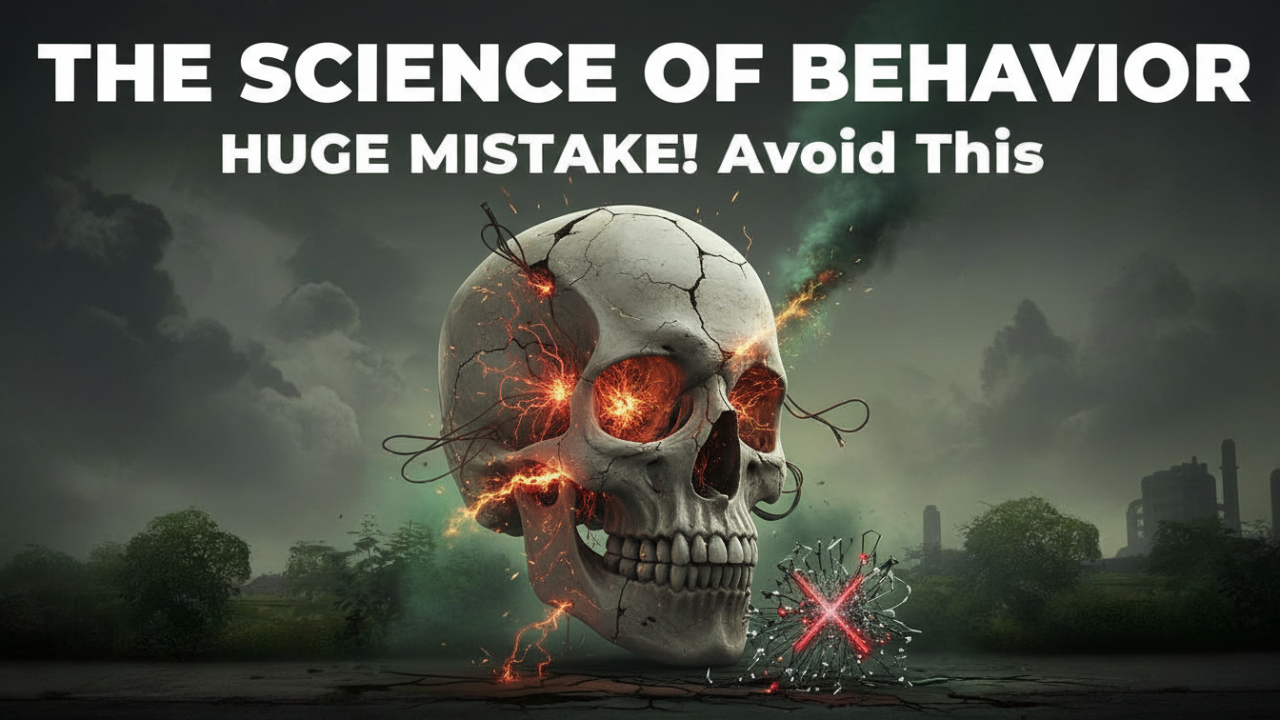
Do you ever feel like there’s a tug-of-war going on in your brain? One part of you knows you should go to the gym, but another part is already steering you toward the kitchen for a donut. You promise yourself you’ll be more patient with the people you care about, but then you find yourself snapping over something small. It’s a frustrating, confusing, and deeply human experience. You’re left wondering, “Why did I *do* that? Why can’t I just do the things I know I should?”
What if I told you this internal struggle isn’t a failure of willpower? That it’s not about being lazy, or undisciplined? What if it’s a deep-seated tension, a biological push-and-pull that’s been wired into our brains over millennia? Today, we’re going to explore this neurological conflict. We’re going to look at what it is, why it happens, and most importantly, how you can start to work *with* your brain to get the results you want.

Section 1: The Problem – The Universal, Relatable Struggle
Let’s be honest. How many times has your alarm gone off with you having a crystal-clear intention: “Today’s the day. I’m getting up early, working out, eating a healthy breakfast, and finally tackling that big project.” The plan is perfect. It’s logical. It’s what you *want* to want. And then… you hit the snooze button. Once. Twice. Suddenly, it’s a mad dash out the door, grabbing a sugary pastry on the way, and that big project gets pushed to “tomorrow.” Again.
This isn’t just your story. It’s a script that plays out in millions of lives, every single day. It’s walking into a store for one thing and leaving with five other items, your wallet a little lighter and your mind a little confused. It’s sitting down at your desk, ready to be productive, only to emerge an hour later from a social media rabbit hole with a surprising new expertise in the migratory patterns of arctic terns.
Or maybe it’s less about tasks and more about people. You love your family and friends and genuinely want to be a source of calm. But after a long day, a simple question like, “What’s for dinner?” can trigger a sharp, irritable response. The words are out before you can stop them, and in the quiet aftermath, regret washes over you. You think, “That’s not who I am. Why did I act like that?”
This gap between our intentions and our actions is one of the most maddening parts of being human. It fuels a narrative of self-blame. We call ourselves procrastinators, impulsive, or weak-willed. We look at others who seem to have it all together—always at the gym, smiling over a salad—and wonder, “What’s wrong with me?”
It feels like you’re a passenger in your own life. It’s as if two different drivers are in your head. One is the thoughtful, long-term planner—the architect of your best self. The other is a creature of impulse, seeking immediate comfort and pleasure, who seems to have a knack for grabbing the steering wheel. This constant internal conflict is exhausting. It erodes confidence and fuels anxiety. But the source of this problem isn’t a character flaw. The source is in the very architecture of your brain.
Section 2: The Agitation – The Hidden Tension in Your Brain
To understand why you act the way you do, we need to understand how the brain is designed. It’s an evolutionary marvel, but it wasn’t built for a world of 24/7 food delivery and abstract goals like “saving for retirement.” It was forged in an environment of immediate, life-or-death challenges.
Inside your skull, decision-making isn’t handled by a single command center. A popular and useful way to think about it is as a negotiation between two different operating systems, a concept often referred to as a dual-process model. Let’s call them the “Automatic System” and the “Deliberate System.”
The **Automatic System** (often called System 1) is ancient and instinctual, involving networks like the limbic system. Its main job is survival in the here and now. It runs on simple, powerful heuristics: seek pleasure, avoid pain, conserve energy. If it sees a high-energy food source, its impulse is to consume it, because, for our ancestors, the next meal was never guaranteed. This system is incredibly fast, emotional, and lives entirely in the present moment. It’s the part of you that sees a donut and thinks, “Sugar! Fat! Energy! Get it now!”
Then there’s the **Deliberate System** (or System 2), which relies heavily on the prefrontal cortex, the brain region right behind your forehead. This is your brain’s planning committee, responsible for logical reasoning, understanding future consequences, and exercising self-control. It’s the part of you that says, “Hold on. That donut doesn’t align with our long-term health goals. Let’s make a better choice.” The Deliberate System is thoughtful and analytical, but it has a crucial weakness: it’s slow and requires a lot of mental energy.
Now, picture these systems in daily life. You’re faced with a choice: write the first chapter of your book or watch another episode of a show you’re hooked on. The task of writing is hard and uncertain. A part of your brain’s Automatic System, a region called the **amygdala**, is involved in processing emotions like fear and anxiety. It can flag the discomfort of a difficult task, creating an urge to avoid it.
At the same time, your brain anticipates the immediate comfort of watching TV. This is where a chemical messenger called **dopamine** comes in. Dopamine is often simplified as the “pleasure molecule,” but it’s more accurate to think of it as being involved in motivation and learning. It’s released not just during pleasure, but in *anticipation* of a potential reward, creating a craving that pushes you toward action. The mere thought of watching that show can give you a dopamine spike, a powerful chemical bribe from your Automatic System.
Meanwhile, your Deliberate System, the prefrontal cortex, is trying to get a word in. It’s reminding you of your long-term goal of becoming an author. But the Automatic System is loud, fast, and armed with powerful neurochemicals. And because the Deliberate System is slower and tires more easily—especially when you’re stressed—it often loses the debate. The Automatic System wins. You pick up the remote. This is procrastination in its purest form: not laziness, but your brain’s ancient, wired-in mechanism for avoiding perceived discomfort and seeking immediate reward.
This tension explains so much. It’s why you might snap at a loved one: your Automatic System triggers a fight-or-flight response to stress before your Deliberate System can step in and regulate the emotion. It’s why you buy that gadget you don’t need: your Automatic System is captivated by the anticipated dopamine hit of novelty, overriding your Deliberate System’s sensible financial plan. It’s a fundamental conflict between systems designed for immediate survival and those for long-term planning. Recognizing this isn’t a reason to give up. It’s the first step toward a new strategy.

Section 3: The Science – Decoding Your Brain’s Key Systems
To really take control, we need to look a bit closer at the neurological hardware involved. Our actions emerge from the interaction of several key brain networks.
First, there’s the **Limbic System**, the heart of your emotional and motivational responses. A key player here is the **amygdala**, the brain’s rapid-response alarm. It’s constantly scanning for potential threats and rewards, generating quick emotional reactions. When you face a task you find daunting, the amygdala can contribute to the feeling of dread that makes you want to do something else. In fact, some correlational studies have suggested a link between having a larger amygdala volume and higher levels of procrastination, though more research is needed to understand this relationship fully. Working with the amygdala is the brain’s reward circuitry, which heavily involves dopamine. When you anticipate something rewarding, this network creates a powerful motivation to go get it.
Second, we have the **Prefrontal Cortex (PFC)**, the main hub of your Deliberate System. Located at the front of your brain, the PFC is your internal control tower, in charge of executive functions like planning, reasoning, and, critically, self-control. The PFC allows you to override impulses from the limbic system, making decisions based on future goals, not just immediate feelings. The tension we feel is essentially a constant tug-of-war for resources and influence between the fast, emotional networks and the slower, rational PFC. When you’re tired or stressed, your PFC has fewer resources, which is why your self-control can seem to evaporate at the end of a long day. Your brain’s control center is literally running on empty.
Finally, there’s a third, often-overlooked player: the **Basal Ganglia**. If the limbic system provides the desire and the PFC sets the direction, the basal ganglia help create the autopilot. These deep brain structures are central to **habit formation**. Your brain is an efficiency expert; it wants to automate routine behaviors to save the PFC’s precious energy. This automation process is often described as a “habit loop”: a cue triggers a routine, which delivers a reward. Every time you complete this loop—for instance, feeling stressed (cue), eating chips (routine), and feeling temporary comfort (reward)—the neural connections for that behavior become stronger and more efficient. The habit becomes so automatic it runs without conscious thought.
This is why habits are so powerful. You’re not just fighting a fleeting desire; you’re fighting a well-paved neural highway designed to run on its own. Breaking a bad habit requires actively carving a *new* neural path. Understanding this three-part interplay is the key. You can’t just yell at your emotional brain, and you can’t rely solely on your PFC’s limited willpower. True behavioral change requires a strategy that addresses all of these systems.
Section 4: The Solution – A 4-Step Plan to Rewire Your Brain
The most exciting discovery in modern neuroscience is **neuroplasticity**. It was once thought the adult brain was largely fixed, but we now know it has a remarkable ability to change and rewire itself based on your experiences, thoughts, and actions. Every time you repeat a behavior, you are physically altering your brain. This means you’re not a victim of your current wiring; you’re the architect who can redesign it.
By leveraging neuroplasticity, we can create a practical, science-backed plan to work with these brain systems. This isn’t about finding a magic “willpower” button. It’s about training your brain. Here’s a four-step strategy to do just that.
Step 1: Strengthen Your Prefrontal Cortex (Train Your Deliberate System
Your PFC is the seat of self-control, but its resources are finite. You can increase its strength and endurance, and one of the most effective ways is through **mindfulness and meditation**. When you practice mindfulness, you train your ability to notice thoughts and feelings without immediately acting on them. This creates a crucial pause between an impulse and your response.
Some scientific studies using MRI have reported that regular meditation practice is linked with increased gray matter or cortical thickness in the prefrontal cortex. While the science is still evolving and not all studies agree, this suggests that practice may literally strengthen your brain’s control center.
* **How to do it:** Start with just five minutes a day. Sit quietly and focus on the sensation of your breath. When your mind wanders (and it will), gently guide your attention back. That act of noticing and refocusing is like a bicep curl for your prefrontal cortex. Consistency is key.
Step 2: Outsmart Your Automatic System (Negotiate with Your Impulses
Your automatic, emotional networks are powerful and don’t respond to pure logic. Trying to crush them with sheer willpower is often a losing battle. A much smarter strategy is to understand what they want—immediate reward and avoidance of pain—and work *with* them.
* **Technique A: The 5-Minute Rule.** Procrastination is often driven by the desire to avoid the discomfort of starting a hard task. So, make a deal with your brain: commit to working on the task for just five minutes. This lowers the perceived threat and makes it easier to get started. Often, once you begin, the initial anxiety fades, your Deliberate System takes over, and you end up working for much longer.
* **Technique B: Temptation Bundling.** This technique links something you *want* to do with something you *need* to do. Your automatic system seeks pleasure, so use that to your advantage. For example: “I will only listen to my favorite podcast while I’m doing the laundry,” or “I can watch one episode of my show after I exercise for 30 minutes.” By bundling the “want” and the “need,” you give your brain the immediate reward it craves, making it a willing partner.
Step 3: Reprogram Your Basal Ganglia (Build a Better Autopilot
Bad habits are just well-traveled neural highways. To change them, you need to stop using the old road and pave a new one by re-engineering your habit loops.
* **Technique A: Identify and Replace.** Every habit has a cue, a routine, and a reward. Say your bad habit is snacking on cookies when you get home from work (routine). The cue might be walking in the door feeling stressed. The reward is the quick hit of comfort. The key is to keep the cue and reward but *replace the routine*. When you walk in feeling stressed (cue), the new routine could be to drink a glass of water and stretch for three minutes. This can also provide a feeling of refreshment and a mental reset (the reward). By consistently choosing the new routine, you start carving a new neural pathway.
* **Technique B: Change Your Environment.** Your automatic system is triggered by what it sees and experiences. The most effective way to break a bad habit is often to make its cue invisible. If you want to stop eating junk food, don’t keep it in the house. Conversely, make cues for good habits obvious. If you want to exercise in the morning, lay out your gym clothes before bed. You’re designing your environment to activate the habits you want.
Step 4: Master Your Motivation (Manage Your Dopamine)
Dopamine is the chemical of motivation and drives you to act. But in a world of constant stimulation, it’s easy to feel unmotivated for normal, healthy activities.
* **Technique A: Break Down Your Goals.** Dopamine is released in anticipation of a reward. A huge goal like “write a novel” is too abstract to generate consistent dopamine. Break it down into tiny, achievable chunks. Your goal isn’t to “write a novel”; it’s to “write 100 words today.” When you hit that small goal, you get a small sense of accomplishment and a dopamine-related reward, which fuels the motivation for the next day.
* **Technique B: Practice Self-Compassion.** When you slip up—and you will—it’s critical to avoid shame and self-blame. Those negative emotions create stress, which depletes the resources of your prefrontal cortex and makes it *more* likely your impulsive system will take over again. Instead of beating yourself up, treat yourself with kindness. Acknowledge the mistake, understand the neurological reasons it happened, and gently guide yourself back to the plan. Research suggests self-compassion is a powerful strategy for building resilience and improving self-control.
CTA & Conclusion
Understanding your brain is the ultimate form of self-awareness. This internal tension between your immediate impulses and your long-term goals isn’t a sign that you’re broken; it’s a sign that you are human. For millennia, this conflict has shaped our behavior, often leaving us feeling powerless. But that era is ending. With the insights of modern neuroscience, we can see the systems at play.
The science of neuroplasticity is proof that you can change. You can strengthen your focus. You can overcome procrastination. You can build habits that serve you and let go of those that don’t. You are not defined by your current impulses. You are the person who can actively choose to lay down new neural pathways, one small action at a time.
The choice between the donut and the gym, between snapping and being patient, between distraction and focus—these choices happen at the intersection of your brain’s core systems. But now you have a strategy. You understand the different systems at play, and you know how to support the thoughtful, deliberate part of you.
So the next time you feel that internal tug-of-war, don’t get frustrated. Get curious. Recognize the tension for what it is. Take a breath, give your Deliberate System a moment to come online, and make a conscious choice. Each time you do this, you’re casting a vote for your future self. You are literally rewiring your brain to become the person you want to be. The struggle is real, but now, so is your power to navigate it.