

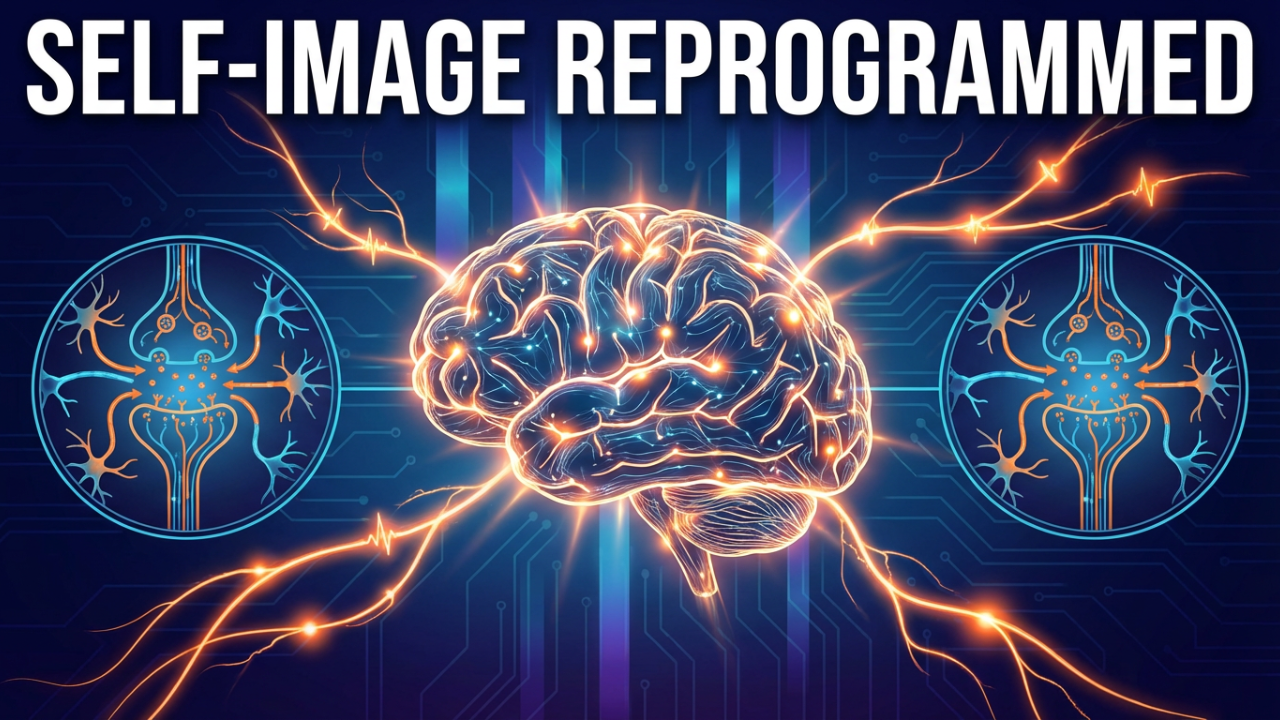
Have you ever felt stuck? Like you’re playing a role you never consciously chose? Maybe you’ve looked in the mirror and wondered who that person staring back at you really is, underneath all the habits, expectations, and beliefs you’ve gathered over the years. It’s easy to feel like your personality is fixed. You might tell yourself, “That’s just how I am. I’m not a confident person,” or “I’ve always been anxious.” It feels like a fundamental truth, as real as the ground under your feet.
But what if I told you that this solid sense of ‘self’ is one of the most persistent illusions your brain has ever created? What if the ‘you’ that you think you are isn’t a static noun, but an active, ongoing verb? It’s a story your brain is constructing, moment by moment. A process, not a final product.
And the best part? You can become the editor of that story.
Deep inside the electrified labyrinth of your brain, a web of neural pathways is constantly shaping who you believe you are. This isn’t just self-help talk; it’s neuroscience. Today, we’re going on a journey deep into the brain to see how its structure, especially a network led by an area called the medial prefrontal cortex, literally builds your identity. We’ll explore the science that reveals how your self-image is formed, and more importantly, how you can use that knowledge to reshape who you are. By understanding the machinery, you get access to the controls. It’s time to meet the architect of your identity: your own brain.

SON OF LORD
Section 1: The Grand Illusion of a Fixed Self
Before we get into the brain’s hardware, we have to challenge a belief that holds most of us captive: the idea that our ‘self’ is a stable, continuous thing. We like to think of our identity as an internal statue—solid and unchanging, carved from our past experiences and genes. We believe there’s a core ‘me’ that wakes up every morning, the same ‘me’ from yesterday and the ‘me’ who will be there tomorrow.
But neuroscientists like Anil Seth argue against this, offering a radical alternative. He describes our entire experience of reality, including our sense of self, as a “controlled hallucination.” That might sound dramatic, but it’s a brilliant metaphor. Your brain isn’t just a passive camera recording the world; it’s a prediction machine, constantly making its best guess about what’s happening out there and inside you.
Think about it. Your brain is locked in the silent, dark vault of your skull with no direct access to the outside world. All it gets are noisy, ambiguous electrical signals from your senses. From this chaos, it has to construct everything: the red of a sunset, the taste of coffee, and most profoundly, your sense of being a ‘self’. It does this by comparing incoming data with the models and beliefs it’s built over your lifetime. Your perception of the world isn’t a direct recording of reality; it’s your brain’s best guess—the most plausible story it can create.
The same goes for your self-image. Your sense of “who you are” is your brain’s best predictive model of itself. It’s a narrative woven from memories, bodily sensations, social feedback, and future hopes. This “narrative self” is a biological masterpiece, a coherent story that gives us a feeling of stability in a constantly changing world. It’s a survival tool that allows us to plan for the future, learn from the past, and navigate social situations. Without it, our lives would feel like a confusing mess of disconnected moments.
But here’s the critical insight: because this self is a constructed story, it isn’t fixed. Stories can be edited. Models can be updated. The belief that you are “just not a confident person” isn’t a fact; it’s a prediction your brain has learned to make based on past data. It’s a pattern of neural firing that’s become so automatic it feels like an unchangeable truth.
This doesn’t mean your identity is fake. It’s very real in its consequences. The story your brain tells about you shapes your choices, emotions, and limitations. If your brain’s story is that you’re unworthy, you’ll act in ways that confirm it. But once you realize that you are not the story, but the one *experiencing* it, everything can change. You create a small space between the storyteller and the narrative. In that space lies the power to pick up the editor’s pen. The first step to changing your self-image is to see it for what it is: a brilliant, adaptive, and editable script written by your brain.
Section 2: The Brain’s Identity Headquarters – The Default Mode Network
So, if our self-image is a story, where in the brain is it being written? For a long time, this was a mystery. But with neuroimaging like fMRI, scientists have been able to peek inside the living brain and find the neural orchestra responsible. It’s known as the **Default Mode Network (DMN)**.
The name “Default Mode Network” might sound boring, but its job is anything but. Scientists found it almost by accident. They noticed that whenever people in brain scanners weren’t focused on a task—when their minds were wandering, daydreaming, or thinking about the future—a specific network of brain regions would roar to life. This is the brain’s “default” state: a state of inward-focused thought. Think of the DMN as your brain’s internal boardroom. When you’re not busy with the outside world, your brain defaults to thinking about… you.
The DMN isn’t a single spot, but a collection of interconnected hubs. Let’s meet the key players:
First is the CEO of ‘You, Inc.’: the **Medial Prefrontal Cortex (mPFC)**. Located just behind your forehead, the mPFC is the central hub for self-referential thought. This is the part of your brain that gets really excited when you think about your personality traits, your hopes, and your fears. Studies show your mPFC lights up like a holiday tree when you reflect on yourself, but the activity is much quieter when you think about someone else. The mPFC is the seat of self-reflection.
Next is the company historian: the **Posterior Cingulate Cortex (PCC)** and the nearby **Precuneus (PCu)**. These regions toward the back of the brain are deeply involved in autobiographical memory. They’re like the brain’s library, storing the personal stories that form the backbone of your narrative self. They provide the thread that connects the ‘you’ of today with the ‘you’ of yesterday.
Then we have the head of public relations: the **Temporoparietal Junction (TPJ)**. The TPJ is fascinating because it’s a bridge between your inner world and the social world. It’s crucial for understanding that other people have their own thoughts and perspectives, but it also helps you understand yourself in relation to others. It’s constantly asking, “How do others see me?” and feeding that information back into your self-concept.
Together, this network of the mPFC, PCC, and TPJ is in constant communication, weaving memories, present thoughts, and social feedback into the story of ‘you’. The activity in your DMN is deeply tied to how you see yourself. For instance, certain patterns of activity in this network are linked to self-referential thought and rumination, which can play a major role in conditions like depression and anxiety. The way your brain dedicates energy to this network seems connected to your fundamental sense of self-worth, though the exact relationship is complex and still being explored.
Understanding the DMN is revolutionary because it demystifies the self. It takes the abstract concept of “identity” and grounds it in a tangible biological process. Your self-image isn’t some ghost in the machine; it’s a pattern of coordinated neural activity. And that’s fantastic news. Because networks can be reconfigured. The boardroom of the DMN doesn’t have to keep approving the same old limiting stories.
Section 3: Neural Pathways – The Roads of Your Mind
If the Default Mode Network is the boardroom where your story is drafted, then neural pathways are the roads that distribute that story throughout your brain, turning ideas into automatic thoughts and feelings. To understand how your self-image gets so deeply ingrained, we need to know how these roads are built.
Imagine your brain is a dense forest. The first time you think a thought, it’s like taking a first step into that forest. It’s slow and requires conscious effort. You’ve created a faint trail, but it’s barely there.
Now, imagine you think that same thought again. You walk the same trail. It’s a little easier this time. Do it again, and again, and that trail becomes a path. With hundreds of repetitions, the path becomes a dirt road. With thousands, it becomes a paved superhighway. A thought that once required effort is now so automatic you can travel down that mental road without even thinking.
This is a metaphor for what happens at a microscopic level in your brain, governed by a principle called Hebbian learning: “Neurons that fire together, wire together.” Every time you have a thought or emotion, a specific combination of neurons fires. The more frequently that sequence fires, the stronger the connections between those neurons become. The brain literally rewires itself to make that pattern more efficient.
This is the basis of habit, but it’s also what solidifies your self-image.
Think about the story, “I’m awkward in social situations.” The first time you had that thought, maybe after a clumsy moment in school, a faint trail was blazed. Another experience reinforced it. Soon, you started anticipating social events with that thought, strengthening the path. After years of repetition, “I’m awkward” is no longer just a thought—it’s a neural superhighway. The moment a social situation arises, your brain, seeking efficiency, shunts your consciousness down this well-traveled road. The feeling of awkwardness becomes an instant, reflexive response.
Many of these core pathways were laid down in childhood as survival strategies. A child who learns that being quiet prevents criticism might develop a strong neural pathway for “It’s safer not to be seen,” which can later manifest as shyness. These aren’t character flaws; they’re learned neural habits that once served a purpose.
The challenge is that the brain doesn’t automatically tear down old roads. But there’s hope. Within your prefrontal cortex, a region known as the **Orbitofrontal Cortex (OFC)** acts as a high-level switchboard operator. It’s involved in switching from automatic habits to more conscious, goal-directed behaviors. It has the power to say, “Wait a minute. The old ‘I’m awkward’ highway isn’t the only option. Let’s try blazing a new trail.”
Changing your self-image is basically a process of conscious road construction. It requires recognizing the old superhighways for what they are—learned habits, not truths. And it requires the courage to start forging new paths, one thought at a time. It will feel difficult at first, like hacking through a dense forest. But with every repetition, the new path gets clearer and stronger, until one day, it becomes your new superhighway.

This book is scientific documentary of the Kingdom of God.
Section 4: The Neurochemistry of Self-Esteem and Insecurity
Our self-image isn’t just a thought; it’s a feeling. Confidence, insecurity, anxiety, and self-doubt are all rooted in the dance of our brain’s chemistry. To understand why some people have a robust sense of self while others are plagued by insecurity, we need to look at the brain’s wiring.
Let’s start with the neurobiology of insecurity. When you feel insecure, your brain is basically in a state of high alert. A key player here is a small, almond-shaped structure called the **amygdala**. The amygdala is your brain’s alarm system, scanning for danger. In people who struggle with low self-esteem, the amygdala tends to be hyperactive, especially in social situations. This means it’s more likely to interpret neutral cues—a quick glance, a pause in conversation—as rejection or a threat. This creates a constant feeling of social anxiety, as if you’re walking on eggshells.
This is sometimes compounded by the **hippocampus**, a brain region critical for memory. While not a direct cause, research has noted that chronic stress and conditions like depression—which often go hand-in-hand with low self-esteem—are linked to a smaller hippocampus volume. A less efficient hippocampus can make it harder to form positive memories, creating a bias where failures feel more significant than successes. It also plays a role in turning off the amygdala’s alarm, so a less functional hippocampus can leave you stuck in a cycle of anxiety.
Now let’s zoom in on how we process social feedback. In a brain with healthy self-esteem, when you get unexpected positive feedback, your brain’s reward circuit, including the **ventral striatum**, gets active. When you receive negative feedback, a part of your prefrontal cortex, the **ventromedial prefrontal cortex (vmPFC)**, acts as an emotional buffer. It helps put the feedback in context, basically saying, “Okay, one person didn’t like my idea, but that doesn’t mean I’m worthless.” It protects your core self-esteem.
In people with low self-esteem, this system can malfunction. Their vmPFC doesn’t buffer as effectively, so a single piece of negative feedback feels like a devastating blow that sends their entire sense of self plummeting.
So what does the resilient brain of high self-esteem look like? First, it involves that robust and well-functioning **vmPFC**, which insulates the core self from minor social ups and downs. Studies have also shown that the physical connections—the white matter tracts—between the self-reflection hub (mPFC) and the reward hub (ventral striatum) are stronger in people with high self-esteem, suggesting a brain that’s literally better wired to turn self-reflection into feelings of value.
But the story doesn’t end there. In fact, some of the most exciting new research points to a surprising player in the story of self-esteem: the **cerebellum**. Traditionally known for coordinating movement, we now know the cerebellum is involved in higher emotional functions. Emerging studies suggest high self-esteem is associated with stronger connections between the prefrontal cortex and parts of the cerebellum known as Crus 1 and Crus 2. This exciting fronto-cerebellar loop is thought to help us predict social dynamics and regulate our emotional reactions, leading to more positive outcomes and reinforcing a stable self-image.
Section 5: The Science of Change – Rewiring Your Brain
We’ve established that your self-image is a biological process. But inside that realization is the most hopeful message in all of neuroscience: if your self is a pattern, it can be re-patterned. The biological mechanism that makes this possible is a property of the brain so powerful it should be a household word: **Neuroplasticity**.
Neuroplasticity is simply the brain’s ability to change and reorganize itself based on experience. For a long time, it was believed the adult brain was fixed. We now know that’s completely wrong. Your brain isn’t static hardware; it’s a living sculpture, constantly being reshaped by your thoughts, actions, and emotions. The question isn’t *if* your brain is changing, but in what *direction*.
**Self-directed neuroplasticity** is the term for consciously taking control of this process. It’s about deliberately engaging in thoughts and behaviors that build the neural pathways for the self-image you *want*. To do this, we can leverage two of the brain’s most powerful tools: visualization and its motivation system.
Let’s start with **Visualization and Mental Rehearsal**. You’ve probably heard about this in sports, where athletes imagine performing perfectly. This isn’t just positive thinking; it’s a neural workout. The reason it works is amazing: your brain doesn’t really distinguish between a vividly imagined experience and a real one.
When you close your eyes and vividly imagine acing a job interview—seeing the room, hearing your confident voice, feeling the firm handshake—you activate many of the same neural circuits that would be active if you were actually there. Brain imaging shows that mental imagery engages the brain in ways that closely resemble actual perception. Your brain is essentially running a simulation, and in doing so, it’s strengthening the neural pathways for that performance.
A key part of this is the **Mirror Neuron System**. These neurons fire not only when you do an action, but also when you watch someone else do it, or even when you just *imagine* doing it. When you mentally rehearse a behavior, your mirror neurons fire as if you were really doing it, building the neural blueprint for that action. This explains a startling body of research. While it’s not a perfect substitute for physical practice, studies have consistently shown that mental rehearsal alone can lead to significant gains in performance. In some cases, the improvements from mental practice can be surprisingly close to those from physical practice, suggesting you can build the neural architecture for a skill without even moving a muscle.
Now, let’s add the fuel that drives this process: **Dopamine**. Dopamine isn’t just the “pleasure molecule”; it’s more accurately the “motivation molecule.” Crucially, dopamine is released not just when you get a reward, but in *anticipation* of one. It’s what drives you to pursue goals.
This is where visualization becomes a motivational powerhouse. When you vividly imagine a desired future and feel the positive emotions that go with it, your brain releases dopamine. This does two things. First, it makes visualizing feel good, so you want to do it more. Second, it energizes and reinforces the very neural circuits you’re activating. It tags the imagined scenario as important, a goal worth pursuing.
This creates a powerful feedback loop. You visualize your desired self, which releases dopamine. This dopamine motivates you to take real-world actions that match that self. Those actions provide real feedback, which strengthens your mental model. The imagined future starts to pull the present toward it.
Section 6: Actionable Steps – Becoming the Editor of Your Story
Understanding the neuroscience is the first step. But knowledge without action is just trivia. The real power comes from turning these insights into practical, daily techniques. It’s time to move from being a passive observer of your mind to an active participant. Here are three actionable strategies to start editing your story.
**Technique 1: Focused Reflection & Labeling**
This technique engages your Medial Prefrontal Cortex (the self-reflection hub) and creates a crucial gap between you and your habitual negative thoughts.
First is **Focused Reflection**. Set aside five to ten minutes each day. Your task is not to judge or fix anything, but simply to observe your internal monologue. What are the recurring stories? You might notice a frequent “I’m not smart enough” narrative or a “People don’t really like me” story. Just notice them.
The second part is **Labeling**. As you go about your day and one of these negative thoughts arises, calmly label it. For example, when the thought “I’m going to say something stupid” appears, mentally tell yourself, “Ah, there’s the ‘I’m not good enough’ story again.” Or, “Label: fear of judgment.”
This simple act is incredibly powerful. By labeling the thought, you’re performing a kind of mental jujitsu. You shift from being *identified with* the thought to being the *observer of* the thought. You are implicitly saying, “This story is not me. It is a pattern happening within me.” This interrupts the automatic nature of the neural pathway and shines the light of awareness on it.
**Technique 2: Scripting Your Future Self**
This technique is a direct application of self-directed neuroplasticity, using visualization and dopamine to build the neural architecture of your desired identity.
Take out a journal and for 15 minutes, write in vivid detail about the person you want to become. Don’t just list traits like “more confident.” Script it. Write in the first person, present tense, as if it’s already your reality. Describe a day in your life as this future self. How do you feel when you wake up? How do you walk, talk, and interact with others? Engage all your senses. What do you see? What do you hear? What does quiet confidence actually feel like in your body?
After you’ve written it, spend five minutes each day reading it and then closing your eyes to vividly visualize it. The key is to *feel the emotions*—the pride, the calm, the joy. This emotional component is what triggers dopamine, tagging this new identity as a high-priority goal for your brain. By doing this repeatedly, you are carving out and strengthening new neural pathways. You’re rehearsing your future until it becomes your nature.
**Technique 3: The ‘As If’ Principle**
This final technique bridges the gap between your inner work and the outer world. It involves consciously choosing to act ‘as if’ you are already the person you want to be, even when it feels unnatural at first.
If your goal is to be more confident, ask yourself, “How would a confident version of me walk into this room? How would they speak in this meeting?” Then, do that. Embody the posture of confidence. Speak with a slightly slower, more deliberate pace. Choose to contribute one idea in the meeting, even if your heart is pounding.
This isn’t about being “fake.” It’s about using your body and actions to lead your brain. Acting ‘as if’ is a direct command to your brain’s switchboard, the Orbitofrontal Cortex. You are forcing your brain to get off the old, familiar superhighway of “I’m shy” and onto the new trail of “I am confident.”
Each time you act ‘as if,’ you send a powerful signal back to your brain that reinforces the new neural pathways. Your actions provide tangible evidence that contradicts the old story. Your brain will begin to update its internal model to match your new behavior. Through consistent action, you make the fiction a fact, one choice at a time.
Conclusion
We began this journey with a simple question: Who are you? We’ve traveled deep into the brain and discovered that the answer is far more extraordinary and hopeful than we ever imagined. You are not a static entity carved in stone. You are a dynamic, unfolding process. Your self-image is not a thing, but a story—a narrative written in the elegant language of neural pathways.
We’ve seen how the Default Mode Network authors this story and how the roads of our minds can become superhighways of self-limitation. But we’ve also uncovered the profound truth of neuroplasticity: you hold the editor’s pen. Your brain is built to change in response to your focus and your experience.
The techniques we’ve discussed—Focused Reflection, Scripting Your Future, and the ‘As If’ Principle—are not just exercises. They are the practical tools of a neuro-sculptor, the methods by which you can consciously take part in your own creation.
The old chapters don’t have to define the ones you have yet to write. The power to begin a new chapter resides within you, right now. It is in your next thought, your next choice, your next action. Pick up the pen. What story will you write?