

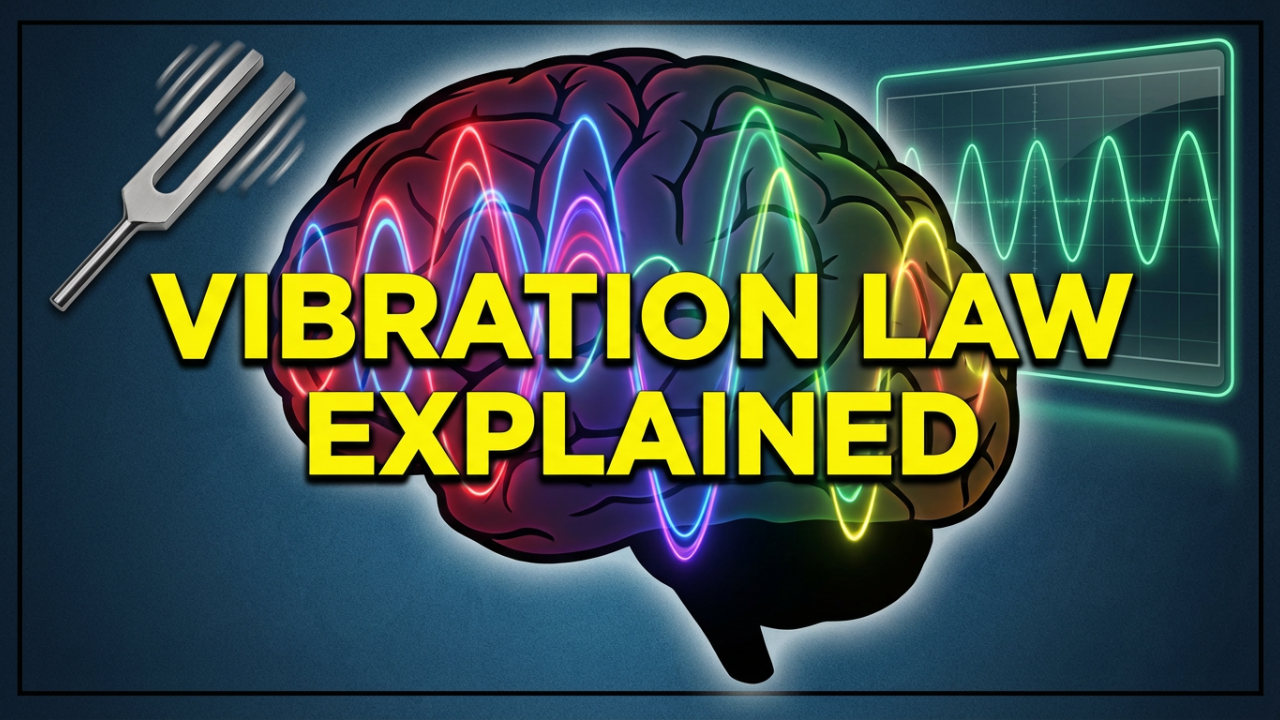
You’ve heard it a thousand times from spiritual teachers and on social media: to get what you want, you just need to “raise your vibration.” Just think positive thoughts, feel the feeling of your wish fulfilled, and the universe will magically deliver your desires on a silver platter. It’s called the Law of Vibration, and it promises a direct line from your thoughts to your reality.
But what if you’ve been trying to “vibe high” for weeks, months, or even years, and you’re still stuck? Still in the same job, struggling with the same anxieties, waiting for a breakthrough that never seems to show up. The promise starts to feel hollow, the frustration is real, and you begin to wonder… is this all just wishful thinking?
What if I told you the secret to changing your reality isn’t about sending a mystical frequency out into the cosmos, but it’s locked deep inside the electrical wiring of your own brain?
Spiritual gurus say you can attract your desires by “raising your vibration.” But what does neuroscience *actually* say about your brain’s frequency? The answer is more surprising—and way more powerful—than you might think.
We’re about to cut through the noise. This isn’t about debunking spirituality; it’s about building a bridge from hopeful belief to tangible, scientific empowerment. We’re going to decode what’s really happening inside your head when you think, feel, and desire. We’ll explore the real, measurable electrical patterns in your brain—your brain *waves*—and see how they are fundamentally connected to how you perceive reality.
The truth is, the so-called “Law of Vibration” isn’t a universal law of physics you can hack. It’s a metaphor for a profound biological process. And once you understand the science, you don’t need to hope for magic anymore. You can learn to consciously and intentionally direct the most powerful tool in the known universe: your own mind. So, let’s meet the real operator of your reality.

SON OF LORD
Section 1: The “What” – Decoding the Five Frequencies of Your Mind
Before we can connect our brain’s frequency to our life, we need to understand what these frequencies are. When spiritual teachers talk about “vibration,” they often use vague metaphors. They’ll say positive thoughts have a “high frequency” and negative thoughts a “low frequency.” From a scientific view, this doesn’t add up. In the real electromagnetic spectrum, low-frequency AM radio waves are harmless, while high-frequency gamma rays can be incredibly destructive. The metaphor just doesn’t hold.
The real “vibrations” of the mind aren’t thoughts radiating into the universe. They’re measurable, electrical patterns from billions of neurons firing together in your brain. These are called brain waves, or neural oscillations. We can measure them with an electroencephalogram, or EEG, which uses electrodes on the scalp to listen in on the brain’s electrical symphony.
Think of your brain less like a radio transmitter and more like a sophisticated orchestra. The neurons are the musicians, and the brain waves are the rhythms they play. Different rhythms create entirely different states of consciousness, just like changing the tempo can turn a funeral march into a party anthem. These brain waves are sorted into five main types, each tied to a different state of mind. Think of them as gears in a car, each one perfect for a specific kind of driving.
Let’s start with the lowest and slowest gear: **Delta waves**. These are the slow, deep waves of your brain, oscillating between 0.5 and 4 times per second, or Hertz. You experience Delta waves during the deepest stages of dreamless sleep. This is your brain’s recovery mode, when it flushes out toxins, consolidates memories, and releases growth hormones. In this state, you are deeply unconscious and largely disconnected from the outside world. It’s the fundamental rhythm of pure biological repair.
Next up is **Theta waves**, a bit faster at 4 to 8 Hertz. If you’ve ever been on the edge of sleep, in that hazy, dreamlike state where ideas and images float by, you were in Theta. This is the frequency of deep meditation, intuition, and the REM sleep stage where most dreams happen. It’s a state of incredible creativity, where the logical mind takes a backseat, allowing for “aha!” moments to bubble up from the subconscious.
Shifting up again, we enter **Alpha waves**, which hum along between 8 and 12 Hertz. Alpha is the brain’s relaxed, reflective state. When you close your eyes and take a deep breath, or find yourself daydreaming out a window, your brain is producing Alpha waves. It’s a state of calm, present awareness—a bridge between your conscious and subconscious mind that’s great for learning new information. Think of it as your brain idling peacefully, ready to engage but free of stress.
Now we get into the faster gears that run our waking lives. First are **Beta waves**, ranging from about 12 to 30 Hertz. This is your default state for most of the day. As you listen and process this information, your brain is humming in Beta. It’s the frequency of active concentration, logical thinking, and problem-solving. But when Beta becomes too dominant, it’s a recipe for stress and anxiety. Living in high-Beta is like redlining your car’s engine; you can do it for a bit, but it leads to burnout.
Finally, at the highest and fastest frequency, we have **Gamma waves**, oscillating from 30 Hertz up to 100 Hertz or more. Gamma is the state of peak performance and intense focus. It’s associated with moments of powerful insight and high-level information processing. Elite athletes “in the zone” or monks in deep meditation show high levels of Gamma activity. It represents the brain at its sharpest.
Crucially, your brain is always producing a complex cocktail of these frequencies. And here’s where it gets truly fascinating. Research from neuroscientists, including Earl Miller at MIT, has revealed a highly organized structure to how these frequencies operate. They’ve found that the brain’s superficial, or outer, layers tend to generate faster Gamma waves for processing real-time sensory information—what’s happening *out there*. Meanwhile, the deeper layers produce slower Alpha and Beta waves, more involved in internal thought and planning—what’s happening *in here*.
This layered system allows your brain to do something amazing: distinguish between the outside world and your internal thoughts. It can focus on a goal (an internal Beta process) while processing sights and sounds (an external Gamma process). Your thoughts and feelings don’t just randomly create frequencies; they *are* the product of these complex, interacting frequencies.
So, when we talk about changing your reality, the scientific path isn’t trying to change some mystical external field. It’s about learning to consciously shift the gears inside your own brain. It’s about moving from high-stress Beta to relaxed Alpha or Theta, and then using focused Beta and Gamma to act on those new insights. This is the real “vibration” we need to master.
Section 2: The “How” – The 3-Step Scientific “Manifestation” Process
So, we’ve established that your brain is a frequency machine, but these frequencies work *inside* your head. How does this internal electrical activity connect to your external reality? How can shifting from Beta to Alpha really impact your career or relationships?
The answer is a three-step process that bridges your inner world with your outer experience. This isn’t magic; it’s a powerful feedback loop between your brain, your perception, and your behavior. The spiritual idea of “manifestation” is just a metaphor for this observable, neurobiological process. Let’s break it down.
**Step 1: The Searchlight of Your Brain – Directing Beta Waves & Your Reticular Activating System (RAS)**
You’ve heard the saying, “What you focus on, expands.” This isn’t a mystical proverb; it’s a literal description of a filter in your brain called the **Reticular Activating System**, or RAS. The RAS is a bundle of nerves in your brainstem that acts as a gatekeeper for your attention. Right now, your brain is bombarded with information—the hum of your computer, the feeling of your chair, the temperature of the air. If you had to consciously process it all, you’d be instantly overwhelmed.
The RAS filters out everything it considers irrelevant and only lets in what’s important. And how does it decide what’s important? It listens to you. It takes orders from the conscious, focused thoughts produced by your Beta brain waves.
Think about it: have you ever decided you wanted a specific car, say, a red Jeep? Suddenly, you see red Jeeps everywhere. It feels like the universe is pointing them out. But the number of red Jeeps hasn’t changed. What changed were the instructions you gave your RAS. By repeatedly thinking about a red Jeep, you told your brain’s filter, “This is important now. Pay attention.” Your RAS, like a good assistant, started highlighting every red Jeep it found—information it would have previously ignored.
This is the science behind the advice to “focus on what you want.” It’s not about sending a signal to the universe. It’s about programming your own brain to *notice* the opportunities that are already there. When you clearly and repeatedly define a goal—a new career, better health, a partner—you are using your Beta waves to give your RAS a new target. Your brain then actively scans your environment for anything related to that goal.
Suddenly, you’ll spot a job posting you would have scrolled past. You’ll overhear a conversation about a health seminar that now catches your ear. These aren’t signs from the universe; this is your own finely tuned perception filter doing exactly what you trained it to do. When the RAS flags something as important, it also helps release neurotransmitters like dopamine, which increases your focus and drives you to act. Each time you notice something aligned with your goal, your brain gets a small chemical reward, reinforcing that you’re on the right path.
So, the first step is to stop thinking about “attracting” and start thinking about *directing*. You are the director of your attention. By defining what you want, you are aiming the powerful searchlight of your RAS, lighting up a path that was hidden in plain sight.
**Step 2: Rewiring Reality – Alpha, Theta, and the Power of Neuroplasticity**
Directing your focus with the RAS is powerful, but what if your underlying beliefs are the problem? What if you consciously want success but subconsciously believe you’re unworthy? This is where many people get stuck. They try to find evidence of success, but their deeper programming keeps filtering for evidence of failure.
This brings us to the second scientific pillar: **Neuroplasticity**.
Neuroplasticity is the brain’s amazing ability to rewire itself by forming new neural connections. For decades, scientists thought the adult brain was fixed. We now know that’s completely wrong. Your brain is constantly changing based on your thoughts and experiences. As the famous saying in neuroscience goes, “Neurons that fire together, wire together.”
Every belief you hold—”I’m not good at math,” “I’m confident,” “Money is hard to come by”—is just a well-worn neural pathway. It’s a highway in your brain paved by repetition. Trying to force a new belief like “I am abundant” while you’re in a stressed-out Beta state is like trying to forge a new path through a dense forest with a spoon. The old highway of “I am lacking” is just too easy for your thoughts to travel down.
To truly change your beliefs, you need to shift your brainwave state. You need to get out of the analytical Beta state and move into the relaxed, suggestible states of **Alpha and Theta**.
Remember, Alpha is relaxed awareness, and Theta is deep relaxation, the gateway to the subconscious. When you meditate, do deep breathing, or engage in focused visualization, you naturally increase Alpha and Theta waves. This shift quiets the analytical “gatekeeper” of your conscious mind, making your brain more open to new ideas. This is the fertile ground where neuroplasticity happens.
When you’re in an Alpha or Theta state and you introduce a new thought or visualize a new reality, you are starting to build a new neural pathway. At first, it’s a faint trail. But if you repeat the process—day after day, entering that relaxed state and rehearsing that new thought—you strengthen that connection. You’re literally telling your brain to build and reinforce a new road.
Meanwhile, by not using the old negative belief, you begin “pruning” it. The old highway starts to get overgrown from disuse. This is “self-directed neuroplasticity” in action: consciously changing your brain’s physical structure.
This isn’t just theory. Studies on practices like compassion meditation show measurable changes in brain regions responsible for empathy after just a few weeks. It’s not about “faking it ’til you make it.” It’s about *rehearsing it until you become it*.
This is the science behind visualization and affirmations. They aren’t magical spells. They are tools for entering a brainwave state (Alpha/Theta) that is ideal for learning, and then using that state to intentionally build new, empowering neural networks. You aren’t just “raising your vibration”; you are physically rebuilding your mind from the inside out.

This book is scientific documentary of the Kingdom of God.
**Step 3: The Expectation Engine – How Your Brain Predicts and Creates Your Reality**
You’ve learned to direct your focus and rewire your beliefs. But there’s a final piece that ties it all together. This is the science of **Expectation**.
Your brain isn’t just a passive receiver of information. It’s an active prediction machine. Based on your past experiences and current beliefs, your brain is constantly generating predictions about what will happen next. Neuroscientists have shown that the prefrontal cortex, in particular, acts as a command center, constantly building models of reality and adjusting your actions based on its predictions. These predictions don’t just shape your thoughts; they can fundamentally change your perception, behavior, and even your body’s chemistry.
The most powerful example of this is the **placebo effect**. In countless studies, patients given a sugar pill but told it’s a powerful drug report real, measurable improvements. They aren’t faking it. Brain imaging shows the *belief* in the treatment can trigger the release of the brain’s own natural painkillers, like endorphins. The expectation of getting better literally changes the body’s chemistry to match that expectation.
So how does this help you achieve your goals? The spiritual concept of “acting as if” is a direct, though maybe unintentional, application of this predictive mechanism. When you consistently and emotionally immerse yourself in the feeling of having already achieved your goal, you’re not sending a signal to the universe. You are training your brain to *expect* that reality.
This rehearsal does two things. First, it strengthens the neural networks of that new reality (neuroplasticity). Second, it recalibrates your brain’s prediction engine. Your brain starts operating from the assumption that this success is inevitable. This expectation has powerful downstream effects.
It changes your perception: you become more sensitive to opportunities that confirm your new expectation (amplified by your RAS). It changes your behavior: you start making decisions that align with the person who has already achieved the goal. It can even change your physiology by reducing stress hormones and increasing motivating neurochemicals like dopamine, giving you more energy and resilience.
This creates a powerful, self-reinforcing upward spiral. Your expectation influences your behavior, your behavior gets better results, and those results reinforce your expectation. This isn’t about passively waiting. It’s about actively generating such a powerful internal state of expectation that it drives the very actions that create your external reality.
These three steps form a closed loop. You use Beta waves to **direct your focus** (Step 1). You use Alpha and Theta waves to **rewire your beliefs** (Step 2). And this new belief system generates a powerful **expectation** that primes your brain and body for success (Step 3). This is the scientific engine of transformation.
Section 3: The “Now What” – The Neuroscientist’s Toolkit for Brain-Tuning
Understanding the theory is the first step. But knowledge without action is just trivia. The real power comes from turning this neuroscience into daily practice. So let’s move from the “what” and “how” to the “now what.” Here are two powerful, science-backed exercises you can start using today.
#### **Exercise 1: The ‘Future-Priming’ Immersive Visualization**
We’ve talked about visualization, but most people do it passively. A scientifically-grounded visualization isn’t a daydream; it’s an *active, multi-sensory rehearsal*. The goal is to create a memory of a future event that is so detailed and emotional that your brain starts to accept it as real. This process is designed to shift you into an Alpha and Theta state, where your brain is most open to change.
Here’s how to do it. Find a quiet spot for 10-15 minutes. Close your eyes and take three deep, slow breaths. With each exhale, feel your body relax. This simple act starts shifting your brain from busy Beta to relaxed Alpha.
Now, pick a single, specific goal. Focus on one moment that represents the *end result*. If your goal is a new job, maybe it’s the moment you read the offer email. If it’s running a marathon, it’s the moment you cross the finish line.
Now, let’s build this scene with all your senses. Don’t just see it; *experience* it.
First, what do you **see**? Look around in your mind’s eye. What are the specific details? What color is the desk? What’s on the computer screen? Make it vivid.
Next, what do you **hear**? Is it the quiet hum of the office? The roar of a crowd? Your own heart pounding? Immerse yourself in the sound.
What do you **feel**? Physically and emotionally. Can you feel the cool surface of the desk? More importantly, what do you *emotionally* feel? This is the key. Is it joy? Relief? Pride? Gratitude? Let that feeling swell up inside you. Actually generate it in your body. This emotional charge tags the experience as important for your brain.
Finally, what do you **smell** or **taste**? The scent of coffee? The salty taste of sweat? Adding these makes the simulation even more real.
Stay in this multi-sensory, emotionally charged scene for several minutes. You are not wishing. You are rehearsing. You are building a neural circuit. When you do this consistently, you’re giving your RAS a rich blueprint. Your brain, having “experienced” this success, now knows what to look for and begins filtering your reality to find what matches this new memory.
#### **Exercise 2: The ‘RAS Spotlight’ Intentional Journaling Method**
While visualization works on the subconscious, this exercise is about consciously commanding your focus. It’s a way to deliberately aim the Beta-wave searchlight of your RAS every single day.
All you need is a notebook. Each morning, before the day pulls you in, take five minutes for this ritual.
**Step 1: Define Your Primary Objective.** At the top of the page, write your single most important goal. Be specific. “Get a new job” is okay, but “Secure a project manager role in tech by the end of this quarter” is way better. Writing it down daily reinforces its importance.
**Step 2: Set Your Daily Search Parameters.** Below that, write the heading: “Evidence I Will Look For Today.” List 3 to 5 specific things you’ll intentionally look for that are related to your goal. This is you, pre-programming your brain’s filter.
For a job seeker, this might be:
1. One new LinkedIn connection at a target company.
2. One article about a skill I need to develop.
3. A conversation where I can mention my career goals.
For someone improving their health, it might be:
1. A healthy meal option on a menu.
2. A 10-minute window for a brisk walk.
3. An opportunity to choose water over soda.
**Step 3: The Evening Review.** At the end of the day, look at your list. Check off what you found. You might be shocked at how, by simply intending to look, these things seemed to appear. This end-of-day review gives your brain a little dopamine reward for finding the target, which strengthens the whole goal-seeking circuit.
This practice transforms your goal from a distant wish into an active, daily quest. You stop waiting for opportunities and start scanning your world for them.
Conclusion
For years, we’ve been told a story about mystical vibrations and universal laws, a story that puts the power to change our lives in some invisible, external force. It’s a nice story, but it often leaves us frustrated when reality doesn’t magically change.
Today, we’ve replaced that story with a new one, grounded in the awe-inspiring machinery of our own biology. The power to shape your world isn’t “out there” in the cosmos; it is “in here,” in the 100 billion neurons firing inside your skull.
It’s not about “raising your vibration.” It’s about consciously directing your brain’s own frequencies. It’s about using focused Beta waves to aim the searchlight of your RAS, turning your attention into a laser beam that spots opportunities you never saw before.
It’s about leveraging the miracle of neuroplasticity in the receptive states of Alpha and Theta, actively rewiring old limits and building the neural architecture of your future self.
And it’s about igniting your brain’s powerful expectation engine, creating such a profound belief in your success that your perception, behavior, and even your body align to make it happen.
The universe doesn’t answer your thoughts. Your brain does. It listens to your focus, it adapts to your rehearsals, and it acts on your expectations. This isn’t a passive process. It’s an active partnership between your conscious mind and your brain’s incredible abilities. You are the architect, and neuroplasticity is your tool. You are the programmer, and your focus is your code.
The feeling of being “in the flow” isn’t a sign the universe has finally heard you. It’s the feeling of your own internal world—your thoughts, beliefs, and brain rhythms—operating in perfect harmony. The magic isn’t out there. The magic is in you.