
The air is thick with smoke and the screams of the dying. A boy, no older than ten, watches, frozen, as a monstrous, skinless giant with a sickeningly permanent smile bites through his mother. The world he knew, the fragile peace of the last hundred years, was just devoured along with her. He’s forced to flee, a refugee in his own land, his mind consumed by a singular, burning desire: to eradicate every last one of them from the face of the earth. This moment of trauma isn’t just his. It belongs to every person who saw the wall fall, to every soldier who would soon die fighting, to an entire civilization suddenly reminded that they are cattle, living inside a cage, waiting for the slaughter. This is the heart of collective anxiety.
When we think of anxiety in a story, we usually picture a hero’s internal battle against their personal demons. But what happens when that demon is outside the gate, for everyone to see? What happens when the fear isn’t just in one person’s head, but is a suffocating blanket covering an entire society?
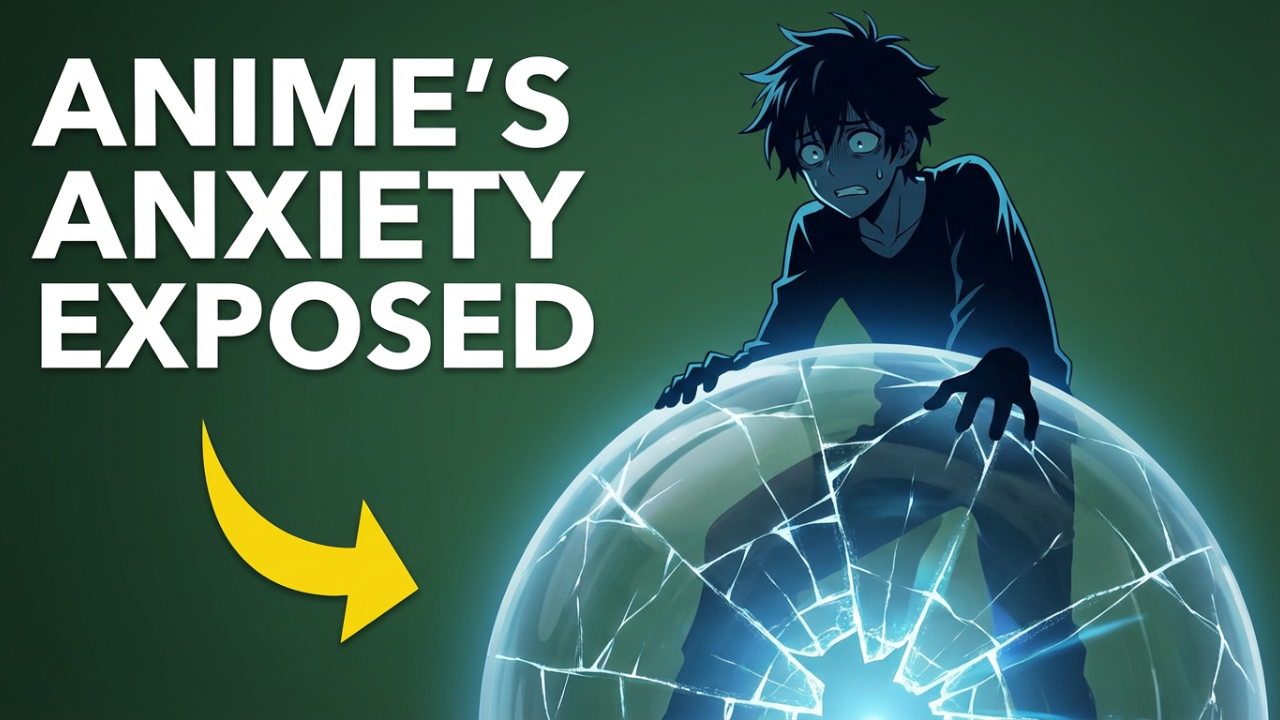
This is where anime as a medium really shines. It often moves beyond the struggles of a single protagonist, using its entire cast, its world-building, and its very premise to paint a sprawling picture of a society gripped by a shared fear. This is collective anxiety: a psychological state that goes beyond the individual and becomes the defining trait of a community, a generation, or even a whole world. It’s that unsettling feeling that the systems you trust are broken, that the ground beneath your feet is unstable, and that the threat on the horizon is coming for everyone, not just you.
We’re going to look at how anime creates this universal feeling of anxiety, reflecting our own world back at us in haunting ways. From the visceral, existential terror of world-ending monsters in shows like *Attack on Titan* and *Neon Genesis Evangelion*, to the creeping dread of a society turning on itself in *A Silent Voice* and *Shinsekai Yori*. We’ll see how the pressure to conform breeds a quiet panic in stories like *Bocchi the Rock!*, and how technologically advanced systems of control, like in *Psycho-Pass*, create a new, uniquely modern form of social paranoia.
The argument anime often makes is that our anxieties are rarely just our own. They’re the products of our shared history, our social structures, and the collective traumas we inherit. These stories show us that fear can be a cage that traps an entire people, but sometimes, understanding that the fear is shared is the first step toward finding a way to endure it.

The Macrocosm of Fear – Existential Threats
One of the most direct ways anime builds collective anxiety is by creating a world defined by a single, overwhelming existential threat. This isn’t a villain who can be punched into submission or a problem you can solve with a clever plan. It’s a permanent condition of the world, a force of nature that instills a baseline of terror in every single citizen. This shared dread becomes the foundation of their society, shaping their culture, their politics, and their psychology.
No series captures this better than *Attack on Titan*. For the people of Paradis, fear isn’t an event; it’s the air they breathe. The Titans aren’t a simple enemy; they’re a grotesque, almost biblical plague. The story kicks off by showing us a century of fragile peace, a time when humanity was lulled into a false sense of security within its walls. Then, in an instant, that security is shattered. The Colossal Titan’s appearance isn’t just an attack; it’s an act of incomprehensible violation that breaks the collective psyche of a civilization.
The anxiety that results has multiple layers. First, there’s the raw, primal fear of being eaten alive. The imagery is deliberately horrific—a bloodbath where humans are consumed by giants with vacant, smiling faces. This trauma is seared into the consciousness of an entire generation, most notably Eren Jaeger, who becomes a vessel for this collective hatred and fear. But Eren’s trauma isn’t unique; it’s just the most potent example of a terror shared by all.
Beyond the physical threat, a more insidious paranoia takes root. The discovery that humans can transform into Titans means the monster is no longer just outside the walls, but could be standing right next to you. Trust evaporates. Neighbors and comrades become objects of suspicion. This paranoia fuels a state of perpetual emergency, justifying brutal military actions and political purges. The government even sacrifices thousands of its own people to deal with food shortages after the first attack, showing how collective panic leads to a moral decay from the very top.
As the series goes on, the source of anxiety evolves. It morphs from a fear of monsters to a fear of the outside world—a world that hates and persecutes the people of Paradis. The story becomes a gut-wrenching parable about inherited trauma and cycles of violence. The characters learn their entire history is a lie, a memory wiped by a royal family to maintain control. This introduces a new kind of collective anxiety: the horror of realizing your identity is built on ignorance and manipulation. *Attack on Titan* suggests that this level of collective trauma, left to fester, doesn’t lead to resilience; it leads to radicalization and ruin.
Then you have a series like *Neon Genesis Evangelion*, which presents a different flavor of existential dread. While the threat in *Attack on Titan* is visceral and constant, *Evangelion’s* is apocalyptic and bewilderingly abstract. The Angels aren’t just monsters; they are celestial, almost divine beings whose motives are completely unknowable. Their periodic attacks are cataclysmic events that threaten to wipe out all of humanity, instilling a global sense of panic.
The collective anxiety in *Evangelion* comes from a feeling of profound powerlessness. Humanity’s survival rests on the shoulders of a few psychologically fragile teenagers—a fact that is both terrifying and deeply absurd. The story is intensely personal, focusing on Shinji Ikari’s struggles with depression, abandonment, and a crippling fear of connecting with others. But his personal anxiety is explicitly framed as a microcosm of the human condition. The show’s central conflict isn’t just about defeating the Angels, but about the “Human Instrumentality Project,” a secret plan to merge all of humanity into a single consciousness to eliminate the pain and anxiety caused by individual separation. In this world, the fear of loneliness is presented as a fundamental flaw in humanity, a collective disease for which Instrumentality is the terrifying cure.
This anxiety is amplified by the very institutions meant to protect people. NERV, the organization fighting the Angels, is secretive, manipulative, and run by the deeply damaged and morally questionable Gendo Ikari. The public is kept in the dark, fed propaganda, and left to live in a state of suspended terror. The very saviors of mankind, the Eva units, are monstrous and unpredictable, prone to going berserk and causing as much destruction as the Angels they fight.
In both *Attack on Titan* and *Evangelion*, an individual’s anxiety is inseparable from the world’s. The characters’ personal demons are just reflections of a much larger, societal sickness. Their struggle isn’t just to survive, but to find meaning in a world that seems fundamentally broken and perpetually on the verge of collapse.
The Microcosm of Fear – Social Breakdown
It’s easy to create anxiety with giant monsters, but some of the most profound stories are the ones where society itself becomes the monster. In these narratives, the threat isn’t an invading giant or an alien; it’s the cruelty, judgment, and systemic failures of the people around you. The anxiety is quieter and more intimate, but it poisons the community from within, creating a shared experience of trauma and isolation.
*A Silent Voice* is a masterful example of this. It explores how a single act of cruelty—bullying—creates a ripple effect of lasting anxiety that infects a whole group of young people. The story focuses on two characters trapped by the same event: Shouko Nishimiya, a deaf girl who is mercilessly bullied, and Shouya Ishida, the boy who led the charge against her. Years later, Shouya is consumed by guilt and social anxiety, ostracized by the same classmates who once laughed along with him. His suffering is a direct result of his past actions, but the film brilliantly shows that he’s not the only one left scarred.
The anxiety is collective because the bullying was a social phenomenon. It wasn’t just Shouya’s crime; it was a failure of the entire classroom. The other students were complicit through their laughter or their silence. When they reunite years later, this shared history hangs over them like a toxic cloud. Naoka Ueno remains defiantly unrepentant, anxious about her own image. Miki Kawai anxiously denies any involvement, desperate to preserve her reputation. Miyoko Sahara is haunted by her own cowardice for not defending Shouko.
The film has a brilliant way of visualizing this social anxiety. Blue “X”s cover the faces of everyone around Shouya, symbolizing his inability to connect with or even look at others. He’s trapped in a prison of his own making, but it’s a prison built with the bricks of social rejection and shared trauma. The central conflict is whether this fractured community can find a path to collective forgiveness. *A Silent Voice* argues that social ills like bullying don’t just create individual victims; they create sick social groups, where anxiety and guilt become the ties that bind.
If *A Silent Voice* shows a social group breaking down, *Shinsekai Yori (From the New World)* portrays an entire society built on a foundation of weaponized anxiety. In this distant future, some humans have developed powerful psychokinesis, or “Cantus.” To prevent this power from leading to total destruction, the society has engineered a complex system of control rooted in absolute fear. The collective anxiety here isn’t an accident; it’s a deliberate tool of the state.
From birth, children are conditioned to fear their own power. They’re taught that a loss of control can lead to a “Karma Demon,” a person who unconsciously leaks their power and kills everything around them. Worse still is a “Fiend,” someone who intentionally uses their power to slaughter others. The society’s solution is brutal: any child showing signs of instability is secretly “disposed of.” This creates a chilling atmosphere of constant terror. The children live in fear of making a mistake, of being different, of simply disappearing one day. The adults live in fear of a child slipping through the cracks and becoming a Fiend, recreating the horrors of the past.
The anxiety is systemic. The education system is designed to instill obedience. The history the children are taught is a heavily redacted lie. The protagonists’ journey is a slow, horrifying unraveling of these lies. They discover the existence of Impure Cats, creatures designed to kill children at the first sign of a psychological problem. They learn about the genetic manipulation of non-Cantus users into the subservient Monster Rat species. Every new truth reinforces the horrifying reality: their peaceful village is a carefully maintained illusion, a gilded cage built from fear and eugenics.
The collective anxiety in *Shinsekai Yori* is the dread of knowing your entire world is based on a monstrous compromise. It’s the fear of what your own society is capable of, and the fear of your own power within that system. These narratives show that the most terrifying monsters are often the ones we create ourselves—the social structures and collective denials that rot a society from the inside out.
The Anxiety of Performance and Conformity
Collective anxiety isn’t always about world-ending threats or societal collapse. Sometimes, it’s a much quieter hum beneath the surface of everyday life: the relentless pressure to perform, conform, and be accepted. This anxiety is born from the unspoken rules of social interaction and the fear of being judged. In a world saturated by social media, this theme has become increasingly central to modern anime.
No recent anime has captured this with more charm and painful relatability than *Bocchi the Rock!*. The series centers on Hitori “Bocchi” Gotoh, a character whose severe social anxiety is so debilitating that ordering a drink becomes a monumental challenge. Her anxiety is often played for laughs, with her internal monologues spiraling into surreal fantasies of failure. But beneath the comedy is a deeply empathetic portrayal of what social anxiety actually feels like: a constant, internal monologue of self-doubt and a paralyzing fear of rejection.
But the show’s genius is that it isn’t just *Bocchi’s* story. It’s about how her anxiety interacts with the personalities of her bandmates. Their collective goal—to become a successful band—forces them all to navigate the minefield of social performance together. Nijika, the drummer, is the cheerful anchor, but her drive is fueled by her own anxieties about fulfilling her sister’s dream. Ryo, the bassist, is a quiet introvert, but her aloofness comes from a place of self-possession, not fear—a crucial distinction the show makes.
Then there’s Ikuyo Kita, the vocalist. On the surface, she is a radiant, popular social butterfly. But the show reveals this is a carefully constructed persona. She initially joined the band and then fled because she lied about being able to play guitar, terrified of being exposed as a fraud. Kita’s anxiety is the anxiety of maintaining a perfect image, the fear that people won’t like the “real” her.
*Bocchi the Rock!* shows that anxiety exists on a spectrum. The collective challenge for Kessoku Band is learning to accommodate each other’s needs. The show powerfully argues that the solution to anxiety isn’t a miraculous “cure,” but finding a place where you can be your authentic, anxious self and still be accepted. The music itself becomes a therapeutic outlet for Bocchi, a space where she can finally express the powerful emotions she can’t articulate in conversation.
Taking this theme to its darkest extreme is Satoshi Kon’s psychological thriller, *Perfect Blue*. The story is focused on the protagonist, Mima Kirigoe, but her descent into psychosis is a direct result of collective societal pressures. As a pop idol transitioning into an acting career, Mima is a product to be consumed, and her anxiety stems from the conflicting demands of her various audiences.
There’s the collective gaze of her loyal fans, who feel betrayed by her decision to shed her pure, innocent idol persona. This is personified by an obsessive stalker, but he represents a broader, collective sense of ownership that fans can feel over an idol’s identity. Then there’s the pressure from the television industry, which pushes her to take on a role in a gritty crime drama that includes a traumatic simulated assault scene, all to rebrand her as a “serious” actress.
Mima’s anxiety is the terror of losing control over her own identity. Her public persona—the one created and judged by the collective—begins to bleed into her private self. She’s haunted by a ghostly apparition of her former idol self, who taunts her for being “dirty.” And then there’s the internet. Mima discovers a website, “Mima’s Room,” where an anonymous user documents her daily life with disturbing accuracy. The collective, anonymous voice of the internet begins to define her reality more than her own experiences—a concept that has only become more terrifyingly relevant since the film was made.
*Perfect Blue* is a harrowing look at how the pressure to perform for a collective audience can lead to a complete fragmentation of the self. Mima’s struggle is a battle against the image that society has created for her. Both *Bocchi* and *Perfect Blue*, in their vastly different ways, reveal a fundamental truth about modern life: a lot of our collective anxiety is born from the gap between the self we present to the world and the self we truly are.
When the System is the Sickness
Perhaps the most chilling form of collective anxiety in anime is when the source of fear is the very system designed to eliminate it. These are stories set in dystopias where order and happiness are not just promised but algorithmically enforced. In these worlds, the anxiety isn’t about chaos; it’s about the suffocating control of a “perfect” society and the terror of being flagged as an outlier.
*Psycho-Pass* is the definitive exploration of this theme. In 22nd-century Japan, the Sibyl System maintains social order. It continuously scans every citizen to determine their “Crime Coefficient”—a number representing their potential to commit a crime. If your number gets too high, you’re labeled a “latent criminal” and are subject to immediate enforcement, which can range from therapy to on-the-spot execution.
On the surface, this has created a utopia. There’s virtually no crime. But beneath this placid surface lies a society saturated with a unique collective anxiety. Citizens live under the constant stress of keeping their mental state, or “hue,” clear. A moment of intense grief or even being the victim of a crime can cloud your Psycho-Pass, putting you at risk. This creates a society that passively discourages strong emotions and empathy; getting too invested in someone else’s suffering could literally be dangerous to you.
But the real anxiety is for those who start to see the cracks in the system. The protagonist, Inspector Akane Tsunemori, quickly learns the horrific truth: the “objective” Sibyl System isn’t an impartial algorithm. It’s a hive-mind made of the brains of “criminally asymptomatic” individuals—sociopaths whose own Psycho-Passes can’t be read by the system, allowing them to judge humanity from a detached, amoral perspective.
The anxiety of *Psycho-Pass* becomes the horror of being ruled by a monster that calls itself a god. The system that promises perfect safety is, in reality, a collective of the very minds it claims to be protecting society from. The ultimate fear is not of criminals, but of the cure itself. They’ve traded free will for a manufactured peace, and the collective dread comes from realizing they are living in a gilded cage, judged by an amoral machine with absolute power over their lives and deaths.
This idea of a flawed system creating anxiety isn’t just for sci-fi dystopias. We see it in how societies, even in fantasy worlds, handle prejudice and trauma. Think about one of anime’s most famous heroes: Naruto Uzumaki. While *Naruto* is a story of adventure, its emotional core is rooted in the collective anxiety and prejudice of the Hidden Leaf Village. As the vessel for the Nine-Tailed Fox, a demon that nearly destroyed the village, Naruto is the subject of village-wide ostracism. The fear and hatred the adults feel for the beast is projected onto the innocent child.
Naruto’s crippling loneliness isn’t the result of a single event, but of systematic, collective social rejection. He is ignored, whispered about, and treated as a pariah. This is a societal failure. The entire village participates in creating the very isolation that defines Naruto’s childhood. The collective anxiety here is twofold. For the villagers, it’s the lingering fear of the monster inside Naruto. For Naruto, it’s the painful anxiety of being an outcast, desperately craving the connection his own society denies him. His journey isn’t just about becoming a powerful ninja; it’s about breaking down a systemic wall of prejudice and forcing his community to confront its own collective fear.
Conclusion
From the blood-soaked earth of Paradis to the glitching mind of a high school guitarist, anime is an uncommonly powerful medium for exploring collective anxiety. It moves beyond the simple story of a lone hero facing their fears and instead gives us a panoramic view of entire societies grappling with shared dread.
What makes these portrayals so effective is their understanding that anxiety is rarely an isolated, personal failing. It is a condition deeply embedded in our social structures, our group dynamics, and our collective traumas. Anime validates this experience, showing us that our fears are often a rational response to an irrational world.
But these stories aren’t just chronicles of despair. They are also, fundamentally, about the struggle for connection in a world that feels like it’s falling apart. They highlight the search for coping mechanisms not as individual pursuits, but as collective endeavors. Whether it’s forming a band, the difficult process of group forgiveness, or rebelling against a broken system, the solution—or at least, the path to endurance—is almost always found through connection with others. These narratives suggest that while anxiety may be a shared burden, the very act of sharing it, of acknowledging that we are all afraid together, can be the first and most crucial step toward bearing its weight.