
Anxiety or ADHD? It feels like you have a million tabs open in your brain, and you can’t close a single one. You’re sitting at your desk, staring at the same paragraph you’ve read ten times, but the words just swim in front of your eyes, refusing to stick. Your thoughts are racing—a chaotic storm of half-finished ideas, forgotten errands, and a vague, persistent hum of dread. You’re spinning your wheels, but not actually going anywhere. You look at the pile of work you need to do, the unanswered emails, the looming deadlines, and all you feel is a rising tide of panic, a physical weight in your chest.
You keep telling yourself to just “focus,” to “calm down,” or to “get it done.” But it feels like you’re trying to shout over a rock concert. Your body buzzes with a restless energy you can’t seem to burn off. Your leg bounces, you fidget with anything you can get your hands on. It’s exhausting. And in the quiet moments, late at night when you’re trying to sleep, the questions you’ve been pushing away for months, maybe even years, finally surface.
Is this anxiety? Is that why I feel so overwhelmed and on edge all the time? Or is there something else going on? Could it be ADHD? The symptoms seem to blur together into one overwhelming state of being stuck. If you’re tired of feeling like you’re fighting a battle you don’t even understand, then you’re in the right place.
In this article, we’ll look closely at the hidden scientific signs to reveal if the root of your struggle is ADHD, anxiety, or, as is often the case, a complex combination of both. My goal is to give you the clarity you’ve been searching for, so you can finally understand the “why” behind what you’re feeling and take the first real step toward getting the right support.
Section 1: The Core Difference – Two Trees, Different Roots
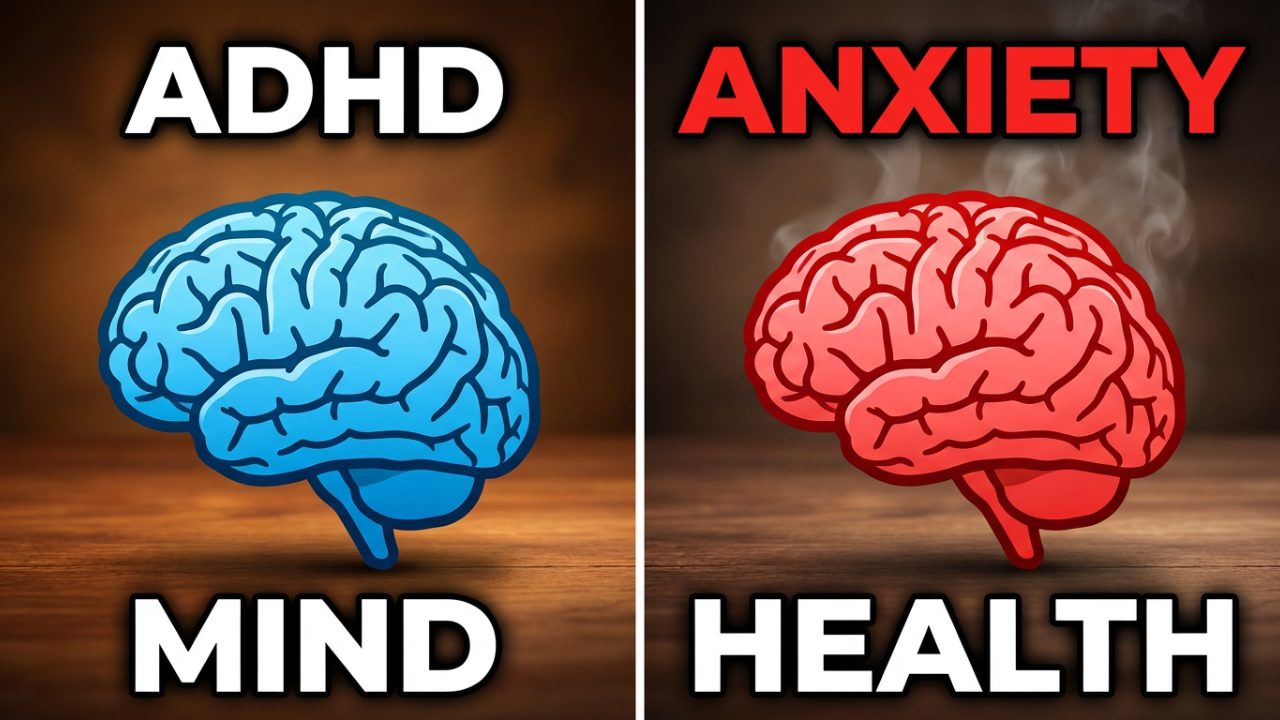
Before we can compare symptoms side-by-side, we have to understand the fundamental difference in what’s happening in the brain. On the surface, ADHD and anxiety can look almost identical. They both lead to restlessness, trouble concentrating, and feeling overwhelmed. You can think of them as two different types of trees that look similar from a distance—they both have leaves and branches. But when you get up close and look beneath the soil, you discover they have entirely different root systems.
For ADHD, the root system is an issue with **Executive Function**. ADHD, or Attention-Deficit/Hyperactivity Disorder, is a neurodevelopmental disorder. That means it starts in childhood and is related to how the brain is built and develops. Specifically, it involves challenges with a set of mental skills known as executive functions. Think of executive functions as the CEO or the air traffic controller of your brain. They’re located in your prefrontal cortex—the front part of your brain—and they’re responsible for managing everything: planning, organizing, starting tasks, remembering instructions, regulating emotions, and controlling impulses.
In a brain with ADHD, this management system is dysregulated. It’s not that the CEO is lazy or doesn’t want to do the job; it’s that the communication lines are spotty. It’s been described as having a “Ferrari brain with bicycle brakes.” You have this powerful engine, capable of incredible creativity and focus on things you find interesting, but the system for slowing down, steering, and managing that power—the brakes—is unreliable. This is often linked to the way the brain uses neurotransmitters like dopamine and norepinephrine, which are critical for maintaining focus and regulating mood and motivation. So, the inattention in ADHD isn’t a failure of will; it’s a neurological difficulty in directing and sustaining attention, especially on tasks that aren’t inherently stimulating.
Now, let’s look at the other tree: anxiety. The root system of an anxiety disorder is a hyperactive **Threat Response**. Anxiety is a natural and essential human emotion; it’s our built-in alarm system. The problem starts when this alarm system becomes faulty. In an anxiety disorder, the brain’s threat detection center, mainly a little almond-shaped structure called the amygdala, becomes oversensitive. It starts to see danger where there is none, or it dramatically exaggerates the level of actual danger.
It’s like a smoke detector that goes off not just when there’s a fire, but also when you burn a piece of toast, or even when you just *think* about turning on the oven. Your body is then flooded with stress hormones like cortisol and adrenaline, kicking off the “fight, flight, or freeze” response. This response is designed for survival; it pulls all of your body’s resources away from complex thinking and toward immediate action. Your heart races, your muscles tense, and your mind locks onto the perceived threat. When this happens, the prefrontal cortex—that same part of the brain responsible for executive function—gets pushed aside. Your brain doesn’t care about planning your week or focusing on a spreadsheet when it thinks a tiger is about to pounce.
So, here is the fundamental distinction to keep in mind:
ADHD is primarily a problem of **regulation**. The brain’s management system struggles to direct focus, energy, and impulses.
Anxiety is primarily a problem of **fear**. The brain’s threat system is constantly being triggered, hijacking focus and energy to prepare for a danger that’s often overestimated.
The confusion happens because a hyperactive threat system *also* cripples executive function. If you’re constantly in a state of fight-or-flight, you can’t concentrate, you can’t organize your thoughts, and you feel restless. The end result can look the same. But the root cause is entirely different. Understanding this difference—a brain that is *under-stimulated and scattered* versus a brain that is *over-stimulated and scared*—is the key to finally telling them apart.

Section 2: Symptom Breakdown – A Head-to-Head Comparison
Now that we’ve established the core difference—Executive Function versus Threat Response—let’s put the most common overlapping symptoms under a microscope. For each one, I’ll break down the experience from an ADHD perspective and an anxiety perspective. The critical question to ask isn’t *what* is happening, but *why* it’s happening.
Sign1: The Nature of Your Distraction
This is maybe the most confusing symptom of all. Both conditions are known for causing a lack of focus. But the *quality* and *source* of that distraction are worlds apart.
The ADHD Flavor of Distraction:
If you have ADHD, your attention is primarily dictated by **interest and stimulation**, not by importance. Your brain is like a web browser with a hundred tabs open, and it’s constantly and impulsively clicking on whichever one seems most novel or interesting. The inattention comes from an inability to regulate your focus and block out distractions. It can happen even when you feel calm and aren’t particularly worried about anything.
For example: you sit down to answer an important email from your boss. You’re calm, you’ve had your coffee. As you open the email, you see a word that reminds you of a movie. Suddenly, you’re on a different tab, looking up the lead actor. You see they were born in a city you’ve always wanted to visit. Twenty minutes later, you’re deep into a travel blog about that city, planning a hypothetical trip. An hour has passed, the email is still unanswered, and you have a vague sense of lost time but no memory of being scared or worried. Your mind wasn’t hijacked by fear; it simply wandered down a more interesting path. Clinicians sometimes call this mental “channel surfing.”
The Anxiety Flavor of Distraction:
With anxiety, your attention isn’t wandering freely; it’s being **captured and held hostage by worry**. Your focus breaks down because your brain’s threat-detection system has been activated. You aren’t distracted by something more interesting; you are preoccupied by something frightening.
Let’s use the same scenario. You sit down to answer that email. The moment you open it, your threat response kicks in. Your thoughts don’t wander; they ruminate. They get stuck in a loop. *“What if I say the wrong thing? My boss sounded a bit abrupt in their last message. Are they mad at me? If I mess this up, I could get a bad review. What if I lose my job?”* You’re not looking up travel blogs; you’re staring at the blinking cursor, paralyzed. Your mind is scanning for danger, replaying past mistakes, and catastrophizing about the future. The distraction isn’t coming from a bird outside; it’s coming from the “tiger” inside your head. You can’t focus on the task because your brain has prioritized what it sees as a much more urgent problem: survival.
What if it’s Both?
This is where it gets truly tangled. You sit down to answer the email. Your ADHD brain immediately finds the task boring, so it starts to wander toward that movie, that city. But then, you realize you’ve been procrastinating. That realization triggers your anxiety. The worry thoughts start: *“There I go again, I can’t even answer a simple email. I’m so lazy. I’m going to get fired.”* Now you have two forces at war. The ADHD is pulling you toward anything more stimulating, while the anxiety is paralyzing you with fear about the consequences. The result is a torturous state of being simultaneously distracted and hyper-fixated on your own failure. You feel restless and agitated, but also frozen and unable to act.
Sign 2: Restlessness & Hyperactivity
That feeling of being “on edge” or unable to sit still is a classic sign of both conditions. But again, what’s fueling that physical energy?
The ADHD Flavor of Restlessness:
In ADHD, restlessness is often a sign of **hyperactivity and a need for stimulation**. The brain is under-aroused, and physical movement is a subconscious way to ramp up that arousal to a more functional level. It can feel like being “driven by a motor.” For many with ADHD, moving actually helps them think. They might pace while on the phone or bounce their leg while trying to read. The restlessness isn’t necessarily tied to fear; it’s an internal, physical buzz that needs an outlet. It happens across different settings, whether you’re at home watching TV or in a work meeting.
The Anxiety Flavor of Restlessness:
In anxiety, restlessness is a direct symptom of the **fight-or-flight response**. Your body is being flooded with adrenaline to prepare you to escape a threat. This isn’t a need for stimulation; it’s your body being revved up by fear. It feels like nervous energy. You might pace back and forth because you’re consumed by a specific worry, not because it helps you think. This fidgeting is often accompanied by other physical signs of anxiety: a racing heart, shallow breathing, or a knot in your stomach. It’s your body saying, “We are in danger, we need to move NOW.”
What if it’s Both?
This creates a powerful and exhausting loop. The baseline hyperactivity of ADHD keeps your body in constant motion. But when a stressful thought triggers your anxiety, that energy gets amplified and infused with fear. You might be fidgeting with a pen out of an ADHD-driven need for stimulation, but then you start worrying about a deadline, and suddenly that fidgeting becomes more frantic. Your heart starts to race, and the harmless leg-bouncing now feels like a desperate attempt to run away from the panic rising in your chest. The ADHD provides the constant static of physical energy, and the anxiety turns up the volume to an unbearable level.
Sign3: The Root of Your Procrastination
Everyone procrastinates, but for people with ADHD and anxiety, it’s a chronic, life-disrupting pattern. The *reason* you’re avoiding a task is the most revealing clue.
The ADHD Flavor of Procrastination:
With ADHD, you procrastinate on tasks that are **boring, overwhelming, or require sustained mental effort**. It’s not about a fear of failure, but a brain that is profoundly resistant to being under-stimulated. This is often called “task-avoidance.” Tasks like filling out forms or starting a large, unstructured project can feel almost physically painful. Your brain, wired to seek dopamine, sees these tasks as a desert with no reward. So, you put them off for something—anything—that provides an immediate hit of interest. The motivation only kicks in when a deadline is so close that the panic finally provides enough adrenaline to jump-start your brain. You’re not afraid you’ll do it imperfectly; you’re struggling to get your brain to engage at all.
The Anxiety Flavor of Procrastination:
With anxiety, you procrastinate on tasks that are **anxiety-provoking, especially those involving performance or the risk of judgment**. This isn’t about boredom; it’s about fear. The most common driver is perfectionism. You avoid starting because you’re afraid you won’t do it perfectly. You stare at a blank page for hours, terrified that the first sentence won’t be brilliant enough. You put off making a phone call because you’re worried you’ll stumble over your words. This is avoidance rooted in a fear of negative outcomes. The task itself becomes a symbol of your potential failure, so you avoid it to avoid feeling judged.
What if it’s Both?
This is the ultimate procrastination trap. A large, important project lands on your desk. The ADHD brain sees it as boring and overwhelming, and its instinct is to run toward something more interesting. But the anxiety brain sees the same project and registers it as a high-stakes performance with a huge potential for failure. So, the ADHD says, “I can’t start this, it’s too boring,” and the anxiety says, “I can’t start this, I’ll never do it perfectly.” You are trapped between a brain that won’t engage and a brain that’s terrified to engage. This often leads to a complete shutdown, where you get stuck in a loop of shame and avoidance, scrolling endlessly on your phone while a storm of guilt and panic rages inside.

Section 3: The “What If It’s Both?” Scenario – A Vicious Cycle
For a huge number of people, the answer to “Is it ADHD or anxiety?” isn’t either/or. It’s “both.” In fact, studies show that up to half of all adults with ADHD also have an anxiety disorder. This overlap isn’t a coincidence. The two conditions are deeply intertwined and often create a vicious feedback loop that makes each one worse.
It often starts with the ADHD. Remember, ADHD is neurodevelopmental, meaning its symptoms have been around in some form since you were a kid. Imagine growing up with a brain that consistently struggles with organization, time management, and impulse control.
From a young age, you might be the kid who is always forgetting your homework, losing your jacket, or blurting things out in class. Teachers might call you “lazy” or “careless.” You see your peers managing their lives with an ease that feels completely alien. Over time, you internalize these messages and start to believe that you are fundamentally flawed or not trying hard enough.
This is the breeding ground for anxiety. The chronic stress and negative feedback from living with untreated ADHD can directly cause what’s known as **secondary anxiety**. It’s an anxiety born from the real-world consequences of your executive function challenges.
Here are a few examples of how ADHD can fuel anxiety:
Anxiety about Time: Your ADHD might give you “time blindness,” where you consistently underestimate how long tasks will take. As a result, you’re chronically late. The shame and consequences of this—letting people down, getting in trouble at work—build up. Soon, you develop an intense, persistent anxiety around time itself. You start checking the clock obsessively, and the thought of an upcoming appointment can fill you with dread, not because of the appointment itself, but because you’re terrified you’ll be late again.
Anxiety about Performance: At work or school, your ADHD makes it tough to stay organized and meet deadlines. You might miss a crucial detail in an email or forget about a meeting entirely. After this happens a few times, you can develop a powerful fear of failure. Every new project becomes a source of intense anxiety, and you start double- and triple-checking your work out of a desperate fear that you’ve missed something.
Social Anxiety: Your ADHD impulsivity might cause you to interrupt people. Your inattention might make you zone out during conversations, making others feel like you don’t care. After enough awkward encounters, you can develop a deep-seated social anxiety. You start seeing social situations as minefields where you’re likely to mess up, and you replay conversations in your head, convinced you offended someone.
Do you see the pattern? The ADHD creates the chaos, and the anxiety develops in response to that chaos.
But it doesn’t stop there. Once anxiety takes root, it pours gasoline on the ADHD fire. Anxiety triggers the fight-or-flight response, which shuts down the prefrontal cortex—the very part of the brain that’s already struggling. So, the anxiety you developed because of your ADHD now makes your ADHD symptoms even more severe.
Your working memory gets worse. Your ability to start tasks becomes nearly impossible when you’re frozen with fear. The constant buzz of worry adds another layer of mental noise on top of the already scattered ADHD brain.
This is the vicious cycle. The ADHD brain drops the ball, and the anxiety brain starts screaming about the dropped ball, making the ADHD brain even more likely to drop the next one. People living with this often feel exhausted, demoralized, and incredibly isolated, like they’re fighting a war on two fronts. If this sounds like you, please know you are not alone. This experience is real, it’s valid, and it has a neurological basis. It is not a character flaw.
Section 4: The Solution – The Path to Diagnosis and Clarity
So, what do you do with all this information? It’s natural to want an immediate answer, but the single most important message here is this: this video is for education, not for diagnosis. The only way to truly know what you’re dealing with is to seek a professional evaluation.
Self-diagnosis, while a helpful starting point, can be risky. These symptoms can be mimicked by other conditions like depression, trauma, or even medical issues like thyroid problems. And as we’ve seen, the overlap is so significant that even trained professionals need to be thorough to tell them apart. Getting the right diagnosis is critical because it determines the right treatment. Treating only the anxiety when underlying ADHD is the real driver is like mopping up a flooded floor without ever fixing the leaky pipe. You might make some progress, but the problem will keep coming back.
So, what does a proper evaluation look like? It’s not a quick online quiz. A comprehensive evaluation involves several steps.
First, a clinician will take a **detailed clinical history**, going all the way back to your childhood. For an ADHD diagnosis, there must be evidence of symptoms before the age of 12. They’ll ask about your experiences in school, at work, and in your relationships to understand the patterns. Is your inattention a lifelong struggle that happens even when you’re calm (pointing to ADHD)? Or did it begin after a stressful period and get much worse when you’re worried (pointing to anxiety)?
Second, you’ll likely fill out **standardized rating scales**. These are validated questionnaires designed to measure symptoms. A clinician might also ask a parent or partner to fill one out to get an outside perspective.
Third, the clinician will work to **rule out other conditions** that could be causing your symptoms, like depression or learning disabilities.
And finally, a good evaluation doesn’t just look for “either/or”; it actively looks for **both**. A thorough clinician will assess for ADHD and anxiety at the same time, knowing how often they appear together. The goal is to build a complete picture of you, not just to check off boxes on a list.
And what does help look like? The good news is that both conditions are highly treatable.
For **ADHD**, treatment often involves a combination of medication (stimulants or non-stimulants) and skills-based therapy or coaching. Medication helps regulate the brain’s chemistry—upgrading those “bicycle brakes”—while therapy helps you build practical skills for organization and time management.
For **anxiety**, the gold standard is often psychotherapy like Cognitive Behavioral Therapy (CBT), which helps you challenge the thought patterns that fuel your fear. Medication, such as SSRIs, can also be very effective.
When **both are present**, treatment requires a coordinated approach. Sometimes, treating the ADHD with medication can reduce anxiety because life simply becomes less chaotic. In other cases, the anxiety might be so severe that it needs to be stabilized first. This is a strategic decision that you and your healthcare team will make together.
Conclusion
I know we’ve covered a lot of ground. We’ve looked at the neurological roots of these two conditions, dissected their most confusing symptoms, and mapped out the feedback loop that can happen when they exist together.
If you take one thing away from this, let it be this: Your struggle is not a character flaw. It is not a lack of willpower. It is not you being “lazy” or “too sensitive.” Whether it’s the executive dysfunction of ADHD, the hyperactive threat response of anxiety, or the exhausting combination of both, what you are dealing with has a biological basis. Giving a name to your struggle isn’t about finding an excuse; it’s about finding an explanation. And an explanation is the first step toward a solution.
The path to figuring this out can feel overwhelming, but you’ve already taken the most important step by seeking out knowledge. Be kind to yourself through this process. You have been navigating a world that wasn’t built for your brain, and that is an exhausting task.
Your next step is to take this knowledge and use it to have an informed conversation with a qualified professional, whether it’s your family doctor, a psychiatrist, or a therapist. Advocate for yourself. Ask for a comprehensive evaluation that considers the possibility of both ADHD and anxiety. You deserve clarity, and you deserve support that is tailored to the true root of your challenges.
Thank you for taking the time to invest in your own understanding today. If this article brought you any sense of clarity or validation, please consider checking our YouTube channel for more helpful content on mental health. The more we understand ourselves, the better we can navigate our lives.