
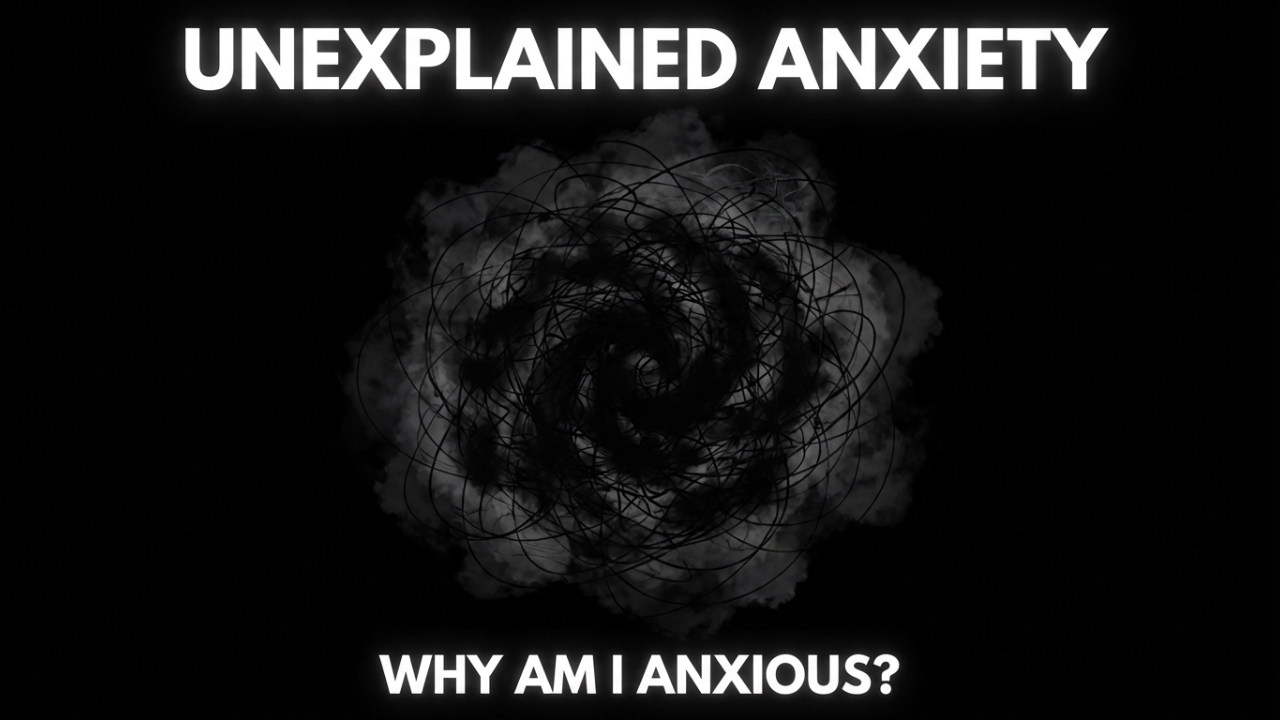
How to deal with anxiety for no reason? You’re just living your life—washing the dishes, driving your car, sitting at your desk—and then it hits you. Out of nowhere. Your heart starts to pound, your chest gets tight, and this wave of pure dread washes over you for absolutely no reason at all. Your mind starts to spiral. “What’s happening? Am I having a heart attack? Am I losing control?” It’s terrifying, and what’s worse, it’s confusing. Because just a second ago, you were completely fine.
If you’ve ever felt that sudden, scary wave of anxiety that seems to come from nowhere, then this article is for you. I want you to know you are not alone, and you are not broken. What you’re feeling is real, it has a name, and most importantly, it’s something you can learn to manage. I’m going to explain why this happens, pulling back the curtain so it’s no longer this big, scary mystery. Then, I’ll give you a concrete, 3-step emergency plan you can use the moment this feeling starts, to stop the panic in its tracks and get back in control.
Introduction: The Problem of “Anxiety For No Reason”
That feeling I just described—that sudden, intense spike of fear with no obvious trigger—is often a panic attack. A panic attack is a sudden episode of intense fear that brings on severe physical reactions when there’s no real danger or apparent cause. They can happen anytime, anywhere, even when you’re relaxing or asleep. This isn’t the same as generalized anxiety, which is more of a constant, nagging worry about lots of different things. While both are tough, the “out of the blue” nature of a panic attack is uniquely unsettling. It can feel like your own body has betrayed you.
And here’s the really frustrating part: the fear of having anxiety *for no reason* becomes a new reason to be anxious. You start to fear the feeling itself. You might start worrying, “When will it happen again? What if it happens while I’m driving? Or in a meeting? Or with my kids?” This fear of the next attack can become a shadow that follows you everywhere, causing you to shrink your own life. You might start avoiding places or situations where you’ve had an attack before, hoping you can prevent another one. But as we’re about to see, that avoidance usually just makes the anxiety stronger.
Why? Why does this happen when there’s no reason?

SON OF LORD- Scientific Institute
Section 1: The “Why” Explained – Unmasking the False Alarm
The single most important thing I want you to understand is this: there is *always* a reason. It’s just not always an obvious, external, or conscious one. That feeling of randomness is a huge part of the experience, but it’s an illusion. To get what’s really going on, we need to talk about your body’s internal security system.
Think of your brain and body as having a super-sensitive smoke detector. This is your fight-or-flight response, run by a part of your brain called the amygdala. Its job is to scan for danger and, if it spots a threat, pull a fire alarm that floods your body with adrenaline. This is an ancient system designed to save your life. It’s what gives you that superhuman surge of energy to jump out of the way of a speeding car. In that case, the smoke detector is working perfectly. There’s a real fire, and the alarm saves you.
But a panic attack is what happens when that smoke detector becomes *overly* sensitive. It’s a “false alarm.” There’s no fire, but the alarm is blaring anyway, and your body is reacting as if the whole building is on fire. Your heart pounds to pump blood to your muscles for a fight that isn’t happening. You start breathing faster to take in more oxygen. You feel a sense of total doom because your brain is screaming “DANGER!” even though you’re just standing in your kitchen.
So, the next question is, why did your smoke detector get so sensitive? This is where the whole “no reason” idea really starts to fall apart. There are a few key things that can secretly turn up the sensitivity dial on your nervous system.
Let’s use an analogy I call the Stress Cup.
Imagine your ability to handle stress is a cup. Every day, little drops of stress go into it. A nasty email from your boss—a few drops. An argument with your partner—a few more. Worrying about money, not sleeping well, sitting in traffic—drops, drops, drops. Sometimes big things happen that pour a lot in at once, like a major life change or a loss. On top of that, you have physical things you might not even think of as stress. Too much caffeine, hormones shifting, not eating right, or even side effects from medication can all add to the cup.
For days, weeks, or even months, you might be walking around with this cup filled right to the very brim. You’re functioning, you’re coping, you might even feel “fine.” But you are at your absolute limit. And then, one tiny, insignificant thing happens. It could be a fleeting thought. It could be a weird physical feeling, like a single heart flutter. It could literally be nothing—the final drop is just a drop.
But because your cup is already overflowing, that one tiny drop is all it takes. The cup spills over. Your nervous system, already on high alert from all that built-up stress, misreads that tiny signal as a massive threat and pulls the fire alarm. And you’re left standing there in the middle of a normal day, having a full-blown panic attack, thinking it came out of nowhere. It didn’t. It came from the total weight of everything that was already in your cup.
This often happens when you finally try to relax, which is super confusing. It’s called the “let-down effect.” When you’re busy and stressed, your body is in get-it-done mode. The second you sit down, your brain goes, “Okay, it’s finally ‘safe’ to process all that stress we’ve been holding back.” And that’s when the overflow often happens.
On top of that, our brains are amazing association machines. Sometimes, a trigger can be subconscious. A specific smell, a certain time of day, or a sound might be vaguely connected to a tough memory from your past. You aren’t consciously aware of the link, but your amygdala—your brain’s little security guard—remembers. It flags a totally safe situation as dangerous because of that faint, hidden connection. To your conscious mind, it feels random. To your subconscious, it was a triggered memory.
So, let’s be clear: the anxiety isn’t coming from “no reason.” It’s coming from a nervous system that’s been made hypersensitive by a mix of things:
1. **A misfiring fight-or-flight response** (the faulty smoke alarm).
2. **An overflowing “stress cup”** (too much life stress hitting a tipping point).
3. **Subtle or subconscious triggers** that your conscious mind doesn’t notice.
4. **Physical factors** like caffeine, poor sleep, or hormonal changes.
Just understanding this doesn’t make the feeling vanish, but it’s the most important first step. It changes the story from “There’s something deeply wrong with me” to “My body is having a very understandable, though extreme, reaction to built-up stress, and my alarm system is just being a little too sensitive right now.” That reframe is the foundation for taking your power back.
Section 2: The Vicious Cycle of Fear
Now that we get the initial false alarm, we need to talk about what keeps the panic going. A panic attack is rarely just one event. It’s a feedback loop, a vicious cycle that you get caught in without realizing it. It’s often called the “Fear of Fear” cycle, and it’s the engine that powers a panic disorder. Here’s how it works.
Stage 1: The Initial Sensation
It all starts with a physical sensation. And here’s the key: it’s usually a totally normal, harmless body feeling. Maybe your heart beats a little faster because you walked up the stairs. Maybe you feel a bit lightheaded from standing up too fast. Maybe it’s a tight feeling in your chest from something you ate. Normally, you wouldn’t even notice it, or you’d just brush it off.
Stage 2: The Catastrophic Misinterpretation
This is where things go wrong. Because your nervous system is already on edge, you don’t brush the feeling off. Instead, your mind, now on high alert, gives it a terrifying meaning. You interpret the sensation catastrophically.
* Your heart flutters, and you don’t think, “Oh, that was weird.” You think, **”I’m having a heart attack.”**
* You feel a little dizzy, and you don’t think, “I should sit down.” You think, **”I’m going to faint” or “I’m having a stroke.”**
* Your thoughts feel jumbled, and you don’t think, “I’m just tired.” You think, **”I’m losing my mind” or “I’m going crazy.”**
This catastrophic thought is like pouring gasoline on a tiny spark. It confirms to your brain that the smoke alarm was right—there *is* a real fire.
Stage 3: The Escalation of Fear and Sensation
Your brain now thinks you’re in mortal danger. And what does it do? It doubles down. It screams at your adrenal glands to release *even more* adrenaline. This massive new surge of adrenaline makes the initial physical feelings a hundred times worse.
Your heart, which was just fluttering, now starts pounding against your ribs. Your breathing, which was a little shallow, becomes rapid hyperventilation, making you feel even dizzier and more lightheaded. The tightness in your chest gets worse. You might start to tremble. Your hands and feet might tingle or feel numb—a common and harmless effect of hyperventilation, but totally terrifying in the moment.
Stage 4: The Confirmation and Reinforcement
These awful physical symptoms now serve as “proof” to your brain that your catastrophic thought was right all along. The feedback loop closes.
The thought “I’m having a heart attack” now feels totally real because your heart is hammering and your chest hurts. The thought “I’m losing control” feels undeniable as your body shakes and your mind races. This creates a tidal wave of pure panic. The symptoms usually peak within a few minutes—which feel like an eternity—and then slowly fade as your body runs out of adrenaline.
But the damage is done. Your brain has just logged what it believes was a life-threatening event. This leads to two powerful after-effects: hypervigilance and avoidance.
Hypervigilance: Your brain wants to make sure this never happens again. So, it becomes hyper-aware, constantly scanning your body for any sign of those first sensations. You start obsessively tracking your heartbeat, your breathing, and any little twinge. Of course, the more you focus on these things, the more you notice them, which you then mistake for a sign that another attack is coming, starting the cycle all over again.
Avoidance: You also start avoiding any place or situation you connect with the attack. If it happened in a grocery store, maybe you start ordering your groceries online. If it happened while driving, maybe you stop using the highway. In the short run, avoiding feels like a relief. But in the long run, it’s devastating. Every time you avoid something, you send a powerful message to your brain: “That place *is* dangerous, and I was right to be afraid.” Avoidance shrinks your world and strengthens anxiety’s hold on you. It reinforces the false alarm.
This whole cycle is the trap. But the good news is, because it’s a predictable cycle, we can jump in and break it. And that is exactly what our 3-step emergency plan is designed to do.

This is Scientific Documentary of the Kingdom of God
Section 3: Your 3-Step Emergency Plan to Stop Panic in its Tracks
Okay, this is the most practical part of our conversation. This is the plan you can turn to the second you feel that familiar, unwelcome wave of anxiety starting to build. I really suggest practicing these steps when you’re calm, so they become automatic. That way, when the alarm bells start ringing, you don’t have to think—you just act.
Our goal is simple: we’re going to systematically take apart the Fear of Fear cycle.
Step 1: Acknowledge and Reframe (Interrupting Stage 2)
The very first thing you have to do when you feel those initial sensations is to consciously stop the catastrophic thought in its tracks. This is the most important step. Instead of letting your mind leap to “I’m dying,” you’re going to intentionally label the experience and reframe it with a pre-written script.
The moment your heart flutters or your chest feels tight, say this to yourself, either out loud or in your head. Pick the one that feels right for you:
* **”This is a panic attack. I know what this is. It’s uncomfortable, but it’s not dangerous.”**
* **”This is my body’s false alarm. My smoke detector is just being extra sensitive right now.”**
* **”This feeling is just a surge of adrenaline. It will pass. I am safe.”**
Here’s why this works. By acknowledging “This is a panic attack,” you’re shifting from being a terrified actor in the drama to being an observer. You’re naming it, which instantly creates a bit of distance. You’re reminding yourself that you know this script, and you know how it ends.
The second part, “…it’s uncomfortable, but not dangerous,” is a direct counter-attack to the catastrophic thought. Panic screams “DANGER!” and you are calmly but firmly replying, “No, this is just discomfort.” You’re correcting the misinterpretation in real-time. Panic attacks feel horrible, but they are not medically dangerous. You won’t die from a panic attack. You won’t go crazy. The symptoms peak, and then they fade. Reminding yourself of this truth is like dropping an anchor in a storm.
Do this now: write your favorite script down. Put it in your phone’s notes, on a card in your wallet, or a sticky note on your monitor. When you’re panicking, the logical part of your brain (the prefrontal cortex) kind of goes offline. Having the script written down means you don’t have to rely on your panicked brain to remember it. You just have to read it. By doing this, you’re refusing to pour fuel on the fire.
Step 2: Anchor Yourself in the Present (Shifting Your Focus)
Okay, you’ve handled the thought. Now we need to handle your focus. Your mind will desperately want to stay focused inward on the scary body sensations. We have to deliberately and forcefully shift your attention away from the internal chaos and onto the neutral, boring, external world. We do this with a powerful grounding technique called the 5-4-3-2-1 Method.
It’s simple, concrete, and you can do it anywhere. As soon as you’ve said your script from Step 1, immediately start this process. Go slowly.
Five: Name five things you can SEE. Look around and, if you can, name them out loud. “I see the blue pen. I see the light on the wall. I see the grain of wood on my desk. I see my fingernails. I see the book on the shelf.” Notice colors, shapes, textures. This forces your brain to engage with the outside world.
Four: Name four things you can FEEL. This is about the sensation of touch. “I can feel the cool surface of the table. I can feel the fabric of my shirt on my arms. I can feel my back against the chair. I can feel the weight of my phone in my hand.” Pay attention to the texture and temperature. This pulls your focus away from the internal panic and onto safe, neutral sensations.
Three: Name three things you can HEAR. Listen closely. “I can hear the hum of the computer. I can hear the distant sound of traffic. I can hear my own breath.” Force yourself to tune into these background noises you usually ignore. This redirects your brain away from the sound of your own pounding heart.
Two: Name two things you can SMELL. This one can be tricky, but give it a try. “I can smell the faint scent of coffee. I can smell the soap on my hands.” If you can’t smell anything, just notice the neutral smell of the air. A pro-tip is to carry something with a strong, pleasant scent with you, like a little bottle of peppermint oil.
One: Name one thing you can TASTE. What’s in your mouth right now? “I can taste mint from my gum.” Or, take a sip of water and focus only on that sensation.
A panic attack hijacks you by trapping you in your thoughts about the future (“What if I die?!”) and your internal feelings. The 5-4-3-2-1 method is a pattern interrupt. It yanks your brain out of that anxious spiral and forces it to engage with the present moment through your senses. Your brain doesn’t have the bandwidth to catastrophize while it’s also trying to describe the texture of your jeans. This sends a signal to your amygdala that you’re processing neutral, non-threatening information, which helps turn down the alarm.
Step 3: Regulate Your Physiology (Calming Your Body)
We’ve dealt with the thought and redirected your focus. Now, we need to manually calm your body down. During panic, you start hyperventilating—breathing becomes rapid and shallow. This is a huge driver of the scariest symptoms like dizziness, tingling, and chest tightness. We’re going to consciously take control of your breathing to reverse this.
A simple and incredibly effective technique is **Box Breathing**. It’s used by everyone from Navy SEALs to nurses to manage high-stress situations.
Here’s how you do it. Imagine you’re drawing a box with your breath.
1. **Inhale slowly through your nose for a count of four.** Try to breathe into your belly, not your chest. Put a hand on your stomach to feel it rise.
2. **Hold your breath gently for a count of four.** Not a tense hold, just a soft pause.
3. **Exhale slowly through your mouth for a count of four.** Imagine you’re blowing gently through a straw.
4. **Hold at the bottom for a count of four.**
5. **Repeat.** Keep this cycle going for a minute or two, or for as long as it takes to feel the storm passing.
The science here is solid. Slow, controlled breathing, especially with a deliberate exhale, directly activates your parasympathetic nervous system. This is your body’s “rest and digest” system—the natural off-switch for the “fight or flight” response. It sends a powerful signal all through your body that the danger has passed. It lowers your heart rate, reduces blood pressure, and stops the flood of adrenaline. You’re using your own breath as a brake pedal for the panic.
So, let’s put the whole emergency plan together. The moment you feel it coming on:
1. Acknowledge and Reframe: “This is a panic attack. It’s uncomfortable, not dangerous.”
2. Anchor in the Present: Start your 5-4-3-2-1 countdown.
3. Regulate your Physiology: Begin your Box Breathing.
These three steps, in this order, are your lifeline. They give you a structured, effective way to respond instead of just reacting in fear. They put you back in the driver’s seat.
Section 4: Beyond the Emergency – Long-Term Strategies for Lasting Calm
The 3-step plan is your emergency kit for when the fire alarm is blaring. But the real goal is to make that alarm less sensitive in the first place, so it goes off less often and less intensely. This is about being proactive, not just reactive. It’s about regularly emptying that “Stress Cup” we talked about, so it’s never filled to the brim.
Here are some of the most effective long-term strategies.
Strategy 1: Master Your Physical Foundation
Your mental and physical health are not separate. They are completely intertwined. Getting these three areas right is one of the most important things you can do to manage anxiety.
Sleep: Make quality sleep a priority. Sleep is when your brain processes emotions. A sleep-deprived brain is an anxious brain. Its amygdala becomes hyper-reactive, making your “smoke detector” way more sensitive. If you struggle with sleep, make it your number one mission to fix it.
Movement: Regular exercise is one of the most powerful anti-anxiety medications on the planet. It burns off excess stress hormones like adrenaline and releases feel-good endorphins. You don’t need to run a marathon. A brisk 30-minute walk most days can make a huge difference.
Nutrition and Hydration: What you put in your body matters. Limit or avoid things known to trigger anxiety, especially caffeine. For many people with panic, coffee is like pouring gasoline on a fire. Also, be careful with alcohol. It might feel like it calms you down at first, but it disrupts sleep and can cause rebound anxiety as it wears off. Finally, try to eat balanced meals at regular times to keep your blood sugar stable, since crashes can feel a lot like anxiety symptoms.
Strategy 2: Become a Detective of Your Own Anxiety
Like we established, panic rarely comes out of absolutely nowhere. There are almost always hidden patterns and triggers. Your job is to become a curious detective and find them. The best way to do this is with a simple journal.
When you feel anxious or have an attack, just jot down a few notes:
* What time of day was it?
* Where were you and what were you doing?
* What were the first physical feelings you noticed?
* What thoughts were running through your mind?
* What did you eat or drink today?
* How did you sleep last night?
* What’s your general stress level been like lately?
After a while, you’ll start to see patterns you never saw before. Maybe your anxiety always spikes in the late afternoon when you haven’t eaten. Or it’s worse after a bad night’s sleep. Or it shows up the day after a big work meeting. This information is gold. It takes anxiety from being a “random monster” and turns it into a “predictable pattern.” And once you see the pattern, you can start to address the root cause.
Strategy 3: Rewire Your Brain with Professional Support
While these strategies are incredibly powerful, if you’re having recurrent panic attacks, the gold-standard treatment is Cognitive Behavioral Therapy, or CBT. This is a type of therapy that is active, structured, and extremely effective for panic disorder. It works in two key ways:
Cognitive Restructuring: A therapist helps you identify your specific catastrophic thoughts (like “I’m having a heart attack”) and teaches you how to systematically challenge and change them. It’s like having a personal coach for Step 1 of our emergency plan, but at a much deeper level.
Exposure Therapy: This is what really breaks the “Fear of Fear” cycle. With the safe guidance of a therapist, you gradually expose yourself to the very things you’ve been avoiding. This might start with something called *interoceptive exposure*, where you intentionally bring on the physical sensations of panic in a controlled way (like spinning in a chair to get dizzy). This teaches your brain, on a gut level, that these feelings are not dangerous. Then, you might move on to visiting places you’ve been avoiding, like the grocery store, proving to your brain that those are safe, too.
Please don’t be afraid to seek help. Reaching out to a qualified mental health professional is a sign of strength. It means you are ready to take your life back. For some people, medication like SSRIs can also be a helpful tool to reduce the frequency and intensity of attacks, often used together with therapy. That’s a conversation to have with your doctor or a psychiatrist. It’s also vital to see a doctor to rule out any underlying medical conditions that can mimic anxiety, like thyroid or heart issues.
Conclusion
That feeling of anxiety coming out of nowhere can be one of the most frightening and lonely experiences you can have. It can make you feel broken and out of control. But I hope after this, you see that you are not broken. There is a logical process happening inside your body and mind. It’s a false alarm, set off by an overflowing stress cup, and kept alive by a vicious cycle of fear.
And because it’s a process, you can influence it. You are not powerless.
Remember your 3-Step Emergency Plan. It’s your anchor in the storm:
1. Acknowledge and Reframe: Name the panic and tell it that it’s uncomfortable, not dangerous.
2. Anchor in the Present: Use the 5-4-3-2-1 method to pull your mind into the safety of the present moment.
3. Regulate your Physiology: Use Box Breathing to manually calm your nervous system.
This plan gives you something to *do* when you feel most helpless. And over the long term, by taking care of your physical health, becoming a detective of your own patterns, and getting professional support if you need it, you can turn down the sensitivity of that alarm system for good. You can learn to trust your body again. You can get your life back from the shadow of fear. This is not a life sentence. It is a challenge, and it’s a challenge you absolutely have the tools to overcome.