

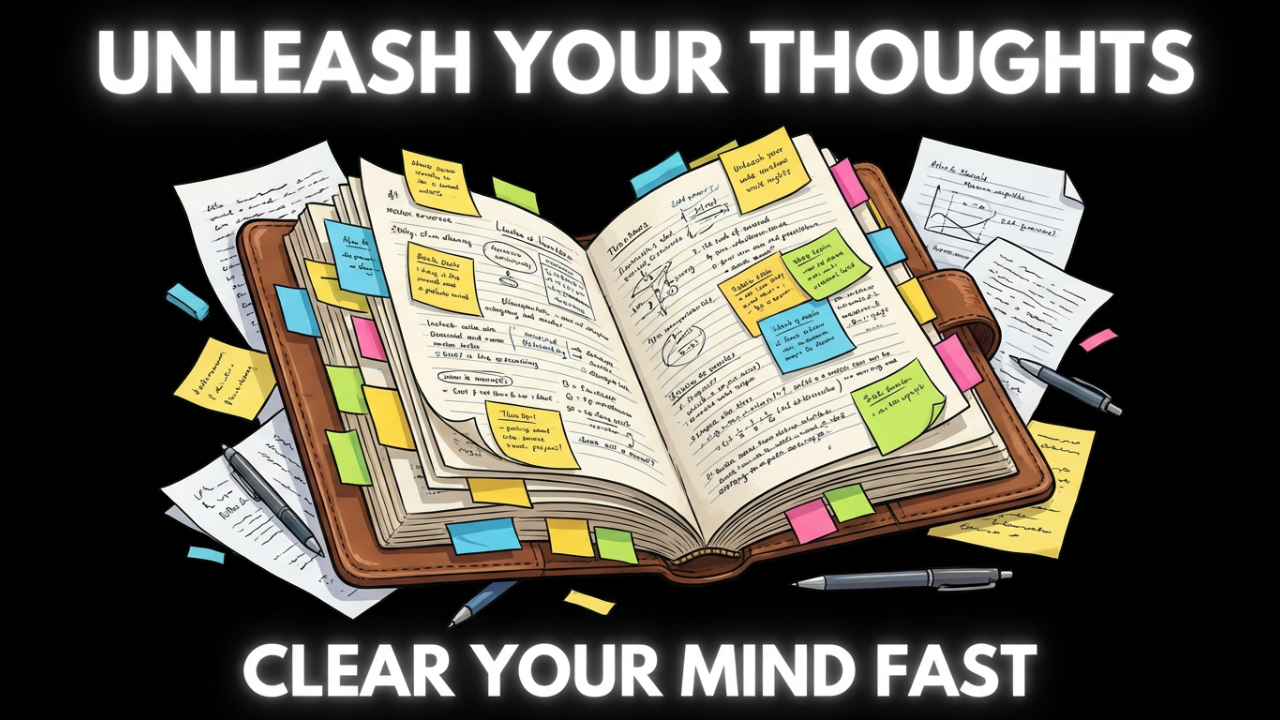
Does your brain ever feel like a chaotic storm of worries and what-ifs, leaving you feeling paralyzed and overwhelmed? Like you have a hundred different browser tabs open in your brain, and you can’t find the one that’s playing music? What if I told you there’s a simple writing exercise that can help externalize that chaos and offer a feeling of relief? Grab a pen and paper, and I’ll guide you through it.
Intro: The “Why” Behind the Dump
That feeling of being completely swamped by your own thoughts is something most of us know all too well. It’s a mental tornado of to-do lists, lingering worries, and half-baked ideas that seem to spin faster and faster until you can’t grab onto a single one. This is often called cognitive overload, and it can be a huge source of stress and anxiety. It’s that sensation of your brain being so full that any new piece of information feels like it could crash the whole system.
This is where a simple but powerful technique called a “brain dump” comes in. A brain dump is exactly what it sounds like: getting all of your thoughts, ideas, and worries out of your mind and onto something external, like paper or a digital document. Think of it as clearing the cache on your computer’s browser or emptying a very cluttered backpack. Once everything is out in the open, you can finally see what you’re actually carrying.
The reason this can work so well for anxiety is rooted in how our brains process information. When we’re anxious, our thoughts can feel abstract and overwhelming, looping over and over. The act of writing them down helps translate them into a more tangible, concrete form. It can create distance. Suddenly, that huge, nebulous worry is just a sentence on a piece of paper. This externalization process may give you a sense of control and can make the thoughts feel far more manageable. It’s like telling your brain, “I’ve documented this. You can let go for now.”
We’re going to walk through this entire process together, step-by-step. I’m not just going to tell you *what* to do; I’m going to show you *how* to do it in a way that provides the most relief, how to make sense of the chaos once it’s on the page, and how to turn it into a habit that can genuinely improve your relationship with anxiety.
Section 1: The Science of Why This Simple Habit Can Make a Difference
Before we pick up a pen, it helps to understand *why* an exercise like this can be so transformative. It’s not just about making lists; it’s about giving your brain a chance to shift from a state of chaos to a state of calm.
Let’s talk for a moment about your brain on anxiety. When you’re feeling anxious, a part of your brain called the amygdala—your brain’s alarm system—can become overactive. When it’s on high alert, your mind can start racing with “what-if” thoughts and potential threats, creating that swirling tornado of thoughts. It’s a feedback loop: anxious thoughts can trigger more anxiety, which then fuels even more thoughts.
Now, let’s bring in another concept: working memory. Think of your working memory as your brain’s RAM—the mental space you use for holding information in the short term. Here’s the catch: it has a limited capacity. An influential early idea from psychologist George Miller suggested we can hold about seven pieces of information there at once. More recent research suggests that for many tasks, the number might be closer to three or four “chunks” of information. When you’re overwhelmed with anxious thoughts and to-do lists, your working memory gets overloaded. This is a big reason why you might feel paralyzed or unable to concentrate.
A brain dump acts like an external hard drive for your mind—it’s a form of “cognitive offloading.” By transferring thoughts from your head to paper, you are literally freeing up mental resources. Reducing the cognitive load that fuels anxiety can give your brain room to breathe, think clearly, and actually problem-solve instead of just spinning in circles.
There’s also something to the physical act of writing. It engages your brain differently than just thinking. Some research on expressive writing has found that writing down worries can help people process emotions more deeply. For example, one study found that students who wrote down their worries before an exam performed better than those who didn’t. The motion of pen on paper can be cathartic—a tangible act of release that signals to your mind that the stress is moving from inside you to outside of you. This isn’t just about getting organized; it’s about regulating your nervous system.
So, as we move into the “how-to,” remember this: you are not just making a list. You are engaging in a practice grounded in principles of cognitive psychology to reduce stress and regain a sense of control.

SON OF LORD- Scientific Institute
Section 2: The Setup – Preparing Your Space for Clarity
Alright, now that you understand the powerful ‘why,’ let’s move into the practical ‘how.’ The first step in a successful brain dump isn’t the writing itself; it’s creating the right environment. Think of this not as another chore, but as a ritual—a dedicated appointment with yourself to find some clarity.
First, find your sanctuary. This doesn’t have to be a special room, but it should be a quiet, comfortable space where you know you won’t be interrupted for a bit. For your first time, try to give yourself a generous window, maybe 20 minutes, so you don’t feel rushed. For later sessions, 10 minutes might be plenty. The key is to minimize distractions. Put your phone on silent and in another room if you can. Close the door. A clear workspace can help create a clear mind. Some people find that soft, instrumental music or a familiar scent from a candle can help signal to the brain that it’s time to relax.
Next, choose your tools. This is a personal preference, and it’s worth experimenting to see what you like. The two main options are analog—pen and paper—or digital—a note-taking app. While digital tools are convenient, many people find that classic pen and paper offers a more connected experience. There’s a therapeutic quality to the physical act of writing that can help process your thoughts more deeply. If you go this route, grab a notebook and a pen you actually enjoy using. Make sure you have plenty of blank paper so you don’t feel constrained.
If you’re more comfortable typing, that’s perfectly fine. Just make sure you choose a tool that’s simple. A blank document is all you need. You don’t want to be fumbling with software.
Finally, and this is the most important part of the setup, is your mindset. You are entering a completely judgment-free zone. The purpose of a brain dump is to get thoughts out, not to write perfect sentences or have brilliant ideas. Give yourself permission to be messy, illogical, and repetitive. Nothing you write down is dumb or silly. If it’s in your head, it deserves a place on the page. This is for your eyes only. Your only job is to let your thoughts flow without a filter.
So, to recap: find a quiet spot, choose your tool, and commit to a judgment-free mindset. Once you have your space set up, you’re ready for the main event.
Section 3: The Brain Dump – How to Let It All Flow
You’re in your quiet space. You have your tools ready. Now comes the heart of the practice. For this step, I highly recommend setting a timer. This creates a defined container for the exercise and can feel less intimidating than an open-ended task. Anywhere from 5 to 20 minutes is a great starting point.
Once you press start, the only rule is to write continuously and without filtering. Don’t pause to think about what to write next. Don’t worry about grammar or spelling. Don’t try to organize your thoughts as they come out. Your mission is simply to translate the chaos in your head directly onto the page in a raw, stream-of-consciousness style.
What do you write? Absolutely everything. Here are some prompts to get you started:
* **To-Do’s:** Big and small. “Finish the quarterly report” and “buy cat food.” “Call the doctor” and “finally fix that wobbly chair.”
* **Worries & What-Ifs:** This is a big one for anxiety. Write down every fear that’s been looping in your mind. “What if my boss hated my presentation?” “What if I can’t pay that bill next month?” “What if that weird noise my car is making is serious?”
* **Frustrations & Annoyances:** Get them out. “I’m so annoyed with the traffic this morning.” “My coworker is driving me crazy.” “Why does this project feel so stuck?”
* **Ideas & Aspirations:** These are the exciting thoughts that often get lost in the noise. “An idea for a new garden layout.” “Maybe I should take that online course.” “I’d love to plan a trip to the mountains.”
* **Random Thoughts & Memories:** The bits and pieces that float by. “I need to remember to call my sister on her birthday.” “That song I heard is stuck in my head.” “I wonder what my friend from college is up to.”
* **Feelings & Emotions:** Put a name to them. “I feel sad today.” “I’m feeling hopeful about this new opportunity.” “I’m just feeling… blah.”
If you hit a wall and find yourself staring at a blank page, don’t panic. That’s common. If you get stuck, try writing a prompt like, “What’s on my mind right now?” or simply, “I don’t know what to write, I feel stuck.” Often, that’s enough to get the flow going again.
Another great technique is to try a “blinding speed challenge.” Set a very short timer, like just two or three minutes, and force yourself to write as fast as you can without stopping. The speed makes it almost impossible for your internal critic to keep up.
For more visual thinkers, don’t feel constrained by words. If a thought comes as an image, sketch it out. Use mind maps. The medium isn’t as important as the act of externalization. The goal is to get it all out of your head and into the physical world.
When the timer goes off, stop. Even if you feel like you could keep going, honor the boundary you set. You’ve now captured the storm. The next step is one that most people skip, but it’s crucial.
Section 4: The Crucial Pause – The Bridge Between Chaos and Calm
You’ve done it. The timer has gone off, and in front of you sits a page—or several—filled with the contents of your mind. It might look chaotic and messy. Your first instinct might be to immediately dive in and start trying to fix everything.
I want you to resist that urge.
This next step is the bridge between the chaotic act of dumping and the clear-headed act of sorting. It’s the crucial pause, and I really don’t want you to skip it.
Put your pen down. If you’re at a computer, push your chair back. Physically separate yourself from what you just wrote for a few moments. Take a real, intentional break. This doesn’t have to be long—even 60 seconds can make a world of difference.
Stand up. Stretch your arms up towards the ceiling and feel the tension release from your shoulders and neck. Roll your head gently from side to side.
Now, let’s take three deep, mindful breaths together. Breathe in slowly through your nose, letting your belly expand. Hold it for a second. And then exhale slowly through your mouth with a soft “whooshing” sound. Feel your shoulders drop. Let’s do that again. In through the nose. Hold. And out through the mouth. One more time. Deep breath in. Hold it. And a long, slow breath out.
The purpose of this pause is to create a state shift. You were just in an active state of unloading. This little break acts as a mental reset button. It helps calm your nervous system and transitions you from being *in* the storm of your thoughts to being an objective *observer* of your thoughts. You are no longer tangled up in the emotions of the words on the page.
This intentional separation allows you to approach the next step, organizing, from a place of control rather than overwhelm. You’ve let the dust from the tornado settle. Now, you can step back in and see what’s what.

This is the Scientific Documentary of the Kingdom of God
Section 5: The Sorting Hat – Bringing Order to the Chaos
Welcome back. With a calmer mind, it’s time to approach the list you created. This is where you transform the raw data of your brain dump into something structured and actionable. You’re about to become the librarian of your own mind, taking that messy pile and neatly organizing it.
Grab your list and a few different colored highlighters if you have them. If you’re working digitally, you can use text colors or highlights. We’re going to go through the list, item by item, and assign each one to a category. Go with your first instinct.
Here are a couple of popular methods. Pick one that resonates with you.
Method 1: The Action-Based Sort
This is a great, straightforward method. You’ll sort everything into a few key buckets:
* **To-Do List:** Concrete, actionable tasks. Things like “Email Susan,” or “Schedule dentist appointment.” Put a simple box ☐ next to these.
* **Worries/Fears:** “What-if” statements and anxieties without a clear action. “What if I fail the project?” or “I’m worried about my family.” Circle these in a specific color.
* **Ideas/Possibilities:** Creative sparks or things you *might* want to do someday. “Idea for a novel,” or “Learn to play guitar.” Underline these or highlight them in an inspiring color.
* **Trash/Vent:** Thoughts that just needed to be expressed. “That driver who cut me off was a jerk.” The act of writing these down was the action. You can now let them go. Physically crossing these out with a thick line can be a powerful symbolic release.
Method 2: The Eisenhower Matrix
For a more productivity-focused sort, you can adapt the famous Eisenhower Matrix. Label each item based on its urgency and importance:
1. **Urgent and Important (Do First):** Top priorities for the next day or two.
2. **Important, but Not Urgent (Schedule):** Long-term goals that need a place on your calendar.
3. **Urgent, but Not Important (Delegate or Minimize):** Tasks that feel urgent but don’t align with your goals.
4. **Not Urgent and Not Important (Delete):** Distractions you can cross off your list.
As you go through your list, just make a mark next to each item—a ‘1’, ‘2’, ‘3’, or ‘4’.
No matter which method you choose, the process is the same: read each item and give it a home. This act of organization is incredibly empowering. You’re taking the chaotic energy of your anxiety and channeling it into structure. You’re starting to see that this overwhelming cloud of thoughts is actually just a collection of distinct, manageable parts.
Once every item has a category, take a moment to look at your organized list. Notice how different it feels. It’s no longer a terrifying wall of text. It’s a map. It’s a plan. But we’re not quite done yet.
Section 6: The Single Step – Your Antidote to Paralysis
You’ve successfully navigated the storm, paused, and brought order to the chaos. But this can present a new, subtle form of overwhelm: “organized overwhelm.” Looking at a long, sorted list can still feel daunting.
This is why the next step is so critical for breaking the cycle of anxiety-fueled paralysis. We are going to find your **single step.**
Look only at your actionable tasks—your “To-Do” list or your “Urgent and Important” quadrant. Read through just those items. Your mission is to choose just ONE.
Not the biggest one. Not the hardest one. You are looking for the single step that is either:
* **The Quickest Win:** What’s something you could do in less than 5 minutes? Like sending one email or making one phone call.
* **The Biggest Relief:** Which task, if completed, would provide the biggest sigh of relief?
* **The First Domino:** What is the tiniest first step of a larger project? Not “Renovate the kitchen,” but “Look up one contractor’s phone number.”
Once you have your single step, circle it, highlight it, put a giant star next to it—make it stand out. This is now your sole focus.
Here is the challenge: As soon as you’re done here, you are going to do that one thing. You’re not going to check your email first or scroll social media. You are going to take the clarity you’ve just created and immediately convert it into action.
The psychology behind this is powerful. Anxiety and overwhelm thrive on feelings of helplessness. By taking one small, immediate action, you can send a powerful signal to your brain: “I am in control. I am not stuck.”
This can create a feedback loop of accomplishment. That tiny surge of dopamine you get from crossing off even the smallest task can begin to build momentum. It breaks the inertia of overthinking and helps you move from passive worrying to active problem-solving. Completing one task makes the next one feel just a little bit easier.
Think of this “single step” strategy as your antidote to paralysis. It’s the bridge between seeing your problems clearly and actually starting to solve them.
Section 7: Specialized Brain Dumps for Targeted Relief
The classic brain dump is a fantastic all-purpose tool. But just as a carpenter has different tools for different jobs, you can adapt the brain dump for specific types of anxiety.
1. The Gratitude Brain Dump
This is your go-to when you’re caught in a spiral of negative thinking. Research consistently shows that practicing gratitude can improve mental health and shift your focus from what’s lacking to what’s abundant.
Here’s how to adapt it: Set a timer for 5 or 10 minutes. The only rule is to write down things you are grateful for. Don’t filter it. It can be big things and tiny things.
* **Big things:** “I’m grateful for my health,” or “my family.”
* **Tiny things:** “I’m grateful for the taste of my morning coffee,” “the chair I’m sitting in,” or “that one song that always makes me happy.”
Write continuously until the timer goes off. The goal is to flood your brain with positive inputs, actively counteracting the negativity bias that anxiety can feed on. Reading the list back to yourself can create a noticeable shift in your emotional state.
2. The Worry-Focused Brain Dump (or “Worry Log”)
This is for when your anxiety is fixated on a few specific, looping fears. Instead of a wide-ranging dump, you’re going to zoom in.
Take your paper and draw a line down the middle. On the left side, write down every single worry on your mind. Be specific. “I’m worried I won’t have enough money for rent,” or “I’m worried my friend is mad at me.”
After you’ve listed them, go through them one by one. For each worry, ask yourself on the right side of the page: **”Is this worry within my control?”**
* If the answer is **yes**, brainstorm one tiny, actionable step. For the rent worry, the action might be “Review my budget for 15 minutes.”
* If the answer is **no**, the practice is to consciously write a phrase of release, like “Let go” or “Out of my control.”
This exercise helps distinguish between productive problem-solving and unproductive rumination, showing you where your energy is best spent.
3. The Before-Bed Brain Dump
If your mind decides to run a marathon the moment your head hits the pillow, this could be a game-changer. A study published in the *Journal of Experimental Psychology* found that people who took five minutes to write a specific to-do list before bed fell asleep significantly faster than those who wrote about tasks they’d already completed.
About 15-30 minutes before you plan to go to sleep, do a quick 5-10 minute brain dump. Focus on getting out any lingering to-dos for the next day and any worries that have popped up. By writing everything down, you are creating an external record and essentially reassuring your brain that it doesn’t need to stay on high alert trying to remember everything. You’ve captured it, and it will be there for you in the morning. This simple act can give your mind permission to finally switch off.
Section 8: Building a Sustainable Habit
Experiencing the immediate relief of a brain dump is wonderful, but the real benefits come from making it a consistent practice. Here’s how to weave this tool into your life.
First, schedule it. Don’t wait until you’re already overwhelmed. Treat your brain dump like any other appointment. For some, a daily 10-minute dump in the morning works best. For others, a weekly session on Sunday evening is enough to clear the slate for the week ahead. Put it on your calendar.
Second, use “habit stacking.” This involves pairing a new habit with an existing one. The old habit acts as a trigger. For example: “After I pour my first cup of coffee, I will sit down and do my brain dump.” Or, “As soon as I close my work laptop, I will take 5 minutes to brain dump.” By linking it to something you already do automatically, you remove the need to rely on willpower.
Third, make it incredibly easy to start. Keep a dedicated notebook and pen on your nightstand or next to your coffee maker. If you prefer digital, create a shortcut on your desktop that opens directly to a blank document. The fewer steps it takes to get started, the more likely you are to do it.
Fourth, experiment and be flexible. There is no single “right” way to do this. Try a morning dump for a week, then switch to an evening dump the next week and see how it feels. Give yourself the grace to adapt the practice to fit the rhythms of your life.
By building this into a routine, you do more than just manage stress in the moment. You cultivate a deeper sense of self-awareness. You can look back and start to see patterns in your worries and ideas. You’re building a powerful, long-term relationship with your own mind—learning to listen to it, understand it, and guide it with care.
Conclusion
We’ve covered a lot of ground today—from understanding the storm of an anxious mind to learning how to capture it, find the calm, and forge a path forward. You now have a complete, step-by-step guide to move from a state of feeling paralyzed to a state of clarity and control. You’ve learned that a brain dump is more than a to-do list; it’s a tool for offloading cognitive load, calming your nervous system, and turning worry into action.
Knowledge is powerful, but the transformation comes from doing.
So here is your challenge: Do your first full brain dump today. Not tomorrow, not next week. Today. Give yourself the gift of 20 minutes to walk through the steps we’ve outlined: set the stage, let it flow, take that pause, sort your list, and identify your single step.
If this guide was helpful and you want more practical tools for building a calmer mind, make sure to check SON OF LORD YouTube Channel.
Thank you for taking this time for yourself today. You are capable of navigating the storms within you. Sometimes you just need a map to get started.
I’ll see you in the next one.