

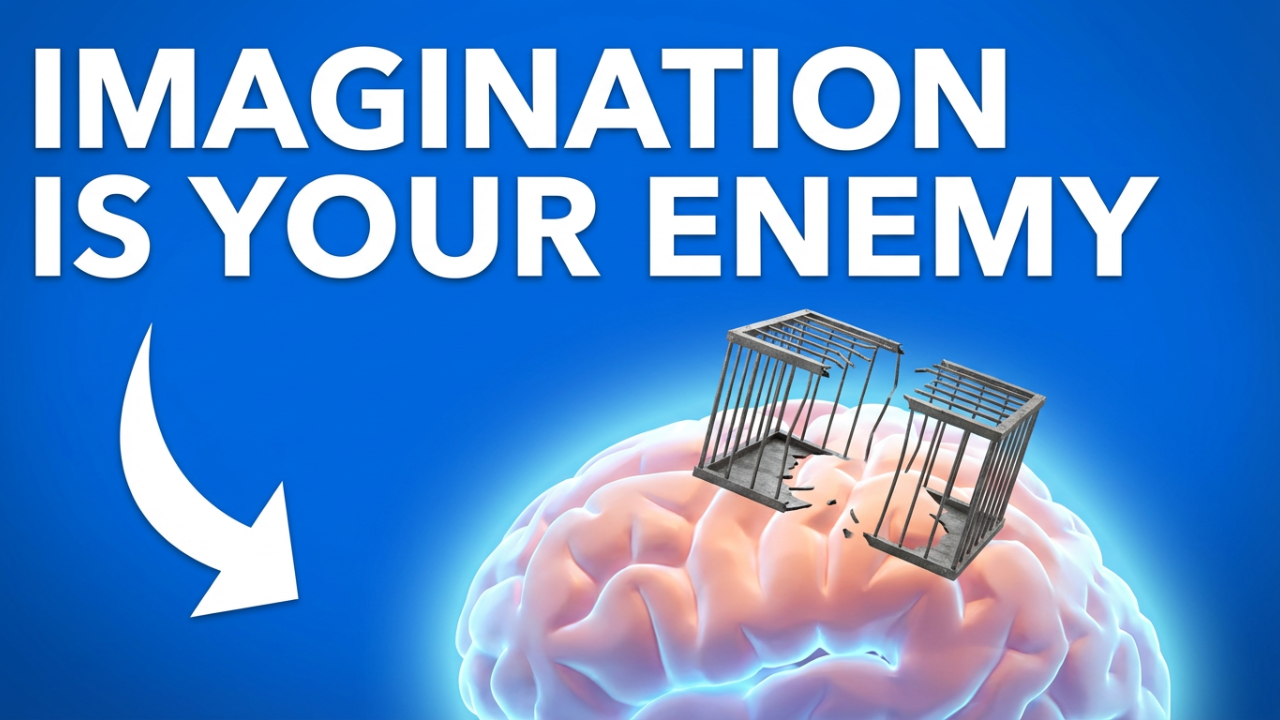
What if the most powerful tool you have, the very engine of your creativity and imagination, was also your biggest enemy? What if that infinite world inside your head wasn’t a playground for new ideas, but a prison you built for yourself?
For so many of us, our imagination has been hijacked. It’s become a machine that does nothing but crank out worst-case scenarios, replay our most embarrassing moments on a high-def loop, and build walls of “what-ifs” that stop us from ever taking that first step.
It’s that little voice whispering, “You’ll probably fail,” before you even start. It’s the movie that plays in your head of everything that could possibly go wrong, so vividly that you feel the anxiety in your bones as if it’s already happening. It’s the silent saboteur convincing you to stay small, play it safe, and let life-changing opportunities pass you by.
If you’ve ever felt like your own mind is holding you back from the life you actually want, you’re not alone. This kind of internal sabotage is a deeply human thing, but it’s not a life sentence. We’re going to show you how to take back control from that inner saboteur and turn it into your most powerful ally. We’re going to dismantle the anxiety machine and rebuild it into an engine for achievement.
Section 1: The Problem – The Prison of a Negative Imagination
Let’s be real. How many times have you had a great idea, a spark of inspiration, only to have your own mind snuff it out in minutes? You think, “I should start a business,” and your imagination immediately serves up images of bankruptcy, of failing in public, of telling your family you lost everything. You think about asking someone out, and your mind plays a 4K movie of the awkward rejection, the pitying looks, the walk of shame.
This isn’t just “negative thinking.” This is your imagination—a tool with incredible power—being turned against you. This negative imagination is what fuels self-sabotage, reinforces the belief that you aren’t good enough, and creates that constant loop of rumination that just kills your motivation and confidence.
It’s a vicious cycle: An opportunity appears. Instead of exploring the exciting possibilities, your imagination gets to work building elaborate scenarios of failure. It doesn’t just ask, “What if this goes wrong?” It shows you. It makes you *feel* the sting of rejection, the shame of failure, the panic of loss. This imagined reality feels so visceral, so real, that your nervous system responds as if it’s actually happening. In fact, studies show that a vividly imagined scenario can activate parts of your brain, like the fusiform gyrus, in a way that’s almost identical to living through the real event.
That fear of failure then triggers avoidance. You put off the project. You don’t send the email. You skip the networking event. The opportunity is lost, not because of anything in the real world, but because you were defeated by a ghost you created in your own head. You end up stuck, not because of your circumstances, but because of the architecture of your own thoughts.
Think about the sheer energy this takes. The hours spent worrying about a conversation that might never happen. The mental gymnastics of planning for every possible disaster. It’s emotionally exhausting to live in a state of high alert, fighting battles that only exist in your mind. This is more than a bad habit; it’s a huge misallocation of your most precious resource: your mental and creative energy.
For some, this goes even deeper, showing up as maladaptive daydreaming, where that inner world becomes so detailed and compelling that it starts to replace real-life interaction. It’s an escape that feels good for a moment, but it just widens the gap between the life you have in your head and the one you’re actually living. You might spend hours in a fantasy world where you’re the hero, you’re successful, you’re loved, because feeling that is easier than facing the real-world challenges of achieving it.
This isn’t a character flaw. It’s a feature of a system that’s just trying to protect you, but its software is outdated and buggy. To break free, we have to understand why our minds are so good at building these prisons in the first place. We have to look at the wiring.

SON OF LORD- Scientific Institute
Section 2: The Agitator – The Science of Why We’re Wired for Self-Sabotage
So why does our mind, this incredible tool, so often default to the negative? The answer is pretty simple: evolution. Our brains weren’t designed to make us happy; they were designed to keep us alive. For our ancestors, survival meant being hyper-aware of threats. The caveman who spent his time imagining all the ways a saber-toothed tiger could sneak up on him was a lot more likely to pass on his genes than the one who was blissfully picturing a successful hunt.
This is where the brain’s “negativity bias” comes from. Your mind is literally programmed to notice, react to, and remember negative things far more easily than positive ones. It’s a survival instinct that, in our modern world, has become a huge liability. The “threats” are no longer predators in the bushes; they’re the possibility of embarrassment, failure, or rejection. But your brain still reacts with that same primal fear.
This primal wiring shows up as automatic thought patterns called cognitive distortions. Think of them as bugs in your mental software—irrational ways of thinking that twist reality to fit a negative story. Spotting these distortions is the first step to disarming them.
Let’s break down the most common saboteurs:
1. All-or-Nothing Thinking (or Black-and-White Thinking):
This is the perfectionist’s curse. Things are either amazing or they’re a total failure. There’s no middle ground. You get a 98 on a test and obsess over the two questions you missed. You start a diet, eat one cookie, and figure, “Well, the day’s ruined. Might as well finish the box.” It stops you from seeing progress and makes tiny setbacks feel like the end of the world.
2. Overgeneralization:
This is when you take a single negative event and blow it up into a never-ending pattern of defeat. You get turned down for one job and your brain concludes, “I’ll *never* get a job. I’m unemployable.” A first date doesn’t go great, and you think, “I’m *always* going to be alone.” You’re taking one data point and treating it like a universal law, which erases all your past wins and future chances.
3. The Mental Filter:
This is like wearing a pair of glasses that filters out everything positive. You could get ten compliments on a project, but you’ll spend all night fixating on the one person who looked bored. This distortion systematically starves you of positive reinforcement, leaving you feeling like you’re just not good enough.
4. Jumping to Conclusions:
This one has two popular flavors: Mind Reading and Fortune Telling.
* **Mind Reading:** You just assume someone is thinking negatively about you, with zero actual evidence. Your boss seems quiet in a meeting, and you think, “She hates my idea.” A friend takes a while to text back, and you’re sure, “I must have offended them.” You’re acting like a psychic, and your predictions are always bad.
* **Fortune Telling:** You predict things will turn out badly and treat that prediction like it’s already a fact. This is the heart of anxiety. “I’m going to bomb this exam.” “This party is going to be so awkward.” You’re living in a miserable future that hasn’t even happened.
5. Catastrophizing:
This is fortune-telling with a Hollywood disaster movie budget. You take one small negative thing and blow it up into a life-shattering catastrophe. You make a typo in an email and your brain spirals: “My boss will see it. I’ll get fired. I’ll lose my apartment. My life is over.” This is the engine of panic attacks, taking a tiny spark and fanning it into an inferno.
6. “Should” Statements:
This is all about having rigid, unspoken rules for how you and other people “should” act. “I should be more productive.” “They should have known that would upset me.” “I shouldn’t feel this anxious.” These “shoulds” are just a way to punish yourself. They create a ton of pressure and guilt without actually helping you change.
These distortions all feed into a devastating cycle called **Rumination**. That’s when you obsessively replay problems and past mistakes over and over without ever finding a solution. It’s like a hamster wheel for your brain—you’re running and running but getting nowhere.
Here’s the critical part: you can’t just force these thoughts to stop. Trying *not* to think about a pink elephant just makes you think about it more. The negative pathways in your brain are like well-worn hiking trails. Trying to block them is like trying to dam a river with a few twigs. The pressure just builds until it breaks through.
So if we can’t stop it, what do we do? We don’t dam the river. We redirect it.
Section 3: The Pivot – Hijacking the Saboteur
This is the turning point. This is where we stop being a victim of our own mind and start becoming the one in charge. The secret isn’t to fight your imagination or to silence it. It’s to hijack it. You’re going to take the very same system that built your prison and use it to design your palace.
Imagination is just “mind-in-motion.” It’s the starting point for every invention, every piece of art, every great achievement in history. It’s neutral energy. Right now, that energy might be flowing down those old, worn-out channels of fear and self-doubt. Our job is to carve new ones—channels that lead to confidence, creativity, and action.
The goal isn’t to get rid of your “negative” imagination. That inner critic, the part of you that cooks up worst-case scenarios? It’s not a villain; it’s a misguided protector. It’s a primitive part of your brain trying to keep you safe from the “harm” of failure or rejection. It’s just using the only tools it knows: fear and avoidance. To fight it is to fight yourself.
Instead, we’re going to learn its language. We’ll acknowledge its intention, and then we’re going to give it a new job. We’re going to turn this saboteur into a strategic advisor. And it all starts with one simple, powerful act: awareness.
Section 4: The Solution Part 1 – Taming the Beast: Awareness and Reframing
Before you can redirect your imagination, you have to see it in action. Most of the time, these negative thought patterns run on autopilot. We don’t even notice them; we just feel the anxiety or sadness they leave behind. This first set of tools is all about turning on the lights and seeing the machine for what it is.
Step 1: The Power of Mindfulness and Observation
Mindfulness is simply the practice of paying attention to the present moment without judging it. It’s not about clearing your mind; it’s about changing your relationship with your thoughts. Instead of being *in* the river of your thoughts, getting swept away, you’re sitting on the bank, just watching it all flow by.
Here’s a simple way to start. Set a timer for five minutes. Sit quietly and just focus on your breath. Your mind *will* wander. That’s what minds do. When it does, your only job is to notice. “Ah, there’s a thought about that awkward thing I said yesterday.” Then, gently, and without beating yourself up, guide your attention back to your breath.
Every time you do this, you’re building a muscle. You’re strengthening your awareness. You start to see that your thoughts are not *you*. They’re just events passing through your consciousness, like clouds in the sky. This creates a tiny, crucial space between a negative thought and your reaction to it. In that space, you find your power to choose a different response.
Step 2: Identify and Label the Distortions
Once you can observe your thoughts, the next step is to name them. For one week, keep a “thought record” in a notebook or on your phone. Whenever you feel a spike of anxiety, sadness, or anger, write down the automatic thought that came just before it.
Then, look at our list of cognitive distortions. Can you label the thought? Was it catastrophizing? Mind reading?
For example:
* **Situation:** I sent an important email to my boss and haven’t heard back in a few hours.
* **Feeling:** Anxious and worried.
* **Automatic Thought:** “She must be mad at me. I bet I messed up the proposal. This is going to kill my chances for a promotion.”
* **Distortions:** Mind Reading, Fortune Telling, Catastrophizing.
Just labeling the thought is incredibly powerful. It takes it from being an objective truth and turns it into a predictable glitch in your thinking. You’re not a failure; you’re just having a moment of “All-or-Nothing Thinking.” It depersonalizes the negativity and gives you back a sense of control.
Step 3: Cognitive Reframing – The Art of the Counter-Argument
Now that you’ve spotted the distortion, it’s time to challenge it. Be a gentle but firm lawyer for yourself. Your negative thought is the prosecution making its case. Your job is to be the defense, presenting counter-evidence.
Using the example from before, you could ask:
* **What’s the evidence *for* this thought?** “Well… she hasn’t replied yet.”
* **What’s the evidence *against* it?** “She’s in meetings all day. She often takes a while to reply to emails that aren’t on fire. She told me last week she was impressed with my work. There are a dozen other explanations for the delay that have nothing to do with me.”
* **What’s a more balanced, realistic view?** “It’s likely she just hasn’t seen the email or is busy. I can’t know what she’s thinking, so assuming the worst is just stressing me out for no reason. I did good work on the proposal, and I’ll wait for her feedback.”
You’re not trying to force some fake, overly-positive thought. You’re just gently shifting toward a perspective that’s more realistic, balanced, and compassionate.
Step 4: Cultivate Self-Compassion
This might be the most important step of all. Self-criticism is the gasoline for a negative imagination. We think being hard on ourselves keeps us motivated, but research shows the opposite is true. Self-criticism just activates the brain’s threat-response, leading to fear and shutdown. Self-compassion, on the other hand, calms your nervous system and creates the psychological safety you need to actually grow.
Self-compassion just means treating yourself with the same kindness you’d give to a good friend. When you mess up or have a negative thought, instead of the usual “I’m such an idiot,” try this:
1. **Acknowledge the feeling:** “Wow, this really hurts.” or “I’m having a really hard time right now.”
2. **Connect to our shared humanity:** “It’s normal to make mistakes. Everybody feels this way sometimes. I’m not the only one.”
3. **Offer yourself kindness:** “May I be kind to myself right now.” Maybe put a hand over your heart. Speak to yourself in a gentle tone.
This practice directly fights the critical, isolating voice of the negative imagination. It tells your brain’s alarm system that you’re safe and that it can stand down. This creates the solid ground we need to start building something new.

This book is the Scientific Documentary of the Kingdom of God.
Section 5: The Solution Part 2 – Unleashing the Ally: Active Imagination & Visualization
Now that we have a foundation of awareness and self-compassion, we can switch from defense to offense. We’re going to actively use our imagination to build the future we want.
Technique 1: Carl Jung’s Active Imagination
This isn’t the same as just spacing out. While passive daydreaming is an unconscious escape, active imagination is a conscious, deliberate conversation with your unconscious mind. It’s a way to bridge the gap between your conscious self and the deeper parts of your psyche.
Here’s a simple way to start:
1. **Choose a Starting Point:** This could be an image from a dream, a strong emotion, or even your inner critic. Let’s use the inner critic.
2. **Find a Quiet Space:** Close your eyes, get relaxed, and imagine your inner critic. Don’t just think about it; let an image form. What does it look like? A grumpy old man? A shadowy figure?
3. **Engage in Dialogue:** Now, start a conversation. But here’s the key: you have to let the figure speak for itself. You’re not writing its script. You ask questions and then you listen for the answers that bubble up.
* **You:** “I see you. Why are you always telling me I’m going to fail?”
* **Listen.** The answer might surprise you. Maybe it’s, “Because if you don’t try, you can’t get hurt.”
* **You:** “So… you’re trying to protect me?”
* **Listen.** “Yes. Remember that presentation in middle school? The shame was awful. I won’t let that happen again.”
Through this dialogue, you start to see the motivation behind the sabotage. It’s not evil; it’s a wounded part of you trying to protect you in a clumsy way. By engaging with it, you can start to negotiate. You can thank it for its service, but explain that you’re stronger now and that you need to take risks to grow. This process transforms abstract anxiety into something you can understand and work with.
Technique 2: Visualization and Mental Rehearsal
While active imagination is about dialogue, visualization is about creating a detailed blueprint for success. Your brain often has trouble telling the difference between a vividly imagined experience and a real one. When you mentally rehearse something, you activate the same neural pathways you use when you physically do it. You’re basically priming your brain to succeed.
This is way more than just “thinking positive.” It’s a detailed, multi-sensory simulation. Let’s say you want to nail a big presentation.
1. **Get Specific:** Don’t just imagine “it went well.” Imagine the whole thing, from start to finish. Picture the room, the audience. What are you wearing? Feel the remote in your hand.
2. **Engage All Your Senses:**
* **Sight:** See yourself standing tall, making eye contact. See the slides looking crisp and professional.
* **Sound:** Hear your own voice, clear and steady. Hear the applause at the end.
* **Feeling:** Feel the calm confidence in your chest. Feel the solid ground under your feet. Feel the handshake from your boss afterward.
3. **Visualize the Process AND the Outcome:** Imagine yourself calmly handling a tough question. Picture feeling a brief moment of nerves, taking a deep breath to center yourself, and then crushing it. Then, feel the successful outcome—the sense of pride and accomplishment.
By doing this regularly, you create a “memory” of a future event. When the real thing happens, your brain goes, “Oh yeah, I’ve been here before. I know what to do.” It dramatically reduces anxiety and boosts performance for anything—a job interview, a tough conversation, or learning a new skill.
Technique 3: Dream Work
Your mind does some of its best work when you’re asleep. You can tap into this by setting an intention before bed. This is like asking your unconscious mind for help with a problem.
Before you go to sleep, just write down a question you’re wrestling with. “What’s my next career move?” or “How can I fix this conflict with my friend?” Keep a journal by your bed. When you wake up, before you check your phone, write down anything you remember. It could be a whole dream, a single image, or just a feeling.
Don’t worry about what it means right away. Just collect the data. Over time, you might start to see patterns, symbols, and creative solutions emerging from the deepest parts of your own mind.
Section 6: The Solution Part 3 – Integrating Imagination into Daily Life
These big techniques work best when they’re backed up by small, daily habits that keep your imagination pointed in the right direction. This is about creating an environment where a positive, creative imagination can thrive.
1. Playful & Embodied Practices
Your imagination isn’t just in your head; it’s in your body. Let’s use that.
* **Playful Daydreaming:** Set a timer for 10 minutes and let yourself daydream on purpose. Imagine a fun invention, the perfect vacation, or a conversation with a historical hero. The key is that it’s a conscious choice, not an unconscious escape. It gives that imaginative drive a healthy outlet.
* **Access Childhood Memory:** Think back to a time when you were a kid, totally lost in imaginative play. Try to reconnect with that feeling of freedom and possibility. It can help unlock a more fluid and less critical creative state.
* **Personify Your Muse:** Give your creative, positive imagination a name—your “Inner Ally” or your “Muse.” This simple trick can make it feel like a friend you can call on when you need a boost of inspiration.
2. Goal-Setting as an Imaginative Act
A clear, compelling goal is one of the best ways to crowd out negativity. It gives your mind a target to focus on, leaving less time for anxious loops. But don’t just set goals, set *vivid* goals.
* **Create a Vision Board:** This is a classic for a reason. Find images, words, and quotes that represent the life you’re building. Put it somewhere you’ll see it every day. It’s a form of passive visualization that constantly reminds your brain what to focus on.
* **Write a Letter From Your Future Self:** Write a detailed letter from you, five years in the future, describing your life. How do you feel when you wake up? What kind of work are you doing? Who are you spending time with? Read it regularly to connect emotionally with the future you’re creating.
3. Rewire Your Brain with Journaling
These are the daily exercises that keep your new mental channels clear.
* **Gratitude Journal:** Every day, write down three specific things you’re grateful for. This simple act forces your brain to scan for positives, directly fighting the negativity bias.
* **Success and Learning Journal:** At the end of each day, write down one thing you accomplished (no matter how small) and one thing you learned. This helps you see your own progress and frames “failures” as learning opportunities.
By integrating these small habits, you’re fundamentally changing your brain’s default settings. You are actively training your imagination to be your ally.
Conclusion
Your imagination is the most powerful force you own. It can build a prison of fear, or it can create a world of endless possibility. We’ve seen how this force, when left on autopilot, can trap us in anxiety and self-doubt, thanks to old survival wiring that’s out of date.
But the point of all this isn’t to crush that part of you. It’s to give it a new job.
By becoming aware of our thoughts, we learn to see them without being controlled by them. By challenging those cognitive distortions, we start to take apart the prison, brick by brick. And with tools like Active Imagination and Visualization, we go on offense—we start drawing the blueprints for the life we actually want, and we start building it.
This journey isn’t a quick fix; it’s a practice. There will be days when the old, negative patterns show up again. That’s okay. That’s part of it. The goal isn’t perfection; it’s awareness. It’s about having the tools to notice when you’ve drifted into that old river of fear, and the ability to gently guide yourself back to the bank.
The choice of what your imagination builds has always been yours. So start today. Start small. Observe one thought. Reframe one distortion. Visualize one tiny success. Take the first step, and reclaim your mind.