

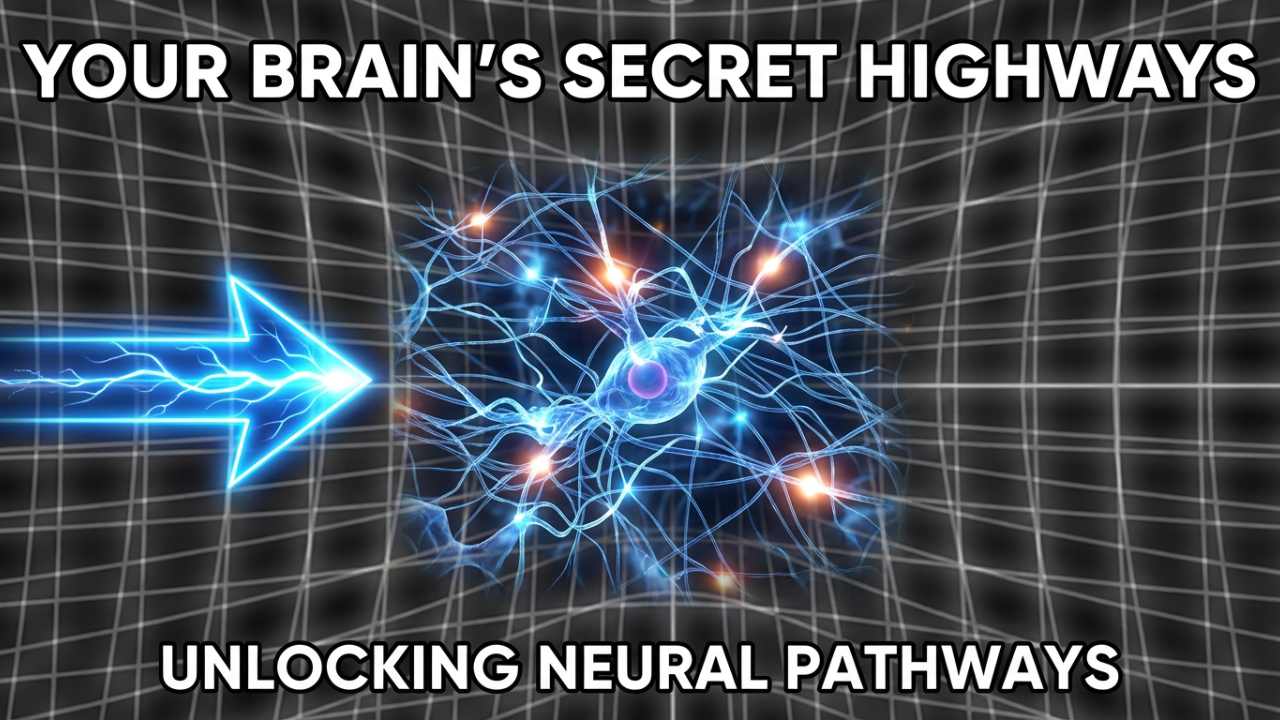
Do you ever feel like you’re trying to learn something new, but the information just won’t stick? You read the page, watch the tutorial, listen to the instructions… but it feels like you’re writing in sand, and the waves of time just wash it all away.
What if I told you this struggle has nothing to do with your intelligence or some fixed limit on what you can do? What if I told you that your brain is like a massive, sprawling city, and you… you have the power to be its chief architect? You can build superhighways for information that let you learn anything faster, master any skill, and even break habits that have held you back for years.
This isn’t science fiction; it’s neuroscience. And the blueprints for this whole project are something called neural pathways. In this article , we’re going to explore what neural pathways are, how they shape everything you do and think, and most importantly, how you can intentionally become the architect of your own mind. By the end, you’ll have a practical, science-backed toolkit to build a brain that serves you better.

SON OF LORD
Section 1: The Brain as a City of Information
Before we get into the deep science, let’s start with an analogy. Picture your brain as a vast, unmapped wilderness. When you’re born, it’s a landscape of pure potential—dense forests, open fields, and mountains, but with very few established routes.
Now, imagine every thought you have or action you take is like a single person setting out to cross this wilderness. The first time you try something new, like learning to ride a bike, it’s like an explorer hacking a path through a dense jungle. It’s slow, awkward, and takes a ton of effort. That first clumsy attempt creates a faint trail. It’s barely there, but it’s a start.
The next day, you try again. Another person—another attempt—walks down that same trail. It’s a little easier this time. With every practice session, more people walk this path. The trail becomes a dirt road. With enough traffic, the city planners—that’s you, by the way—decide to pave it.
If you keep using this skill, it becomes a central part of your life. That road gets widened into a four-lane boulevard. Eventually, it can become a massive superhighway, where information travels from A to B almost instantly, with zero conscious effort. Think about tying your shoes. You don’t even have to consider the steps anymore. The information is on a superhighway.
This is what a neural pathway is: a road for information inside your brain. And the process of building and reinforcing these roads is called neuroplasticity. For a long time, we thought the brain was basically fixed after childhood. We now know that’s completely untrue. Your brain is a dynamic, constantly changing city, and it can be rewired and reorganized your entire life. You are *always* the chief architect, whether you realize it or not.
Every second, new roads are being built, others are being reinforced, and some old, unused roads are being decommissioned. The question is: are you letting this construction happen randomly, or are you taking the architect’s seat and directing your mental city with intention? This video is about handing you the blueprints to do just that.
Section 2: The “What” – Deconstructing the Neural Pathway
So, let’s zoom in from our city view and look at the actual building materials. What are these roads really made of?
Your brain’s city has about 100 billion citizens. These are your neurons, or brain cells. Like people, they need to communicate to get anything done. A neuron has a main body and long, branching arms. One special, extra-long arm is called an **axon**. This is the primary road. A neural pathway is basically a bundle of these axons running together, forming what scientists call nerve tracts—the major highways of our brain city. When these axons are covered in a fatty substance called myelin, it acts like high-quality pavement on a superhighway, allowing electrical signals to travel incredibly fast and efficiently.
But the roads don’t just crash into the next neuron. Between the end of one neuron’s axon and the start of the next, there’s a tiny gap called a **synapse**. If axons are the roads, synapses are the intersections. This is where the actual transfer of information happens.
When an electrical signal travels down the axon and reaches the synapse, it triggers the release of chemical messengers called **neurotransmitters**. Think of them like little ferry boats that travel across the synaptic gap to deliver the message to the next neuron.
So when you learn something new, you’re not really growing billions of new neurons. You’re forging new connections and making these synaptic intersections more efficient. The first time a signal travels between two neurons, the connection is weak. The courier is slow, maybe gets a little lost. But with repetition, this connection gets stronger. This process is called **synaptic plasticity**, and it’s the absolute core of learning and memory.
Think about solving a new math problem. The signal is forging a new path, trying to find the right sequence of neurons. It’s a slow, bumpy ride. But as you practice, the synapses along that pathway become more sensitive. This strengthening process is known as **Long-Term Potentiation**, or LTP. It’s your brain’s way of saying, “Hey, this route is important. Let’s upgrade it.” With enough LTP, that pathway becomes so strong that the signal fires effortlessly. The thought becomes automatic.
This system is totally impartial; it just follows orders. If you repeatedly have anxious thoughts, you’re paving a superhighway for anxiety. If you consistently procrastinate, you’re strengthening the pathway for avoidance. But if you intentionally practice a new skill, focus on positive thoughts, or build a healthy habit, you are consciously directing your city’s resources to build the mind you actually want. You are the architect.
 This book is the scientific documentary of the Kingdom of God
Section 3: The “Why” – The Life-Changing Benefits of Being the Architect
Okay, so that’s the mechanics. But why should you care about being your brain’s architect? The real-world benefits can be life-changing.
**1. Learn Anything Faster**
This is the big one. Whether you want to learn a language, play an instrument, or code, the speed at which you learn is directly tied to how efficiently you build these pathways.
Imagine trying to learn Spanish. In the beginning, every word is a struggle. Your brain is hacking through that jungle. But by applying the principles of pathway construction, you’re deliberately sending more traffic down that trail. Soon, you’re not just translating words; you’re starting to *think* in phrases. That’s a sign the dirt road is becoming a paved street. Eventually, with consistent practice, you can converse fluently without conscious effort. You’ve built a superhighway. This applies to any skill, turning the frustrating climb of learning into a manageable construction project.
**2. Break Bad Habits and Build Good Ones**
Habits, good and bad, are just well-established neural superhighways. Think about mindlessly scrolling on your phone. The trigger—boredom, anxiety—sends a signal down a deeply entrenched highway that leads straight to that action. It’s automatic.
Trying to break a bad habit with willpower is like putting up a flimsy “Road Closed” sign on a ten-lane interstate. Traffic will just plow right through. The architect’s approach is different. Instead of just blocking the old road, you actively build a *new* one.
Let’s say every time you feel that boredom trigger, you consciously choose to do something else: read one page of a book or take three deep breaths. The first time will feel forced. The urge to get back on that familiar superhighway will be immense. But every time you choose the new path, you strengthen it. At the same time, the old superhighway gets less traffic and begins to fall into disrepair. The brain, being ruthlessly efficient, doesn’t like maintaining unused roads. Over time, it starts to decommission that old highway in a process called synaptic pruning. The new, healthier pathway becomes the default.
**3. Overcome Mental and Emotional Ruts**
Our thought patterns are just habits of the mind. Cycles of anxiety or negative self-talk are incredibly powerful neural pathways. When something stressful happens, the brain often shunts the signal onto the “anxiety superhighway” because it’s the most established route.
By becoming the architect, you can actively build alternative routes. This is the foundation of therapies like Cognitive Behavioral Therapy (CBT). You learn to spot the trigger—the on-ramp to the anxiety highway—and consciously reroute the signal. You might build a “rational thought” pathway or a “mindfulness” pathway. With practice, you give your brain more options. When stress hits, it no longer has just one road to take. This gives you profound control over your emotional landscape. You’re not a victim of your brain’s traffic patterns; you’re the traffic controller.
**4. Enhance Your Physical Performance**
Neural pathways are critical for movement. A gymnast’s tumbling pass or a dancer’s graceful turn are the result of extraordinarily well-developed motor pathways. The brain sends signals to the muscles with incredible speed and precision because those pathways have been perfected through thousands of hours of repetition.
Recent studies have even highlighted how gentle, focused movements, like those in the Feldenkrais Method, can rewire the brain to relieve chronic pain and improve physical function by creating more efficient movement patterns. When you learn a new physical skill, you are literally sculpting your brain’s motor cortex. By focusing on quality movement and deliberate practice, you build cleaner highways, leading to better coordination and what we call “muscle memory”—which is really just a perfectly built neural superhighway.
Section 4: The “How” – 3 Steps to Become the Architect of Your Mind
So, how do you actually pick up the tools and start building? The process breaks down into three key steps.
**Step 1: Laying the Foundation – The Power of Focused Attention**
You can’t build a pathway if your brain doesn’t know where to build. **Focused attention** is the spotlight that tells your brain, “Build here.”
Neuroscientists like Dr. Andrew Huberman emphasize that real neuroplasticity doesn’t happen without focus. When you’re intensely focused on one thing, your brain releases neurochemicals like acetylcholine and norepinephrine. Acetylcholine acts like a spotlight on the specific neurons you’re using, while norepinephrine acts like an alarm bell, signaling that this connection is important and needs to be saved.
This is why multitasking is the enemy of learning. If you try to listen to a lecture while scrolling on your phone, you’re forcing the construction foreman to run between two job sites. No significant work gets done at either.
So, how do you apply this?
* **Embrace Single-Tasking:** When you learn, give it your undivided attention. Close the other tabs. Put your phone in another room. This creates the optimal neurochemical state for brain change.
* **Use Time-Blocking:** Work in focused, uninterrupted blocks. The Pomodoro Technique—25 minutes on, 5 minutes off—is effective because it demands a short burst of intense focus. Many people also find that 90-minute blocks work well, aligning with our natural energy cycles.
* **Generate Interest:** Attention follows interest. Before you start, remind yourself *why* this is important to you. This conscious motivation naturally commands your focus.
Without focus, any effort is built on unstable ground. You can repeat something a thousand times distractedly, and the pathway will remain a flimsy dirt road.
**Step 2: Paving the Road – The Law of Repetition and Consolidation**
Once your focus has marked the route, it’s time to pave it through **repetition**.
As we said, every time you use a pathway, you strengthen it through LTP. The first time is a trail. The tenth time is a path. The thousandth time is a paved road. But it’s not just about brute-force repetition.
* **Embrace Spaced Repetition:** Cramming is a terrible long-term strategy. Studying for one hour on four separate days is far more effective than studying for four hours straight. This is because of memory consolidation. Spacing out your sessions gives your brain time to solidify the new connections. It’s like letting a layer of asphalt dry before adding the next one.
* **The Critical Role of Sleep:** Sleep is not downtime. It’s the brain’s graveyard shift, where the most important construction work happens. While you sleep, your brain replays the neural activity from the day, strengthening the new pathways you marked as important and pruning away unused connections. Without enough quality sleep, you’re essentially firing your nighttime construction crew.
* **Incorporate Mistakes and Active Recall:** Passive re-reading isn’t very effective. **Active recall** is where the magic happens. This means forcing your brain to retrieve information without looking. Quizzing yourself or explaining a concept to someone else are great forms of active recall. The struggle to retrieve information is a powerful signal to strengthen a pathway. And making mistakes is incredibly valuable. When you get something wrong and then correct it, your brain flags the moment, increasing attention and enhancing the learning that follows.
**Step 3: Building the City – Making Meaningful Connections**
A superhighway to an empty field is useless. An effective neural pathway connects to other pathways, forming a rich, interconnected network. This final step is about weaving new information into what you already know.
* **Use Analogies and Metaphors:** This whole video is built on the “brain as a city” analogy. Why? Because you already have a strong network for the concept of a “city.” When you learn something new, ask yourself: “What is this like?” Creating your own analogies builds powerful mental bridges.
* **The Feynman Technique:** Named after the physicist Richard Feynman, this is a brilliant way to build deep connections. First, choose a concept. Second, try to teach it to a child using simple language. Third, identify your knowledge gaps—wherever you struggle to explain it simply is where you need to go back and learn more. Finally, organize and simplify it. You’ll have built a robust, interconnected understanding.
* **Embrace Novelty and Emotion:** The part of your brain crucial for memory, the hippocampus, is highly responsive to novelty and emotion. When you learn in a new environment or attach a strong emotion to information, your brain releases dopamine, which acts like a “save button” for that memory. This is why you remember where you were during a major life event but not what you had for lunch last Tuesday. You can leverage this by making learning more engaging—study in a new cafe, use colored pens, or connect the material to a personal story.
By focusing your attention, using intelligent repetition, and building rich connections, you are no longer letting your brain develop on autopilot. You are doing the deliberate, rewarding work of a master architect.
Conclusion
We started by picturing the brain as a city. We saw how our thoughts and actions forge paths that can grow into superhighways. And we’ve learned these aren’t just ideas; they’re real, physical connections between neurons, shaped by a process called neuroplasticity.
Being the architect of this city means you can learn faster, break bad habits, and gain real control over your emotional well-being. This isn’t just a metaphor; it’s a biological reality. Your brain’s ability to change is the single greatest tool you have for personal growth, and it’s with you your entire life.
The blueprints are simple:
First, **Focused Attention**: Pointing your mental spotlight to tell your brain exactly where to build.
Second, **Repetition and Consolidation**: Paving the road through deliberate practice, spaced out over time, and supercharged by sleep.
And third, **Making Connections**: Weaving new roads into the existing grid of your knowledge with analogies and emotion.
The truth is, you’ve been the architect of your mind your whole life. Every habit, belief, and skill is a structure you’ve built. The only question is whether you’ll continue to build on autopilot or step into your role, pick up the tools, and build with purpose. The power to rewire your brain is right here, right now.
Start with one road. Pick one small skill or one tiny habit. Lay the foundation with your focus. Pave it with your practice. And watch as you, the architect, transform your world, one neural pathway at a time.