

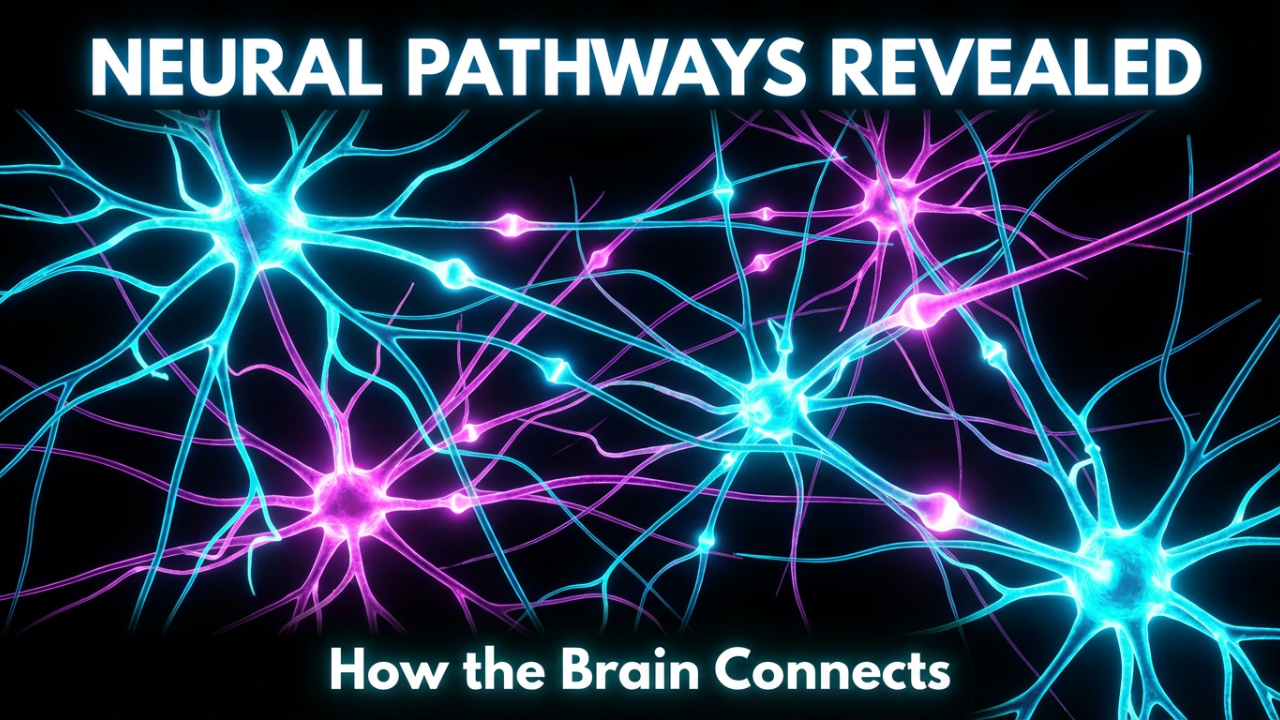
How a Neural Pathway Is Formed from Birth to Adulthood. Have you ever wondered how you became *you*? How you learned to walk, talk, solve problems, or feel a certain way about a specific song or the smell of rain?
What if I told you the blueprint for your entire life—your personality, your talents—was furiously built before you could even say a full sentence? And what if I told you that the *same* process that built your infant brain is still at work right now? A silent, powerful force that lets you learn, change, and even reinvent yourself at any age.
Today, we’re exploring how a single neural pathway gets built, from the quiet of the womb to the complexity of adult life. We’ll see how this process shapes who we are, and more importantly, how you can grab the controls and use this power for the rest of your life.

Section 1: The Blueprint Before the Building: The Prenatal Brain
Our story doesn’t start at birth. It starts long before, in the protected world of the womb. Here, the most complex structure in the known universe begins to assemble itself, following a genetic guide refined over millions of years.
It all kicks off with a process called neurogenesis—literally, the birth of neurons. Around 42 days after conception, your brain’s story truly begins. A delicate sheet of embryonic tissue has already folded into the neural tube, the primitive forerunner to your entire central nervous system. By about day 28, this tube closes, sealing the fate of the cells inside and establishing the grand highways of the brain that will last a lifetime.
Inside, progenitor cells—the brain’s stem cells—start dividing like crazy. Think of it as a cellular big bang. These cells are the ancestors of every single one of the roughly 86 billion neurons you’ll have. In these first stages, the new neurons are like workers waiting for a job assignment. They don’t have a purpose yet, just pure potential.
Once born, these new neurons go on a remarkable journey: they migrate. Guided by a complex cocktail of molecular signals—like microscopic breadcrumbs—they travel from their birthplace to their final destinations. Some form the brainstem, the ancient core handling basic life functions. Others go to the limbic system, the seat of emotion. And many take the longest trip to the cerebral cortex, the wrinkled outer layer that will one day house your consciousness, thoughts, and creativity.
This migration is a masterpiece of biological engineering. Early neurons build a temporary scaffold, allowing the billions of neurons that follow to travel along an established highway system. It’s an inside-out construction job, where later-born neurons climb past the older ones to form the outer layers. Even before birth, the first, most basic pathways start to form. By mid-gestation, for instance, the critical thalamocortical pathway is being established—a superhighway connecting the brain’s sensory relay station (the thalamus) to the cortex. This is the very connection that will one day let you feel the warmth of the sun or hear a loved one’s voice.
When these neurons reach their new neighborhoods, they don’t just stop. They start to mature, sprouting the intricate, tree-like branches that will define them. They extend a long transmitter cable called an axon, which has a dynamic “growth cone” at its tip that literally ‘feels’ its way through the microscopic environment, searching for its partners. At the same time, they grow a dense forest of shorter branches called dendrites, the receivers that gather incoming signals.
The goal? To form synapses—the microscopic gaps where neurons exchange information using chemical messengers. This process, synaptogenesis, starts before birth. Axons find their target dendrites, and a connection is made. It’s like a tentative handshake, the first whisper of communication. These early connections aren’t random; they’re laying the groundwork for everything to come.
Think of the prenatal brain as a city being built in the dark. The genes are the blueprints, the neurons are the workers, and the axons and dendrites are the roads. Before the lights are ever turned on—before the first sight, sound, or touch from the outside world—the fundamental layout is in place. It’s a structure of pure potential, waiting for the one thing that will bring it to life: experience.
Section 2: The Explosive Beginning: The World of the Newborn
The moment of birth is a neurological spectacle. The brain, which has been developing in a quiet, muffled environment, is suddenly flooded with an overwhelming rush of new information. Light, sound, touch, temperature, smell—every sensation is a jolt of electricity surging through the new circuits. This isn’t chaos; it’s activation.
The statistics of what happens next are staggering. At birth, a baby’s brain is about a quarter of its adult size. It will double in size in the first year alone. By age three, it’s about 80% of its adult size, and by five, it’s nearly fully grown at 90%. But it’s not just about size. The real story is in the connections. In the first few years of life, your brain was forming more than one million new neural connections *every single second*. No, that’s not a typo. One million per second. It’s the most intense period of brain development in a human life.
This period of “synaptic exuberance” is a frantic, glorious explosion of growth. The brain is over-producing connections, creating a dense jungle of potential pathways. Every new experience—a face, a sound, a touch—triggers a cascade of activity. Each time one neuron fires and talks to another, the connection between them is strengthened.
This is where the idea of “serve and return,” from Harvard University’s Center on the Developing Child, is so critical. An infant ‘serves’ by reaching out—a babble, a look, a gesture. A caregiver ‘returns the serve’ by responding—making eye contact, talking back, smiling.
Imagine a two-month-old babbling at her father. That’s the serve. He smiles, leans in, and babbles back. That’s the return. In that simple moment, a universe of neurological activity is unfolding. The neural pathways for social connection, emotional regulation, and language are being physically built and reinforced. The neurons that fired when she saw his smile are forming stronger bonds. These back-and-forth interactions, repeated thousands of times, literally build the architecture of the developing brain.
This whole process follows a “bottom-up” principle. The brain builds from the simplest circuits to the most complex. First up are the circuits for basic senses like vision, hearing, and touch. Then, built on that foundation, come the more complex circuits for language and higher thinking. You can’t build the second story of a house without a solid foundation, and you can’t develop complex skills without robust sensory pathways. Early experiences aren’t just making memories; they’re physically constructing the foundation for all future learning and health.
But this explosive growth can’t last. The brain is an energy hog. In the first year, it uses a shocking 60% of the body’s total nutrition, compared to about 20-25% for an adult. To become the efficient organ it needs to be, the brain has to make some cuts. It has to shift from creation to refinement. This brings us to a crucial process: the elegant, ruthless art of pruning.

This book is the scientific documentary of the Kingdom of God
Section 3: The Critical Window and the Art of Pruning
Imagine trying to forge a path through a dense forest. At first, you might hack away in a hundred different directions. This is the infant brain, a tangle of millions of potential trails. But to create a usable path, you have to pick the best route and walk it over and over. As you do, the path becomes clearer and easier to travel, while the unused trails slowly vanish back into the undergrowth.
This is exactly what happens in your brain during childhood in a process called synaptic pruning. Its guiding principle is simple: “use it or lose it.” The connections that are used often through repeated experience get stronger, faster, and more permanent. The connections that aren’t used get weak and are eventually eliminated.
This pruning might sound like a loss, but it’s actually a vital move toward a more powerful and efficient brain. It’s like a sculptor chipping away marble to reveal the statue inside. By clearing out the noisy, redundant connections, the brain can focus its resources on the pathways that matter most, based on a child’s unique environment and experiences. The result is a network of lightning-fast superhighways for information.
Different skills have different “critical periods,” or sensitive windows, when the brain is most open to learning. The window for visual development, for example, peaks around six months. The window for language is a bit longer, peaking in the first few years. That’s why young children seem to absorb new languages like sponges—their brains are primed to wire themselves for whatever sounds and rules they’re exposed to.
Then there are the higher-order functions, like problem-solving and empathy. Their critical periods extend further into childhood. This is where experiences like free play are neurologically essential. When a child builds a tower of blocks, they’re not just having fun; they’re conducting physics experiments, developing fine motor control, and learning cause and effect. When they have to negotiate who gets which block, they’re building the circuits for social skills and empathy.
These experiences of building and pruning establish the brain’s core architecture. A child in a safe, responsive, and stimulating environment is building a sturdy, well-wired neurological home.
On the flip side, a child experiencing “toxic stress”—prolonged abuse, neglect, or chaos without a supportive adult—is building their brain on a weak foundation. The body’s stress response system produces a hormone called cortisol. When the system is constantly activated, the brain is bathed in high levels of cortisol, which can disrupt its developing architecture. The brain becomes wired for danger, strengthening circuits for fear while weakening those for planning and reasoning. It builds a house designed for constant threat.
This critical window doesn’t just slam shut on a specific birthday. Recent research from the University of Cambridge suggests the “childhood epoch” of this network-building lasts until about age nine. After that, the brain shifts into a new phase, getting ready for the next stage of life.
Section 4: The Adult Brain and the Dawn of Neuroplasticity
For a long time, the prevailing view in neuroscience was that the brain had a deadline. You went through the explosive growth of infancy, the critical pruning of childhood, and by your early twenties, the structure was largely set in stone.
We now know this is profoundly wrong.
The brain isn’t set in stone. It’s more like a dynamic, living sculpture that is constantly, subtly reshaped by your thoughts, actions, and experiences. This lifelong ability to reorganize its own structure and connections is called neuroplasticity.
So what does the adult brain’s landscape look like? That same Cambridge study found that the “adolescent phase” of brain refinement actually extends, on average, until age thirty-two. During this time, the brain is actively fine-tuning its communication networks. The white matter, made of myelinated axons that form the brain’s superhighways, continues to develop, allowing signals to travel faster and more efficiently.
Then, around age 32, the brain shifts into what the researchers call “adult mode,” the longest and most stable phase of our neural lives. But stable does *not* mean static. This is where neuroplasticity takes center stage.
So what *is* neuroplasticity, really? The most famous saying in the field comes from Donald Hebb: “Neurons that fire together, wire together.” This simple phrase captures the whole idea.
Think about that forest path again. In adulthood, you’re not hacking a thousand new trails at once. You have a well-established network of roads. But what if you want to build a new one? What if you decide to learn to play the guitar?
The first time you try to form a G-chord, it’s awkward. Your fingers feel clumsy. In your brain, there’s no pre-built “G-chord” pathway. The signal is weak, like a whisper across a crowded room.
But you try again. And again. Each time you practice, the specific network of neurons for that action fires together. And as they fire together, the connections between them get a little stronger and more efficient. Over time, with practice, the brain physically changes. The weak whisper becomes a clear command. You’ve carved a new neural pathway into your brain.
This happens constantly. When you learn a new fact, you strengthen connections in your hippocampus. When London taxi drivers had to memorize the city’s 25,000 streets, researchers found their posterior hippocampus—a region for spatial memory—had physically grown to accommodate the knowledge.
This is the power of neuroplasticity. It’s the biological basis for learning and habits. But it’s a double-edged sword. Just as you can build positive pathways, you can reinforce negative ones. If you repeatedly react to stress with anxiety, you’re strengthening the pathway for anxiety. The pathway becomes a deep, comfortable rut.
But the beautiful truth is that no rut is so deep that you can’t carve a new trail. You’re not just a product of your brain; you’re its chief architect. And with the right tools, you can become a master builder.
Section 5: The How-To: Taking the Controls of Your Brain
Understanding this journey isn’t just a cool science lesson. It’s the key to your own growth. Knowing your brain is constantly remodeling itself based on your actions gives you an incredible sense of agency. You’re the driver. So, how do you take the wheel?
It comes down to a few core principles: focused attention, deliberate repetition, and embracing challenge.
First, let’s talk about learning a new skill. It all starts with intense focus. When you’re truly focused on one thing, your brain releases chemicals that act like a spotlight, highlighting the exact circuits you’re trying to use. Multitasking is the enemy of neuroplasticity. If you’re trying to learn while scrolling your phone, you’re diffusing that spotlight and not giving your brain the clear signal it needs to change.
Next is repetition, but it has to be *deliberate* practice. This means paying close attention to your mistakes. When you play the wrong note, mispronounce a word, and you stop, recognize the error, and correct it, you’re sending a powerful signal to your brain. That moment of error-and-correction is a neurological goldmine. It tells your brain, “Whoops, that wasn’t right. Let’s adjust the wiring here.” Celebrating your mistakes is the fastest way to build accurate pathways. They’re the signposts of learning.
Now, let’s apply this to bad habits. Here, you’re not just building a new road; you’re trying to close an old, busy highway. Research from UCLA Health suggests a powerful trick: frame your goal in terms of what you *will* do, not what you *won’t* do. Instead of “I won’t eat junk food,” which actually focuses your brain on junk food, try “I will eat a healthy snack at 3 PM.” You’re giving your brain a clear, alternative path to build.
The key is to identify the cue that sends you down the old path. When the 3 PM energy slump hits (the cue), instead of reaching for the cookie (the old routine), you reach for an apple (the new routine). The first few times will feel hard. You’re forcing your mental traffic onto a new, unpaved trail. But every time you succeed, you strengthen that new path. Every time you avoid the old one, you starve it of the activity it needs to survive. Over time, the new road becomes the default.
Finally, all of this is powered by your mindset. The belief that you *can* change is a catalyst for change. This is what Stanford psychologist Carol Dweck calls a “growth mindset.” It’s the understanding that your abilities aren’t fixed. When you believe your brain can grow, you’re more likely to embrace the challenges needed to trigger neuroplasticity. A challenge is no longer a threat; it’s an opportunity for your brain to get stronger.
Conclusion
We’ve traveled from the prenatal brain, where genes guided billions of migrating neurons, to the newborn’s world, where over a million connections formed every second. We saw how the “use it or lose it” rule of childhood sculpted a unique brain, guided by the “serve and return” dance of early relationships.
We learned this process never really stops. The adult brain is profoundly malleable. We discovered neuroplasticity—the superpower that allows us to consciously change our own minds.
By using focused attention, learning from our mistakes, and strategically building new habits, we can become the active architects of our neural landscape. The process that took you from a helpless infant to the person you are today is still at your command. You have the power to learn that skill, break that habit, and become more *you*. The paths of your past have shaped you, but the paths you choose to walk today will define your future. Change isn’t just possible; it’s the fundamental language of your brain.