

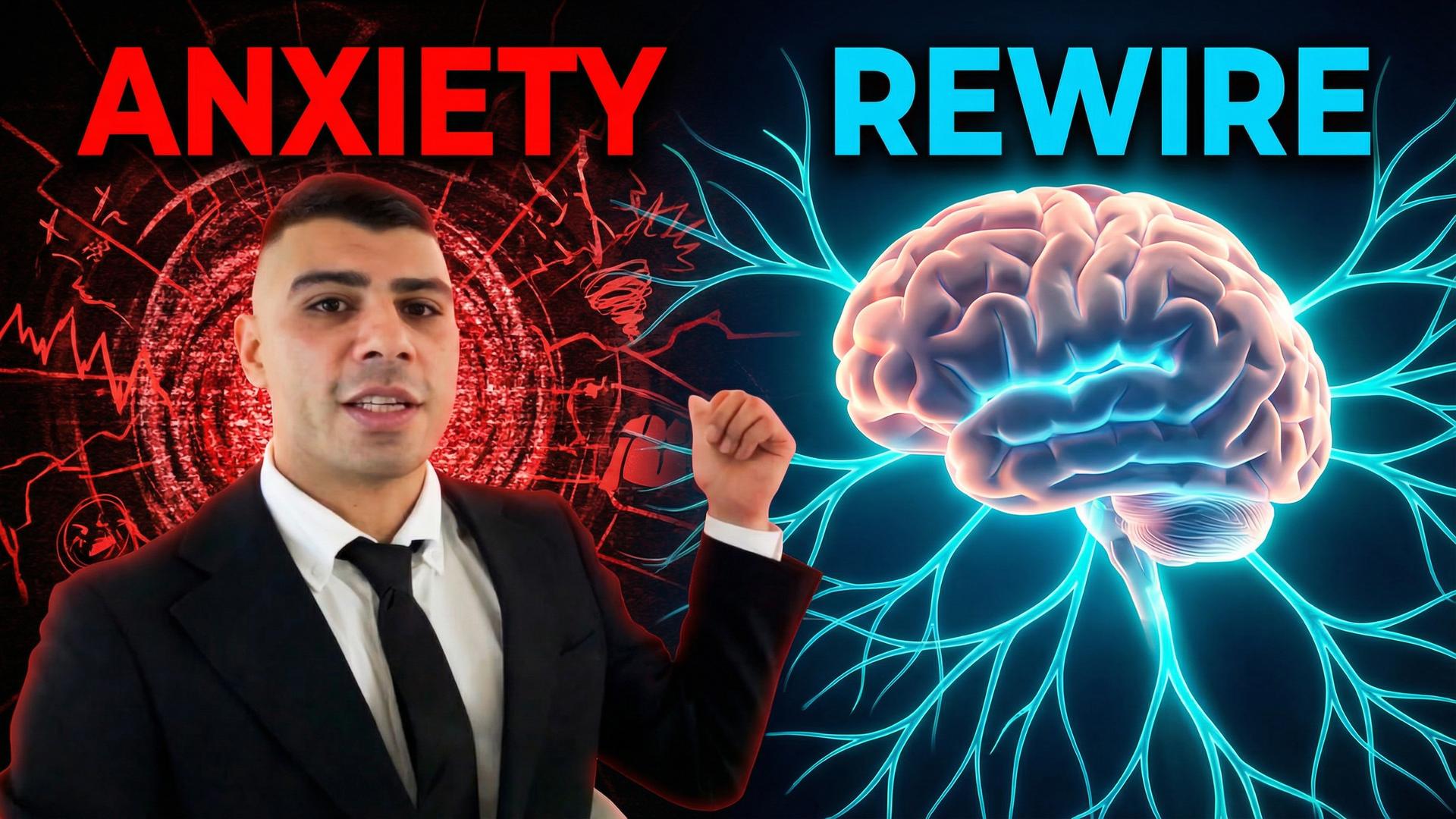
Does your brain ever feel like it’s stuck in a loop of worry? Like it’s constantly scanning for threats, leaving you in a state of high alert you just can’t switch off? You’re exhausted, on edge, and feel trapped in a cycle of fear that seems to call the shots. It’s as if your brain is just wired for anxiety, and you’re along for the ride.
But what if that wiring isn’t permanent? What if you could scientifically rebuild your brain’s pathways, quiet the constant alarms, and break that cycle of fear for good? This isn’t wishful thinking—it’s based on the science of neuroplasticity. Your brain has an incredible ability to change, adapt, and reorganize itself based on your thoughts and experiences. It’s not a fixed machine. It’s a dynamic, living network that you can actively sculpt. In this guide, I’m not just going to tell you that change is possible; I’m going to give you a step-by-step blueprint to do it. We’ll look at how anxiety hijacks your brain and then explore seven powerful, evidence-based techniques to take back control. This is your guide to rewiring your brain and shifting your default state from threat to calm, confidence, and control.
Let’s start with a simple but profound truth: anxiety is not a character flaw. It’s a learned brain pattern. For millions of years, our brains evolved a powerful survival mechanism: the fight-or-flight response. This system was designed to protect us from immediate, life-threatening dangers, like a predator in the bushes. The problem is, in our modern world, that same ancient alarm is being triggered by work emails, traffic jams, and even our own negative thoughts.
Your brain can’t tell the difference between a real tiger and a perceived one. When it senses a threat, a small, almond-shaped region called the amygdala takes over. Think of the amygdala as your brain’s internal alarm system. Its job is to sound the alarm at the first hint of danger, flooding your body with stress hormones like adrenaline and cortisol. This is what makes your heart race, your palms sweat, and your mind go blank. It’s a system designed for short, intense bursts of action.
But what happens when that alarm gets stuck in the ‘on’ position? What happens when it becomes so sensitive that it goes off not just for real fires, but for every piece of burnt toast? That’s chronic anxiety. Through repetition, your brain has learned to be anxious. The neural pathways tied to fear and worry have become so well-traveled they’re no longer just paths—they’re superhighways. Every time you avoid something you fear or get lost in a spiral of worry, you’re reinforcing that superhighway. You’re telling your brain, “Yep, that was a real threat. Be even more vigilant next time.” Avoidance and rumination are the fuel that keeps the anxiety engine running. This isn’t your fault; it’s just biology. But understanding how it works is the first step to reversing it.

Section 1: The Anxious Brain – A Deeper Dive into the Hijacking
To truly rewire your brain, you first need to understand the architecture of the anxious brain. It’s not just a feeling; it’s a physical and chemical state. When anxiety becomes chronic, it doesn’t just pass through your brain—it reshapes it.
At the center of it all is the hyperactive amygdala. We’ve called it an alarm system, but in an anxious brain, it’s an over-caffeinated security guard seeing threats everywhere. Neuroimaging studies show that in people with anxiety, the amygdala is often more reactive. It’s quicker to fire and slower to calm down. While some studies find it can be larger, the most consistent finding is its hyperactivity. This is a direct result of the brain learning from past experiences. If you had a panic attack in a grocery store, your amygdala logs that. The next time you even *think* about going to the store, the amygdala shouts, “Warning! We’ve been here before. It was dangerous!” and triggers the alarm, whether the threat is real or not.
But the amygdala doesn’t act alone. It’s in a constant tug-of-war with another part of your brain: the prefrontal cortex. Located right behind your forehead, the prefrontal cortex is the “CEO” of your brain. It handles rational thinking, problem-solving, and emotional regulation. It’s the part that should be able to look at the amygdala’s alarm and say, “Hang on, that’s just burnt toast. We’re safe. Stand down.”
In an anxious brain, however, that communication line breaks down. Chronic stress weakens the connection between the rational prefrontal cortex and the emotional amygdala. It’s like the CEO is being drowned out by a screaming, panicked intern. Your ability to logically assess a situation gets sidelined, leaving the hyper-vigilant amygdala in charge. Studies have confirmed this imbalance, showing that therapies like Cognitive Behavioral Therapy (CBT) work by helping restore this connection.
This problem is compounded by another region: the hippocampus. The hippocampus is vital for memory, especially for putting memories into context. It helps you remember that while you once felt anxious in a crowd, you’ve also been in many crowds where you were perfectly fine. But chronic stress is toxic to the hippocampus. A constant flood of cortisol can cause it to shrink, a finding most pronounced in severe, prolonged conditions like PTSD. A less effective hippocampus has a harder time creating new, safe memories and putting old fears in their proper place. This creates a vicious cycle: anxiety impacts the hippocampus, and a weakened hippocampus makes it harder to regulate anxiety.
Finally, there’s the brain’s inherent “negativity bias.” For our ancestors, it was far more important to remember the one time they saw a predator by the waterhole than the ninety-nine times they didn’t. Our brains evolved to be like Velcro for negative experiences and Teflon for positive ones. Anxiety exploits this bias to the extreme, training your brain to constantly scan for, focus on, and remember the negative.
This is the state of the anxious brain: an overactive amygdala, an under-communicating prefrontal cortex, an impacted hippocampus, and a powerful negativity bias, all feeding each other in a loop. It’s a formidable system, but it’s not permanent. The very same force that created these pathways—neuroplasticity—is the force we’ll use to build new ones.
Section 2: The Solution – Introducing Your Superpower, Neuroplasticity
If that last section felt a little grim, this is where the hope comes in. This is where you get your power back. The key to breaking free from anxiety is a remarkable scientific principle called neuroplasticity.
Neuroplasticity is simply the brain’s ability to reorganize itself in response to your experiences. For a long time, we thought the adult brain was more or less fixed. We now know that’s completely false. Your brain is constantly changing and adapting throughout your entire life. Think of your brain’s neural pathways like trails in a forest. When you first think a thought or try a new action, it’s like hacking a small path through the undergrowth—it takes effort. Anxious thoughts and behaviors have, over time, turned their trails into wide, paved, eight-lane superhighways. The signals travel down them quickly and automatically.
Neuroplasticity means you can choose to stop taking that superhighway. You can start carving a new path. At first, this new path—of calm, of rational thought—will feel overgrown and difficult. You’ll have to consciously choose it, again and again. But every time you do, the path gets a little clearer and a little easier to walk. With consistent practice, this new path becomes your brain’s new default. Meanwhile, the old anxiety highway, from disuse, starts to grow over. The connections weaken.
It’s important to know that we don’t have a “delete” button for old fears. Rewiring the brain isn’t about erasing the old anxiety circuits; it’s about building new, stronger, competing circuits that become more dominant. The old fear might still be there, but its voice gets drowned out by the new, powerful voice of calm you’ve intentionally built.
So how do we build these new pathways? With a protein called Brain-Derived Neurotrophic Factor, or BDNF. Scientists often call BDNF “Miracle-Gro for the brain.” BDNF supports existing neurons and encourages the growth of new ones. It’s the biological engine of neuroplasticity. When you do certain activities, your brain releases BDNF, which helps strengthen the neural connections you’re using in that moment. Many of the techniques we’re about to discuss directly boost BDNF levels.
This isn’t a metaphor; it’s biology. When you practice these techniques, you are physically changing your brain. MRI scans have shown measurable changes in the brains of people who practice mindfulness or undergo therapy. For instance, research has shown that after just a few weeks of practice, the amygdala’s reactivity can decrease, while the prefrontal cortex can become denser. This is physical proof of rewiring. Your thoughts and actions create structural changes in your brain. Now, let’s learn how to direct that change.
Section 3: The Blueprint – 7 Scientific Steps to Rewire Your Brain
Welcome to the practical core of this guide. These aren’t quick fixes but consistent practices that will physically reshape your brain over time. Remember, every time you practice one of these techniques, you’re laying another stone on your new neural pathway of calm.
**Step 1: Mindful Meditation – Training the Brain’s “CEO”**
If there’s a single foundational practice for rewiring the anxious brain, it’s mindfulness meditation. Mindfulness is simply the practice of paying attention to the present moment on purpose, without judgment. For an anxious mind that’s constantly lost in future worries or past regrets, the present moment is a sanctuary.
Here’s the neuroscience: Regular meditation does two incredible things. First, it quiets the amygdala, making your brain’s alarm system less trigger-happy. Second, and maybe more importantly, it strengthens the connection between the prefrontal cortex and the amygdala. It thickens the gray matter in the prefrontal cortex, essentially giving the “CEO” of your brain a stronger voice to regulate your emotions. You are literally training your brain to be less reactive.
How to do it (The Step-by-Step):
1. **Find a Quiet Space:** Sit comfortably in a chair with your feet on the floor or on a cushion. Keep your back straight but not stiff.
2. **Set a Timer:** Start with just 5 to 10 minutes a day. Consistency is way more important than duration.
3. **Focus on Your Breath:** Close your eyes and bring your attention to the feeling of your breath. Notice the air coming in, your chest rising and falling. Just observe it.
4. **Acknowledge Distractions:** Your mind *will* wander. That’s its job. When you notice it has wandered, don’t get frustrated. Just gently label it in your head as “thinking.”
5. **Gently Return:** After you label the thought, kindly guide your attention back to your breath. This act of noticing and returning *is* the push-up for your brain. That’s the moment of rewiring.
6. **Practice Daily:** Make this a non-negotiable part of your day, like brushing your teeth. This simple, consistent practice will fundamentally change your brain’s response to stress.
**Step 2: Cognitive Restructuring – Arguing With Your Anxiety**
Anxiety is often fueled by distorted, automatic negative thoughts. They pop into your head so quickly you just accept them as fact: “I’m going to fail,” “Everyone is judging me,” “This feeling will never end.” Cognitive Restructuring, a core part of CBT, teaches you to become a detective for your own thoughts.
Here’s the neuroscience: Every time you have an anxious thought, you strengthen that neural pathway. By actively challenging and reframing that thought, you weaken the old pathway and start building a new, more realistic one. This process engages your prefrontal cortex, using your rational brain to counter the amygdala’s alarm.
 This book is the scientific documentary of the Kingdom of God
How to do it (The Step-by-Step):
1. **Catch the Thought:** Notice when your mood suddenly shifts or you feel a physical symptom of anxiety. Ask yourself: “What just went through my mind?”
2. **Write It Down:** Get the thought out of your head and onto paper. For example: “If I go to this party, I won’t know anyone and I’ll just stand in the corner looking awkward.”
3. **Gather Evidence:** Now, play detective. What’s the evidence this thought is 100% true? What’s the evidence it’s *not* true? Have you been to parties before and ended up talking to someone?
4. **Identify the Distortion:** Learn to label the type of thought distortion. Is it “fortune-telling” (predicting a negative outcome) or “all-or-nothing thinking”? Naming the distortion robs it of its power.
5. **Create a Balanced, Alternative Thought:** Based on your evidence, write a new, more realistic thought. It doesn’t have to be blindly positive, just balanced. For instance: “It might feel awkward at first, but I’ve handled new situations before. I could meet someone new, or I can just plan to stay for an hour. It’s not a catastrophe either way.”
6. **Check In:** After reframing, notice how you feel. Often, the intensity of the original fear has gone down. Doing this consistently creates a new habit of questioning anxiety instead of obeying it.
**Step 3: Expressive Writing – Getting It Out of Your Head**
Rumination—getting stuck in a loop of negative thoughts—is a signature of anxiety. The thoughts spin around and around, gaining momentum. Expressive writing is a profoundly effective way to break this cycle.
Here’s the neuroscience: When you write down your deepest thoughts and feelings, you engage your brain differently than when you just ruminate. Translating abstract fears into words requires structure, which involves the prefrontal cortex. This helps you process the emotions instead of just being overwhelmed by them. It reduces the mental load of trying to suppress those thoughts, calming your system down.
How to do it (The Step-by-Step):
1. **Set a Timer:** Find a quiet spot and set a timer for 15-20 minutes.
2. **Write Continuously:** The only rule is to keep writing for the whole time. Don’t worry about spelling, grammar, or making sense. Don’t censor yourself.
3. **Explore Your Feelings:** Write about what’s making you anxious. What are you most worried about? How does it feel in your body? What’s the worst-case scenario playing out in your mind?
4. **Connect it to Your Life:** How has this stress affected your life? Your sleep? Your relationships?
5. **Let it Go:** When the timer goes off, close the notebook. The goal isn’t to create a masterpiece; it’s to get the thoughts out of your head. You can even throw the paper away. The power is in the act of writing.
6. **Repeat:** Do this for a few days in a row whenever you feel a buildup of anxiety.
**Step 4: Visualization – Rehearsing for Calm**
Your brain has a hard time telling the difference between a vividly imagined experience and a real one. When you worry, you are using visualization to practice for failure. You’re showing your brain images of things going wrong, which strengthens the fear pathways. We can flip this and use visualization to rehearse for success.
Here’s the neuroscience: When you visualize yourself calmly handling a tough situation, you activate the same neural networks you’d use in reality. It’s mental rehearsal. You are creating a new “memory” of success, a new blueprint for your brain to follow. This proactively tells the amygdala, “We have a plan. We’ve been here before in our minds, and it went well. No alarm needed.”
How to do it (The Step-by-Step):
1. **Define the Scenario:** Pick a specific situation that causes you anxiety, like giving a presentation or going on a first date.
2. **Get Relaxed:** Sit or lie down and take a few deep breaths to relax your body.
3. **Engage All Your Senses:** Close your eyes and imagine the scenario from start to finish. Don’t just see it; *feel* it. What do you see? Hear? Smell?
4. **Visualize a Capable You:** See yourself moving through the situation with confidence. See yourself breathing calmly with relaxed body language. If an anxious thought pops up, imagine yourself acknowledging it and just letting it float by.
5. **Focus on the Positive Outcome:** Imagine the successful end of the event. Feel the relief, pride, and accomplishment. Let that positive feeling sink in.
6. **Practice Daily:** Like any rehearsal, this is most effective when done consistently. Make it a short, daily practice, especially in the days before a challenging event.
**Step 5: Physical Exercise – The Ultimate Brain Fertilizer**
If there were a magic pill that could reduce anxiety, boost mood, and improve memory, it would be exercise. Its effect on the anxious brain is profound.
Here’s the neuroscience: First, exercise is one of the best ways to boost BDNF, the “brain fertilizer” that helps grow new neurons. This helps strengthen the hippocampus and prefrontal cortex, the very areas impacted by chronic stress. Second, aerobic exercise burns up stress hormones like cortisol. Third, it releases endorphins, your body’s natural mood elevators. And maybe most importantly for anxiety, it gives you a form of controlled stress exposure. Exercise raises your heart rate and makes you breathe faster—the same symptoms of panic. By purposely creating these feelings in a safe context, you teach your brain they aren’t dangerous. This reduces the “fear of the fear itself.” In fact, recent studies have shown aerobic exercise can be just as effective as some standard treatments for anxiety, as it helps the nervous system become more adaptable.
How to do it (The Step-by-Step):
1. **Choose Something You Enjoy:** The best exercise is the one you’ll actually do. It could be brisk walking, running, dancing, or cycling.
2. **Aim for 30 Minutes:** Try for 30 minutes of moderate-intensity exercise most days of the week. But if that feels like too much, start with 10. Anything is better than nothing.
3. **Be Mindful:** Pay attention to the physical sensations. Feel your feet on the ground. Notice your breath. Feel your muscles working. This turns your workout into a moving meditation.
4. **Add Bursts (Optional):** High-intensity interval training (HIIT) can be especially good at boosting BDNF. This could be as simple as adding a few 30-second sprints to your walk.
5. **Make it a Habit:** Schedule your exercise like an important appointment. Consistency is what rewires your brain.
**Step 6: Gradual Exposure – Facing Your Fears Safely**
Avoidance is the oxygen that fuels anxiety. Every time you avoid something you fear, you confirm to your amygdala: “See? That was dangerous. Good thing we avoided it.” Gradual exposure systematically breaks this cycle by facing your fears in a controlled, step-by-step way.
Here’s the neuroscience: Exposure works by creating new learning in the brain. When you stay in a feared situation long enough for the anxiety to peak and then naturally fall—without you running away—you give your brain powerful new evidence that contradicts the old fear. You are teaching your amygdala, “This is uncomfortable, but it’s not dangerous.” With repetition, you create a new “safety memory” that becomes stronger than the original fear memory.
How to do it (The Step-by-Step):
1. **Create a Fear Hierarchy:** List the situations you avoid. Rank them from 1 (mildly anxious) to 10 (terrifying).
2. **Start Low:** Begin with something that’s a 2 or 3 on your list. The goal is to challenge yourself, not traumatize yourself.
3. **Plan the Exposure:** Be specific. If you’re afraid of dogs, your first step might be looking at pictures of dogs online for 10 minutes.
4. **Stay With It:** During the exposure, your anxiety will rise. This is expected. Your job is to stay in the situation and ride the wave. Use your breathing to tolerate the discomfort. Stay until your anxiety drops by about half from its peak.
5. **Log the Outcome:** After you’re done, notice that the catastrophe didn’t happen. You survived. This is crucial new data for your brain.
6. **Repeat, then Move Up:** Repeat the same exposure until it causes very little anxiety. Only then do you move to the next item on your list. This process is one of the most powerful ways to dismantle anxiety disorders.
**Step 7: Learn Something New – Building Cognitive Reserve**
An anxious mind often gets stuck in a rut, treading the same neural pathways over and over. One of the best ways to break out of this is to engage your brain with a new, challenging skill.
Here’s the neuroscience: Learning a new language, a musical instrument, or even a complex game forces your brain to create entirely new pathways. It’s a full-brain workout that stimulates BDNF and improves cognitive flexibility. This process builds “cognitive reserve,” making your brain more resilient and less likely to get stuck in rigid, negative thought patterns. Plus, focusing intently on a new skill elbows out anxious thoughts. You can’t worry about work while you’re concentrating on playing a G-chord on a guitar.
How to do it (The Step-by-Step):
1. **Choose a Novel Challenge:** Pick something genuinely new and interesting to you. It could be learning to code, taking up painting, or trying to solve a Rubik’s Cube.
2. **Dedicate Focused Time:** Set aside 15-20 minutes a day for practice. Consistency is key.
3. **Embrace Being a Beginner:** You will not be good at it at first. That’s part of it. The struggle is what’s building the new pathways. The goal is the process, not perfection.
4. **Doodle and Daydream:** Even unfocused activities like doodling can activate different brain networks, providing a gentle break from anxious thinking.
5. **Notice the Shift:** Pay attention to how you feel after a session of learning. You’ll likely notice a sense of accomplishment and a temporary break from the anxious chatter, which reinforces the new habit.
You now have the blueprint. You have seven science-backed tools to start rewiring your brain. But knowledge is only potential power. Real power comes from action. This journey isn’t about becoming fearless; it’s about becoming courageous—about choosing, again and again, to take the new path, even when the old highway is calling your name.
This won’t happen overnight. It requires patience, self-compassion, and most of all, consistency. You’ll have good days and tough days. That’s not a sign of failure; it’s part of the process. You are competing with pathways reinforced for years. But every time you meditate, challenge a thought, or face a fear, you cast a vote for a new way of being. You are physically rebuilding your brain, one action at a time.
Conclusion
We’ve learned that the anxious brain is a learned pattern, reinforced by a hyperactive amygdala and an underactive prefrontal cortex. But we’ve also learned that through neuroplasticity, you are the architect of your own brain.
By practicing mindfulness, you strengthen your brain’s CEO. By restructuring your thoughts, you calmly debate your own anxiety. Through expressive writing, you release the pressure of rumination. With visualization, you rehearse for a confident future. With exercise, you give your brain the fertilizer it needs to grow. By facing your fears, you prove to your brain that you’re safe. And by learning new things, you build a more resilient, flexible mind.
This is an active process. It requires your commitment and your effort. But the reward is freedom. Freedom from the constant hum of worry, and the freedom to engage with your life fully. The freedom to be the calm, confident, and resilient person you were always meant to be. You are not broken. You are adaptable. Your brain learned its way into anxiety, and with these tools, you can teach it the way out.