
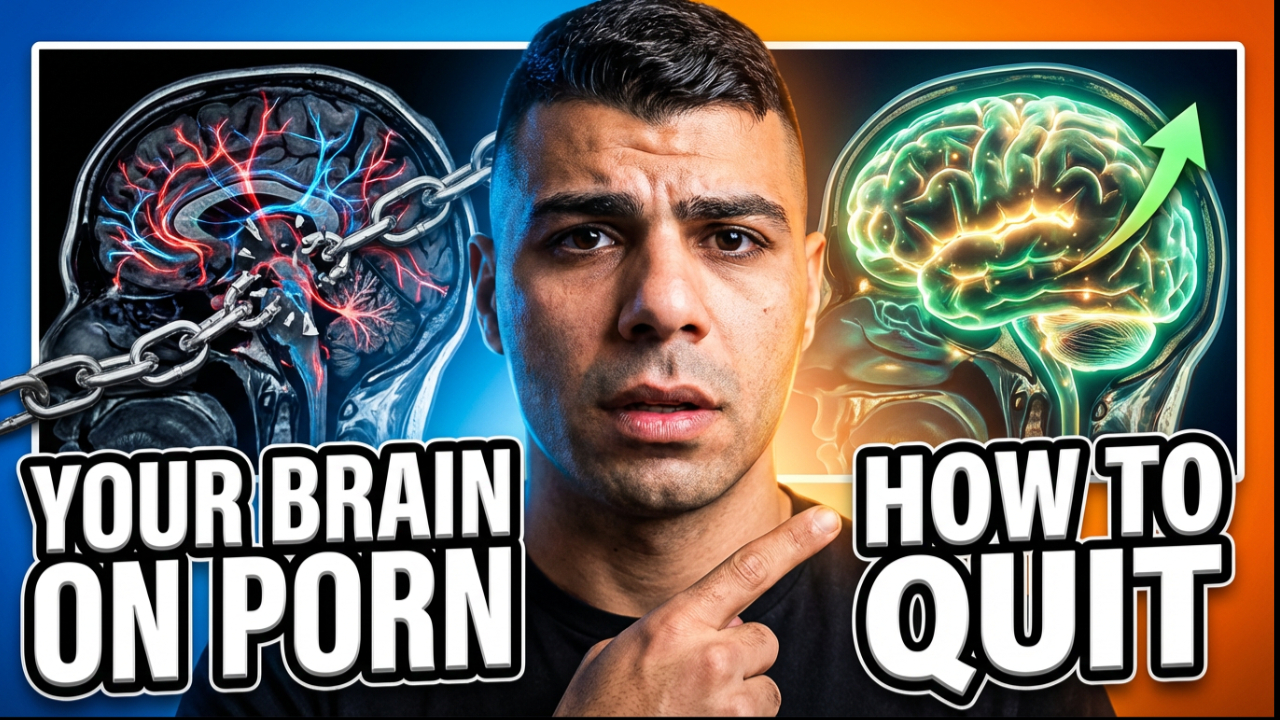
If you feel like you’re trapped in a cycle you can’t escape—that pornography is stealing your focus, your energy, and your joy—you aren’t just imagining it, and you are definitely not alone. But what you might not know is that this struggle isn’t about a lack of willpower or some moral failing. It’s about brain science. A growing body of research shows that pornography can hijack your brain’s reward system, creating patterns that look a lot like those seen in substance addiction.
That’s a neurological reality. The patterns of compulsive use, seeking more intense material, and withdrawal that people experience with pornography often mirror addiction. We’re not just going to show you *why* this happens; we’re going to give you a clear, science-backed plan to break free, rewire your brain, and reclaim your life. We’ll explore the mechanics at play inside your head and then walk through a step-by-step guide to quitting for good. This isn’t about shame; it’s about understanding the science so you can take back control.

Section 1: The Problem – How Pornography Hijacks Your Brain
To understand how to quit, we first have to understand what we’re up against. The modern crisis of compulsive pornography use is fueled by what can be called the “Triple-A Engine”: **A**ccessibility, **A**ffordability, and **A**nonymity. Never before has such a potent stimulus been available 24/7, for free, in total privacy, on a device in your pocket. This constant availability creates the perfect storm for a behavioral addiction to take root.
But what is it actually doing to your brain?
At its core, pornography acts as what scientists call a “supernormal stimulus.” This is an exaggerated version of something that triggers a stronger response than the real thing it evolved for. Think of a bird that prefers to sit on a giant, brightly colored fake egg instead of its own smaller, paler ones. Internet pornography is a supernormal stimulus for our ancient sexual wiring. It delivers novelty and intensity that far exceeds what we typically experience in real life.
When you view pornography, your brain gets a major hit of a neurotransmitter called dopamine. Dopamine is often called the “pleasure chemical,” but it’s more accurately the “motivation chemical.” It’s what tells your brain, “Pay attention! This is important. Do it again.” It drives us to seek out things like food, water, and sex.
Under normal circumstances, this system works perfectly. A good meal gives you a nice dopamine bump. Real-life sexual activity can spike it even higher. However, the sheer novelty and intensity of internet pornography can trigger a much larger and more prolonged dopamine release. This isn’t just a small bump; it’s a neurochemical flood. Neuroscientists have observed that this lights up the brain’s reward circuitry—specifically the pathway connecting the ventral tegmental area (VTA) and the nucleus accumbens—in a way that shows similarities to what happens with addictive substances. This repeated, intense activation is where the hijacking begins. Your brain, trying to protect itself from this overwhelming stimulation, starts to make changes. Those changes have two major consequences: desensitization and a disruption of your brain’s “CEO.”
First, let’s talk about desensitization. Imagine walking into a room with a strong smell. At first, it’s all you notice. After a few minutes, you barely smell it. Your brain has adapted. This is what happens with dopamine. To cope with the constant flood, the brain starts to downregulate, or reduce, its dopamine receptors. It’s like turning down the volume on a speaker that’s blasting too loudly.
The result is that the same material that used to be exciting no longer provides the same rush. This is tolerance. To get the same level of arousal, you now need more—more novelty, more intensity, more extreme content. This is escalation. Users find themselves spending more time chasing that original high. This is a classic path of addiction: sensitization to the cues that predict the reward, followed by desensitization to the reward itself. Real-life intimacy, which provides a normal, healthy dopamine level, can start to feel boring by comparison, which can lead to issues like pornography-induced erectile dysfunction (PIED) and a loss of libido for real-world partners.
The second major consequence is a disruption in your prefrontal cortex—the part of your brain right behind your forehead. Think of it as your brain’s CEO. It’s responsible for impulse control, long-term planning, and weighing the consequences of your actions. It’s the part of you that says, “Maybe I shouldn’t eat that second piece of cake; I’m trying to be healthy.”
Chronic, compulsive pornography use can lead to a condition some neuroscientists call hypofrontality, which is linked to reduced activity or blood flow in this frontal lobe. While the science is still evolving—with some recent studies showing *increased* connectivity in certain prefrontal areas as the brain tries to manage impulses—the end result is a shift in the balance of power. The impulsive, reward-seeking parts of your brain (the “go” system) get stronger, while the rational, impulse-controlling part (the “stop” system) gets weaker.
This neurological shift explains why people often feel a complete loss of control. You might know that watching pornography is hurting your relationships or your productivity, but in the moment of a craving, the prefrontal cortex isn’t strong enough to hit the brakes. The brain stops asking, “Is this a good idea?” and just follows the well-worn path to the reward. You aren’t “weak-willed”; your brain’s very structure for decision-making has been altered.
This pattern is so well-documented that the World Health Organization recognizes “Compulsive Sexual Behavior Disorder” (CSBD) in its International Classification of Diseases, the ICD-11. It’s defined by a persistent failure to control intense, repetitive sexual urges, which leads to behavior that causes you significant distress or impairs your life. It is a brain issue, not a moral one.
Section 2: The “Why” – The Vicious Cycle of Addiction
Now that we get the mechanics, let’s look at how they create a self-perpetuating cycle that feels impossible to escape. This is the loop that keeps you stuck.
It all starts with a trigger. This can be anything your brain associates with pornography. It could be external, like a pop-up ad or just being alone with your phone. Or, it could be internal—a feeling of stress, boredom, loneliness, anxiety, or fatigue. A common way to remember these internal triggers is the acronym HALT: **H**ungry, **A**ngry, **L**onely, or **T**ired. These states make us vulnerable, and the brain looks for a quick fix.
When you hit a trigger, your brain‘s reward system, now sensitized to these cues, anticipates a dopamine hit and creates a powerful craving. It’s an intense feeling of wanting. At this point, your disrupted prefrontal cortex struggles to intervene. The thought “I shouldn’t do this” is drowned out by the emotional part of your brain screaming, “This will make you feel good right now!”
So, you give in. You watch pornography and get the dopamine flood. For a moment, the stress or loneliness is gone. You feel relief. But this relief is temporary. Every time you complete this cycle, you strengthen that neural pathway. You are practicing the addiction, teaching your brain that this is the solution to that trigger.
Immediately after, the consequences kick in. First, the neurochemical crash. After the artificial high, your dopamine levels drop, often leaving you feeling worse than before—brain fog, fatigue, and a lack of motivation. Then comes the psychological fallout: shame, guilt, and self-loathing. You broke a promise to yourself again. This shame is corrosive, lowering your self-esteem and feeding anxiety and depression. And what’s a common trigger for turning to pornography? Feeling anxious and depressed. The cycle feeds itself. You feel bad, so you use porn to escape feeling bad, which makes you feel worse, creating an even stronger need for escape.
This is the addiction trap. It’s no longer about seeking pleasure; it’s about escaping pain. You’re not using to feel good, you’re using to stop feeling bad.
Some studies have even found a link between heavy pornography use and a reduction in gray matter volume in parts of the brain tied to reward and motivation. While researchers are still debating whether the porn use *causes* this change or if other factors are involved, it shows how deeply this habit can be linked to our brain’s physical structure.
But here is the single most important message: this process is reversible. The same mechanism that got you here can get you out. It’s called **neuroplasticity**—the brain’s ability to reorganize itself and form new connections throughout your life. Your brain isn’t set in stone. Addiction is a disease of negative neuroplasticity. Recovery is the process of intentionally rewiring your brain in a positive direction. The brain that learned compulsion can relearn control.

This book is the scientific documentary of the Kingdom of God.
Section 3: The Solution – A Step-by-Step Guide to Quitting
Okay, we’ve laid out the problem. Now for the most important part: the solution. This isn’t a list of quick fixes. It’s a multi-layered strategy based on neuroplasticity and evidence-based addiction treatment.
Step 1: Find Your “Why” and Acknowledge the Truth
Before you do anything else, you need a rock-solid foundation. You have to know *why* you’re doing this. Quitting just because you feel you “should” won’t be enough to fight a strong craving. You need deep, personal reasons.
Take out a piece of paper and answer this with brutal honesty: “What has this habit cost me?” Has it cost you hours you could have spent on a hobby or with loved ones? Has it drained your mental energy? Has it created distance in your relationships? Cost you your confidence? Your self-respect?
Write it all down. Then, on the other side, write your vision for the future. What will life look like when you’re free? More present? More energetic? More confident? A healthier intimate life? This “why” is your north star. When things get tough, you’ll come back to this to remind yourself why you started.
Part of this is also fully accepting that this is a brain issue, not a moral failing. The shame you feel is a symptom, not a reflection of your character. Letting go of that shame is key, because shame keeps us hiding.
Step 2: Create a Fortress – Environmental Control
You can’t fight a battle on enemy territory. The first practical step is to change your environment to make accessing pornography as difficult as possible. We need to add friction.
First, delete everything. Go through your computer and phone and delete all saved material, bookmarks, and browser history. This first step isn’t negotiable.
Second, install a powerful content blocker or accountability software on all your devices. Some just block sites, while others send a report to an “accountability partner”—a trusted friend or therapist. This might feel extreme, but it’s one of the most effective steps you can take. It interrupts the automatic habit loop. That moment of seeing a blocked page gives your prefrontal cortex a split second to come back online and ask, “What am I doing?”
Third, change your routines. Do you typically use porn in a specific room at a specific time, like late at night in the bedroom? Change that. Make a rule: no phones or laptops in the bedroom. Charge your phone somewhere else. If you find yourself scrolling mindlessly, get up and leave the room.
Step 3: Become a Detective – Identify Your Triggers
You can’t win a war if you don’t know your enemy. Your triggers are the enemy’s scouts. For the next week, every time you feel an urge, stop and document it.
Write down:
* **Time of day:** When did it happen?
* **Location:** Where were you?
* **What were you doing?**
* **What were you feeling?** (This is the most important one.) Were you stressed? Bored? Lonely? Anxious? Tired?
At the end of the week, you’ll have a map of your personal addiction cycle. You’ll see patterns. Maybe it’s always around 10 PM when you’re tired and bored. Maybe it’s after every stressful workday.
Once you have this data, create a proactive “If-Then” plan. For example: “**IF** I feel bored at 10 PM, **THEN** I will call a friend or listen to a podcast.” Or, “**IF** I feel stressed after work, **THEN** I will immediately go for a 20-minute walk.” This is a core principle of Cognitive Behavioral Therapy (CBT): creating a new, healthier response to a known trigger.
Step 4: Rewire Your Reward System – Find Healthy Dopamine
Your brain has been trained to get its dopamine from one artificial source. A huge part of recovery is teaching it to get that dopamine from healthy, natural sources again. You have to replace the habit.
**Physical Activity:** Exercise might be the most powerful tool you have. It releases dopamine, reduces stress, and improves the function of your prefrontal cortex. It doesn’t have to be a marathon. A brisk walk, a quick workout, or lifting weights are all incredibly effective.
**Engage in Meaningful Hobbies:** What did you used to love to do? Play an instrument? Learn a language? Engaging in challenging, skill-based activities is a fantastic way to get a dopamine release that comes with a sense of accomplishment.
**Social Connection:** Loneliness is a massive trigger for addiction. Humans are wired for connection. Make a conscious effort to build and nurture real-life relationships. Call a friend. Join a club or a team. Support groups are another powerful form of connection. Connection is the antidote to addiction.
Step 5: Master Your Mind – Cognitive and Mindfulness Techniques
So far, we’ve focused on changing your environment and behaviors. Now, we need to change how you think.
**Cognitive Behavioral Therapy (CBT) Principles:** CBT is a gold-standard treatment for behavioral addictions. A key technique is challenging the distorted thoughts that fuel the addiction. For example, you might think, “I’ve had a hard day, I *deserve* this.” A CBT approach would challenge that: “Is this really a reward? Or is it something that will make me feel worse in an hour? What’s a *true* reward that aligns with my goals?”
**Acceptance and “Urge Surfing”:** Another powerful approach, often found in Acceptance and Commitment Therapy (ACT), teaches you to accept uncomfortable thoughts and feelings without acting on them. An urge is just a mix of thoughts and sensations. It feels powerful, but it can’t make you do anything. The technique of “urge surfing” involves imagining your craving as a wave. It builds, crests, and then, if you don’t feed it, it will always subside. You don’t fight the wave; you just ride it out, noticing the sensations and thoughts without judgment until they pass. Each time you surf an urge, you weaken the old pathway and strengthen your self-control.
**Mindfulness and Meditation:** Mindfulness is simply paying attention to the present moment without judgment. It has been shown to increase gray matter and activity in the prefrontal cortex—the very part of the brain that needs strengthening. Even 10 minutes a day can train your ability to observe your thoughts without getting swept away by them.
Step 6: Don’t Go It Alone – Build Your Support System
Trying to overcome this alone is like trying to climb a mountain without any gear. Building a support system is a sign of strategic strength.
**Therapy:** A therapist who specializes in behavioral addictions or CSBD can be one of the best investments you can make. They can provide professional guidance with techniques like CBT, help uncover underlying issues like anxiety or trauma, and offer non-judgmental support.
**Support Groups:** Groups like Sex Addicts Anonymous (SAA), SMART Recovery, and other peer-support programs can be life-changing. They break the isolation and shame that are so central to addiction. Hearing others share stories that sound just like yours is incredibly powerful.
**Trusted Friends or Family:** Confiding in a trusted friend or family member can make a world of difference. This person can be your accountability partner, someone to call when you’re struggling, or just someone who knows what you’re going through and can offer encouragement.
Step 7: Prepare for Withdrawal and Handle Relapse with Compassion
When you stop, your brain will go through a withdrawal period as it recalibrates. This is a normal and expected part of healing. Symptoms can include intense cravings, anxiety, irritability, brain fog, and trouble sleeping. These symptoms are temporary signs that your brain is healing.
Finally, you must have a plan for relapse. A relapse is not a failure; it’s a data point. The worst thing you can do is fall into a shame spiral and give up completely. That’s the trap that turns a single lapse into a full-blown binge.
Instead, practice self-compassion. Acknowledge what happened without judgment. Then, get curious. What was the trigger? What was I feeling? What part of my plan broke down? A relapse is a learning opportunity to strengthen your recovery plan. Forgive yourself, learn the lesson, and get right back on track.
Section 4: Reclaiming Your Life – The Benefits of Quitting
The journey is challenging, but the destination is more than worth it. As your brain begins to heal and rewire, you’ll start to notice profound changes.
One of the first things people notice is the return of mental clarity. The persistent “brain fog” that accompanies heavy use will begin to lift. You’ll find it easier to concentrate and you’ll have more mental energy for work, hobbies, and life.
Your emotional world will also come back into focus. The numbing effect of porn will fade, and you’ll experience a fuller range of emotions again—especially joy and empathy. Your relationships will deepen as you become more present with the people you care about.
Your sexual health and real-world intimacy can be restored. As your brain’s reward system renormalizes, your sensitivity to natural intimacy returns. Many who experienced pornography-induced erectile dysfunction find that their function returns as their brain heals. You can rediscover intimacy based on real connection, not a pixelated fantasy.
Perhaps most importantly, you will regain your self-control and self-respect. You will prove to yourself that you are not a slave to your impulses—that you are in the driver’s seat. This builds a deep and resilient confidence that will impact everything you do. You will be free from the cycle of secrecy and shame, able to live an authentic life aligned with your values.
Conclusion
We’ve seen how pornography, as a supernormal stimulus, can hijack your brain’s reward system, leading to desensitization and a weakened “stop” signal in your brain. We’ve explored the vicious cycle of triggers, cravings, use, and shame that keeps people trapped.
Most importantly, we’ve laid out a clear, science-backed plan to break free. It starts with finding your “why,” creating an environment that protects you, identifying your triggers, rewiring your brain with healthy habits, mastering your mind with cognitive tools, and building a strong support system.
Remember the principle of neuroplasticity: your brain *can* change. This journey isn’t about becoming “perfect.” It’s about building the skills and resilience to navigate challenges without resorting to a habit that harms you. Recovery is possible. Change is possible. You have the power to rewire your brain and reclaim your life.