
What if the very thing you blame for your anxiety—that overactive, relentless imagination—was actually the secret to your freedom?
What if that vivid, worst-case-scenario generator in your head isn’t a flaw at all, but a superpower that you’ve just been using on the wrong setting? Our brains are wired to believe what we imagine. For years, you’ve likely been using this power to practice feeling anxious, to rehearse failure, to feel the phantom pains of things that haven’t even happened. Well, today, we’re flipping the switch.
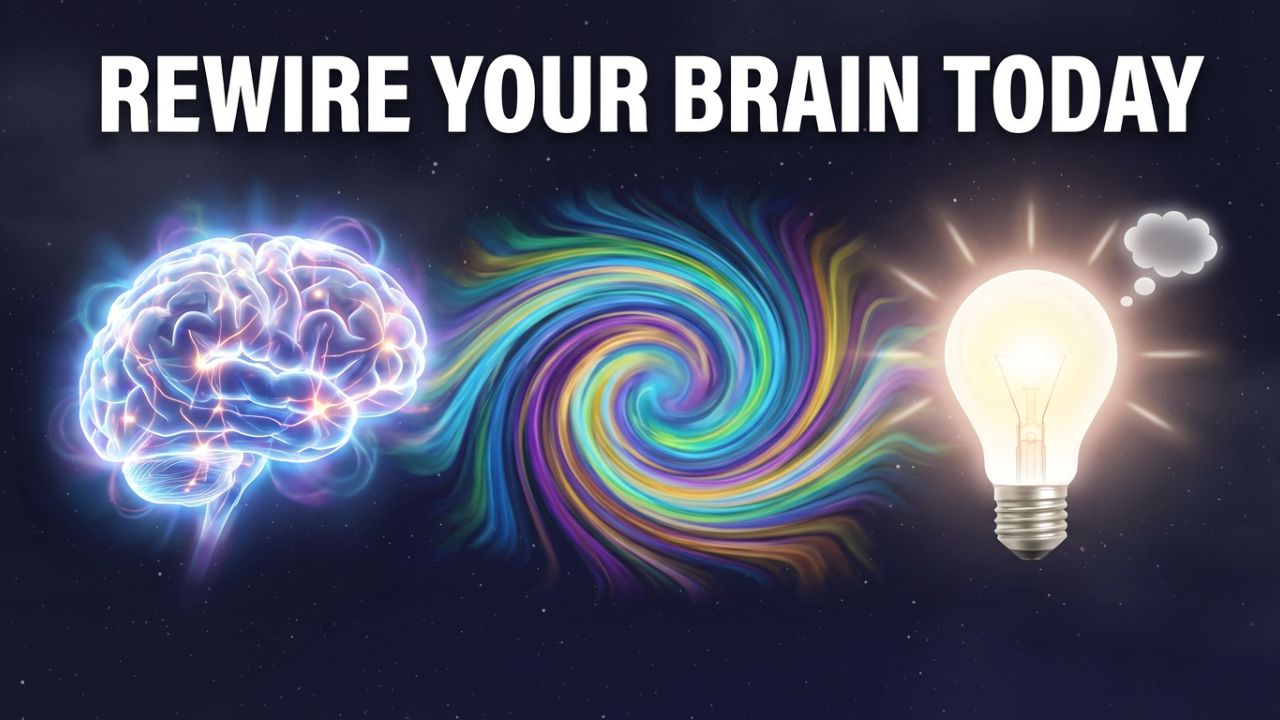
If you’ve ever felt your heart race because of a vague email from your boss, or spiraled into a panic over some future “what-if,” this is for you. This isn’t just about “thinking positive” or ignoring your fear. This is about leaning into some real neuroscience. It’s about understanding that your brain has a remarkable, built-in capacity for change, a quality known as neuroplasticity. And it turns out, your imagination is the most powerful tool you have to direct that change.
In this article, I’m going to show you exactly how to use that power. We’re moving beyond theory and into actual practice. I’ll guide you through science-backed techniques you can use to physically weaken your brain’s fear circuits and build new, calmer, more confident neural pathways. This isn’t magic; it’s the instruction manual for your own mind. By the end of our time together, you’ll have a concrete, actionable plan to start rewiring your brain—turning your imagination from your greatest enemy into your most powerful ally.

SON OF LORD- Scientific Institute
Let’s start with a question. Have you ever been so caught up in a worry that your body reacted as if it were real? Your heart pounded, your palms sweat, your stomach churned… all from a *thought*? Maybe you imagined a presentation going horribly wrong, replayed an awkward social interaction on a loop, or pictured a loved one in danger. If you have, you’ve experienced the sheer power of your imagination firsthand. It can create a full-body physiological response from nothing more than a mental image.
Now, here’s the amazing thing about your brain: it’s made to rewire itself, all the time. This is the core principle of neuroplasticity. For a long time, scientists thought our brains were more or less fixed after childhood. But with modern imaging technology, we can now literally see the brain change its structure and function based on how we use it. Think about that. The things you repeatedly think, feel, and do are actively sculpting the physical landscape inside your skull.
For those of us who struggle with anxiety, this can feel like bad news at first. It means that every time we indulge a worry, every time we mentally rehearse a catastrophe, we’re essentially strengthening the neural pathways for anxiety. We’re making that “anxiety road” in our brain more well-traveled, making it the default route for our thoughts. Your brain isn’t doing this to be cruel; it’s just designed to keep you alive, not necessarily to make you happy. When you worry about a threat and then avoid it, your brain mistakenly learns that the avoidance worked and reinforces the anxiety to “protect” you next time. But here is the profound, life-altering truth: if you can wire your brain for anxiety, you can absolutely unwire it. And the tool you’re going to use is the very same one that may have gotten you into this mess: your powerful, creative, and until now, untamed imagination.

This book is scientific documentary of the Kingdom of God.
Section 1: The Problem – The Neuroscience of the Anxious Imagination
To really understand the solution, we have to get brutally honest about the problem. For someone with anxiety, the imagination often feels less like a whimsical tool for creativity and more like a relentless torture device. It’s a 24/7 movie theater in your mind that specializes in horror, and you’re the star of every film.
Let’s make this real. You send an important work email, and hours go by with no reply. The non-anxious brain might think, “Eh, they’re probably busy.” But the anxious imagination kicks into high gear. It doesn’t just *think* you made a mistake; it *shows* you the movie. You can vividly picture your boss’s disappointed face. You can *hear* the condescending tone in their voice. You can *feel* the flush of shame spreading across your chest. You’re not just having a thought; you’re having a full-sensory experience. To your nervous system, there isn’t much of a difference between something you vividly imagine and something that is actually happening. As far as it’s concerned, the threat is real.
Or think about social anxiety. You get invited to a party. Immediately, your imagination starts storyboarding the disaster. You’ll walk in, and everyone will stop talking. You’ll try to join a conversation and say something awkward, and you can just *picture* the pitying looks. You feel the knot in your stomach tighten. The *imagined* social rejection feels so real, so viscerally painful, that staying home feels like an act of self-preservation. Every time we do this—every time we avoid a situation because of the horrible movie our imagination produced—we teach our brain a dangerous lesson: “That was a close call. The world is dangerous. Avoiding things keeps us safe. Let’s be even more anxious next time to make sure we don’t forget.”
So, what’s going on inside your brain during these mental horror films? Let’s break down the neuroscience in simple terms.
Think of your brain as having a highly effective but very primitive smoke detector. This is a small, almond-shaped region called the **amygdala**. Its job is to scan for threats—fire, predators, danger. When it perceives a threat, real or imagined, it pulls the alarm, triggering the fight-or-flight response. It floods your system with stress hormones like adrenaline and cortisol to prepare your body to face a tiger. Your heart rate increases, your breathing quickens, your senses go on high alert. It’s a brilliant system for keeping you alive.
The problem is, the amygdala isn’t very sophisticated. It can’t easily distinguish between a real tiger and an *imagined* tiger. When your imagination creates a vivid picture of getting fired or being humiliated, the amygdala sounds the alarm just as loudly.
Now, in a well-regulated brain, the “thinking” part of your brain, the **prefrontal cortex**, steps in like a wise fire chief. It assesses the situation and says, “Okay, amygdala, thanks for the heads-up, but this is just a thought. It’s a worst-case scenario. We are not actually in danger.” This calms the amygdala down, and the stress response subsides.
In an anxious brain, this system is out of balance. Chronic worry essentially trains the amygdala to be hyper-vigilant. It’s like turning the sensitivity of your smoke detector all the way up. Now, it doesn’t just go off for a real fire; it goes off when you burn the toast. At the same time, the neural pathways that allow the prefrontal cortex to act as the calm fire chief can become weaker. Its voice gets quieter, less convincing. The result is that you get “stuck” in high alert. This loop, with the amygdala screaming “danger!” and the prefrontal cortex trying and failing to regulate it, keeps you on edge, as if a threat is always present.
Think of your neural connections like paths in a dense forest. The first time you have an anxious thought, it’s like forging a tiny new trail. But if you walk that same path every day—worrying about your job, your health, your relationships—that trail becomes wider and clearer. Eventually, it becomes a deep, muddy trench that your thoughts fall into automatically. This is why anxious thoughts feel so repetitive and inescapable. You’re not weak; you have simply, and unintentionally, become an expert at walking the path of anxiety. But now, we’re going to learn how to use this very same principle to our advantage.
Section 2: The Reframe – Your Imagination is a Superpower
Here’s where we pivot. Here’s the “aha!” moment that can change everything. The fact that your imagination is powerful enough to create such a visceral, physical response is not a weakness. It’s the single greatest clue to your recovery. It is, in fact, your superpower. You just need to learn how to aim it.
This brings us back to the incredible concept of **neuroplasticity**. Neuroplasticity is simply the brain’s ability to reorganize itself by forming new connections in response to our experiences, thoughts, and behaviors. It’s the “how” behind all learning, habit formation, and healing. The same process that carved those deep, anxious ruts in your brain can be used to create new super-highways of calm and resilience.
A classic example is the London taxi drivers. To earn their license, they have to pass an insanely difficult test called “The Knowledge,” which requires them to memorize over 25,000 streets. Neuroscientists scanned their brains before and after their years of training and found a significant increase in the gray matter in the hippocampus, a part of the brain heavily involved in memory and spatial navigation. Their brains had physically changed to adapt to the demands placed on them. They rewired the brains they already had through focused, repetitive practice.
This is precisely what we are going to do with anxiety. Your brain doesn’t just change in response to physical actions; it changes in response to *imagined* actions. Brain-imaging studies confirm that vividly imagining an action activates many of the same neural pathways as actually doing it. Athletes have used this for decades. A basketball player mentally rehearses a free throw; a skier visualizes a perfect run. This mental practice works because it’s literally building and strengthening the neural circuits for success.
So, how does this apply to you? For years, your anxious imagination has made you an Olympic-level athlete in the sport of “What-If Catastrophe.” You have expertly practiced the feeling of panic. You’ve rehearsed the bodily sensations of fear. You’ve strengthened the neural pathways of worry until they are robust and efficient.
The reframe is this: you are going to become an athlete of calm. You are going to use the exact same mental machinery—your powerful, sensory-rich imagination—to practice a new skill. Instead of visualizing failure, you will practice visualizing success, or even just getting through something okay. Instead of rehearsing panic, you will rehearse calm.
Every time you intentionally use your imagination to create a feeling of safety or confidence, you’re doing the equivalent of a mental bicep curl for the calm parts of your brain. You’re forging new pathways in that dense forest. At first, these new paths of calm will feel small and overgrown, and it will be much easier to slip back into the old trench of anxiety. But with **repetition**—the most critical word in this entire process—that new path gets wider and clearer. Eventually, the calm pathway can become the new default. The old anxiety trench, no longer used, begins to fade away. This isn’t just a metaphor; it’s a description of the physical process of your brain rewiring itself.
The core message here is one of profound empowerment. The solution isn’t outside of you. The tool you need is the one you’ve had all along. You already have a world-class imagination. Now, it’s time to take the director’s chair back and start producing a different kind of movie.
Section 3: The How-To – 4 Steps to Rewire Your Brain
This is where we get practical. Knowing the theory is great, but applying it is what creates change. We’re going to walk through four powerful, science-backed exercises that use your imagination to actively rewire your brain. Remember, consistency is everything. Think of this like starting a workout routine. You wouldn’t expect a six-pack after one trip to the gym. Likewise, you won’t erase years of anxious thinking with one visualization. But with small, consistent daily practice—say, 10-20 minutes a day—you can create profound and lasting change.
**Step 1: The Imaginative Exposure Hierarchy (Facing Fear in a Safe Space)**
This technique comes directly from the principles of Exposure Therapy, one of the most effective tools for dismantling specific fears. The twist is that groundbreaking research has shown that *imagining* exposure in a safe environment can be just as effective for your brain. The goal is to teach your brain, through repeated, safe, imagined experiences, that the thing you fear is not a life-or-death threat.
Here’s how it works. First, **pick one specific fear** you want to work on. Let’s use a common one: fear of public speaking.
Second, **create a “fear ladder.”** List situations related to that fear, from least scary to most scary. A list might look something like this, rated on a 1-10 anxiety scale:
* **1/10:** Imagining writing bullet points for a speech, alone at my desk.
* **2/10:** Imagining practicing the speech out loud, alone in my car.
* **4/10:** Imagining giving the speech to my dog.
* **6/10:** Imagining giving the speech to one supportive friend.
* **8/10:** Imagining giving the speech to a small group of colleagues.
* **10/10:** Imagining giving the keynote address at a huge conference.
Third, **you start at the bottom.** Your daily practice is to take 10 minutes and vividly imagine the *easiest* item. So, you’d sit in a quiet, comfortable space, close your eyes, and for 10 minutes, just imagine yourself writing those bullet points.
The key is to make the visualization as sensory-rich as possible. Don’t just think about it; *experience* it. Feel the keys under your fingers. See the words on the screen. Smell the coffee on your desk. And most importantly, as you imagine this, you imagine it going *well*, or at least, neutrally. You see yourself feeling calm and focused.
You might feel a spike of anxiety at first. That’s normal. That’s your amygdala firing its usual alarm. But here’s the magic: you stay with it. You’re completely safe. As you sit there, imagining the “scary” thing, and nothing bad happens, your brain gets new data. It learns, “Huh. I guess that wasn’t so dangerous after all.”
You repeat this practice every day until imagining it no longer causes a big anxiety spike. Only then do you “graduate” to the next level on your ladder. You are systematically and gently proving to your brain, one imagined step at a time, that it can handle this, restoring your sense of safety.
**Step 2: Relabel, Reframe, Refocus, Revalue (The 4 R’s)**
This four-step method is adapted from a powerful mindfulness technique developed by Dr. Jeffrey Schwartz at UCLA. While originally for OCD, it’s incredibly effective for dealing with any intrusive anxious thought the moment it arises. It’s about changing your relationship *with* the anxiety.
Let’s say you feel a wave of anxiety—your heart races, and the thought “Something is terribly wrong” hits you. Here’s how you apply the 4 R’s:
1. **Relabel:** Call the experience what it actually is. Instead of “I’m losing control,” you consciously say to yourself, “This is not me; this is just an anxious thought,” or “This is a deceptive brain message.” By relabeling it, you create a crucial space between *you* (the observer) and the experience. You are not the anxiety; you are the one *noticing* it.
2. **Reframe:** Change what the feeling means. Your anxious brain’s frame is “This is a catastrophe!” Your job is to reframe it with the truth. Remind yourself that this feeling, while uncomfortable, is not dangerous. It’s just a temporary blast of biochemical noise. You could say, “This is my overactive amygdala firing a false alarm. It’s uncomfortable, but it will pass.” A useful metaphor is to see the anxiety as a storm cloud passing through the vast, clear sky of your awareness. You are the sky, not the storm.
3. **Refocus:** Actively shift your attention. Anxious brains want to obsess over the feeling, which only fuels it. Instead, you must consciously shift your attention onto something else—preferably something that engages your senses. For five minutes, focus with all your might on the feeling of your feet on the floor. Or, use the 5-4-3-2-1 grounding technique: name five things you can see, four things you can feel, three things you can hear, two you can smell, and one you can taste. This starves the anxious circuit of the one thing it needs to survive: your focus.
4. **Revalue:** This happens after the anxious wave has begun to subside. Look back and revalue the experience. Initially, you valued it as a “terrible attack.” Now, you see it for what it was: a “deceptive brain message” that you successfully navigated. Give yourself credit: “That was hard, but I handled it.” By devaluing the anxious thought (recognizing it as unimportant noise), you further weaken its hold. You teach your brain that these alarms are not worth listening to.
**Step 3: Positive Pathway Visualization (Paving the Road to Calm)**
While the first two techniques manage existing fear, this one is about proactively building new, positive neural pathways. It’s our offensive strategy. The goal is to make the state of calm feel just as familiar and automatic to your brain as anxiety currently does.
Here’s how to practice it. Set aside 10 minutes each day.
**First, choose a realistic scenario** where you’d normally feel anxious, but instead, you’ll imagine navigating it with calm confidence. It could be acing that presentation or feeling relaxed at a social event.
Let’s use the example of feeling calm during a weekly team meeting. Find a comfortable position, close your eyes, and start with some deep breathing. Try box breathing: inhale for four, hold for four, exhale for four, hold for four. This activates your body’s “rest and digest” system.
Now, build the scene in your mind, engaging all your senses.
* **See:** Picture the conference room, the faces of your colleagues—not as critics, but just as people. See the screen, the light from the window.
* **Hear:** The low hum of the projector, the sound of your own voice—clear and steady. Hear a colleague responding positively.
* **Feel:** The solid chair beneath you. Most importantly, feel the internal sensation of calm in your body. Imagine a warmth spreading through your chest, your shoulders relaxing. What does confidence *feel* like? Maybe it’s a feeling of being centered and solid.
* **Smell/Taste:** Can you smell the coffee in the room? Taste the mint from your water?
Now, run the movie. Play out the entire meeting from start to finish, keeping yourself in this state of imagined calm and competence. See yourself answering questions with ease. End the visualization with a powerful feeling of accomplishment. By repeatedly pairing a trigger with a state of calm, you are literally teaching your brain a new response.
**Step 4: Somatic Imagination with Movement (Embodying the Change)**
Our final technique recognizes a crucial truth: anxiety isn’t just in your head; it’s in your body. The tension in your shoulders, the knot in your stomach—these are physical manifestations. Somatic imagination brings the body into the practice, creating an even more powerful, integrated effect.
**Example 1: The Tension-Release Walk.**
Go for a 20-minute walk. For the first ten minutes, just notice the physical sensations of anxiety in your body. Is your jaw tight? Shoulders hunched? As you walk, imagine that with every step, you are gently shaking that tension loose. With every exhale, visualize it leaving your body.
For the second ten minutes, shift your focus. Imagine a feeling of calm, flowing energy moving through you. With every inhale, visualize drawing in a sense of ease. Imagine your stride becoming more confident. Feel your shoulders relax and your chest open. Imagine that with each step, you are walking *into* a calmer version of yourself.
**Example 2: Stretching with Imagination.**
If you only have five minutes, stand up and do some simple stretches. As you raise your arms overhead, imagine you are stretching away all the day’s stress. As you release the stretch and exhale, vividly imagine tight knots of tension in your muscles loosening, untangling, and dissolving like ice in the sun. This creates a powerful, unified signal to your brain and nervous system that it’s safe to let go.
By actively involving your body, you’re not just *thinking* about being calm; you’re giving your brain direct, physical evidence of it.
Conclusion: Empowerment, Summary
We’ve moved from the depths of neuroscience to practical, hands-on techniques for taking back your mind. The one core message I want you to walk away with is this:
Your brain is not fixed. It is not hardwired for anxiety. It is a dynamic, living organ that is constantly changing in response to your focus. For a long time, you may have been an unwitting participant in that process, letting your imagination deepen the neural pathways of fear. But that can end today.
Today, you can become the intentional architect of your own mind. You now understand your imagination is not a curse; it’s a powerful tool for directing change. We’ve walked through the four key practices to start this process:
1. **Imaginative Exposure:** To safely teach your brain that what you fear isn’t a true threat.
2. **The 4 R’s:** To disarm anxious thoughts the moment they arise.
3. **Positive Pathway Visualization:** To proactively build new highways of calm.
4. **Somatic Imagination:** To bring your body into the practice for a deeply integrated sense of well-being.
The power is not in the complexity of these techniques, but in their consistent application. This is your work. It’s a practice, not a performance. Some days will be easier than others. Some days, the old anxious thoughts will be loud. That’s okay. On those days, meet the anxiety not with frustration, but with compassion, and gently return to your practice. Every single time you choose to guide your imagination intentionally, you are casting a vote for a new way of being.
So here is your invitation. Choose just ONE of the four techniques we discussed—the one that resonated with you the most. Commit to practicing it for just 10 minutes every day for the next week. That’s it. Start small, build momentum, and prove to yourself that you can do this. This small act of commitment is the first step in rewiring your brain. You have the map and you have the tools.
One final, important note: these techniques are incredibly powerful for managing mild to moderate anxiety. However, if you are struggling with severe anxiety, trauma, or a diagnosed anxiety disorder, these tools are best used as a complement to, not a replacement for, professional support from a therapist or counselor. Seeking that support is a sign of profound strength.
Thank you for your time and your attention. You are the director of the cinema in your mind. Go create a masterpiece.