
Take a look around you. Your phone, the chair you’re sitting on, the room you’re in. It all feels solid, real, unquestionable. But what if I told you your brain can’t always tell the difference between what’s in front of your eyes and what’s in your head? What if that line between perception and imagination is just a dial your brain can turn up or down? Neuroscience is showing us that reality isn’t something you just *see*; it’s something your brain *builds*. And that makes you the architect. We’re about to explore the science that proves your mind constructs the world you experience—for better or for worse.
Section 1: The Grand Illusion
We all live our lives under the spell of a grand illusion: the idea that our senses deliver a perfect, high-definition copy of the world straight to our consciousness. We trust our eyes, ears, and memories like they’re flawless recording devices. But think about it. How many times have you sworn you felt your phone buzz in your pocket, only to pull it out and see nothing? Or argued with a friend over a shared memory, with both of you completely certain your version is the right one? These aren’t just weird quirks; they’re windows into how we actually experience the world.
Our perception isn’t a passive camera feed. It’s an active, creative process. Take optical illusions—you know, the drawing that’s both a young woman and an old one, or the lines that look curved but are perfectly straight. These aren’t just party tricks; they’re live demos of your brain in action. They prove that what you see isn’t always what’s *there*, but what your brain *thinks* is there. It’s constantly making its best guess based on a lifetime of experience.
One of the leading neuroscientists in this area, Dr. Lisa Feldman Barrett, puts it this way: your brain is “trapped in a dark, silent box”—your skull. It doesn’t get clear pictures or sounds. It gets messy, ambiguous data streams: light waves, chemical signals, changes in air pressure. And from that chaos, it has to guess what in the world is going on. It literally has to build your reality from the ground up.
For decades, we thought the brain was reactive. A light flashes, a sound bangs, and *then* our neurons fire. But a wave of new research has completely flipped that idea on its head. It turns out, your brain isn’t just sitting around waiting to react. It’s a prediction machine. From the moment you’re born, your brain is building a model of the world, constantly running simulations of what’s about to happen next. It’s predicting the next word you’ll read. It’s predicting the feeling of your seat under you. It’s predicting the taste of your next coffee.
Every single experience you have is a mix of these predictions and the actual sensory information coming in. When the real-world data matches the prediction, that’s your reality. But when it *doesn’t* match, the brain can do one of two things. It can update its prediction—which is what we call learning. Or, if the prediction is strong enough, it can actually *override* the sensory data. You feel a buzz in your pocket because your brain *expected* a notification, even if your phone never made a peep.
This radically changes how we see ourselves. We aren’t passive observers of the world; we’re active co-creators of it. We’re constantly projecting our internal models onto everything we experience. This predictive power is how a baseball player can hit a 95-mile-per-hour fastball. A purely reactive brain would be way too slow. The player’s brain predicts the ball’s trajectory, initiating the swing before the ball is even halfway to the plate.
And this brings us to a mind-bending question. If the brain is always running these simulations… what is that process, if not a form of imagination? Imagination isn’t just for daydreaming. On a basic level, it’s your brain’s ability to create sensory experiences without any outside input. It’s the engine that drives prediction. And this is where the line between real and imagined starts to dissolve, not just philosophically, but neurologically. What if the only difference between seeing an apple on a table and vividly imagining one is just a question of volume inside your head?

SON OF LORD- Scientific Institute
Section 2: The Reality Threshold
Back in 1910, a psychologist named Cheves Perky ran a wild experiment that gave us the first scientific peek behind this curtain. She asked people to stare at a blank screen and visualize an object, like a banana. But here’s the trick: unbeknownst to them, she used a projector to cast a super faint, almost invisible image of that same banana onto the screen.
The results were bizarre. Nobody said, “Hey, I see a faint banana on the screen.” Instead, they just described their *imagination* of the banana as being surprisingly vivid and clear. One person even noted that their imagined banana kept showing up at a weird angle they weren’t trying to create. They had taken real sensory information from the world and mistaken it entirely for a creation of their own mind. This is now known as the Perky Effect, and it showed that our brains don’t label experiences with a neat little tag that says “Made by Reality” or “Made by Imagination.”
Fast-forward a century, and modern brain scans let us see exactly what Perky could only guess at. Research has helped us identify the mechanism the brain uses to tell “real” from “imagined”: a concept called the “reality threshold.”
It works like this. When you see a tree, light hits your eyes, gets converted into electrical signals, and travels to high-level visual areas like the fusiform gyrus, which helps you recognize what you’re seeing. This region lights up with a strong, clear pattern of activity.
Now, close your eyes and vividly *imagine* that same tree. Guess what happens? The exact same brain region, the fusiform gyrus, becomes active again. The neural pathways you use to see are the same ones you use to imagine. There’s no separate “imagination center.” Imagination is just your brain simulating the act of seeing.
So, how on earth do we tell the difference? It all seems to come down to the *strength* of the signal. The neural activity from actually seeing something is usually stronger and more detailed than the activity you generate yourself. Your brain monitors the intensity of this activity in these shared circuits. If the signal is strong enough to cross a certain “reality threshold,” your brain concludes the experience is real. If the signal stays below that line, it gets filed under “imagination.”
But this isn’t a perfect system. It’s more like a dimmer switch than an on/off switch. Most of the time, imagination is the light turned down low, and reality is the light on full blast. But what happens if you crank the dimmer on imagination?
Let’s try a quick experiment. I want you to close your eyes, if it’s safe to, and imagine a bright yellow lemon. Don’t just think the word; really *see* it. See the waxy, dimpled skin. See the little green nub where it was picked from the tree. Now, in your mind, place that lemon on a cutting board, grab a knife, and slice it right down the middle. Hear that squish as the knife breaks the skin. See the two halves fall open, the glistening fruit inside, the juice beading on the surface. Now, pick up one of those halves, bring it to your mouth, smell that sharp citrus scent… and take a big bite.
What happened? Chances are, your mouth started watering. You might have even winced a little. Your body just reacted to a purely imagined event as if it were real. Why? You generated a mental image so vivid, so detailed, that the neural signals were strong enough to be taken seriously. Your brain ran the “biting a lemon” simulation with such high fidelity that your salivary glands got the memo: “Lemon incoming! Prepare for acid!”
This simple exercise proves the point: a sufficiently vivid thought is a biological event for your brain. Researchers using fMRI scanners found that when people vividly imagined a stimulus, it could boost activity in the visual cortex so much that they’d report “seeing” something even when nothing was there. Their imagination literally crossed the reality threshold. This also helps explain why people with naturally vivid imaginations can sometimes blur that line—their internal signals are already so strong, they can easily mimic reality. This has huge implications for everything from creativity to understanding conditions like schizophrenia, where the brain’s reality threshold might be set too low, or the internal signal turned up way too high.
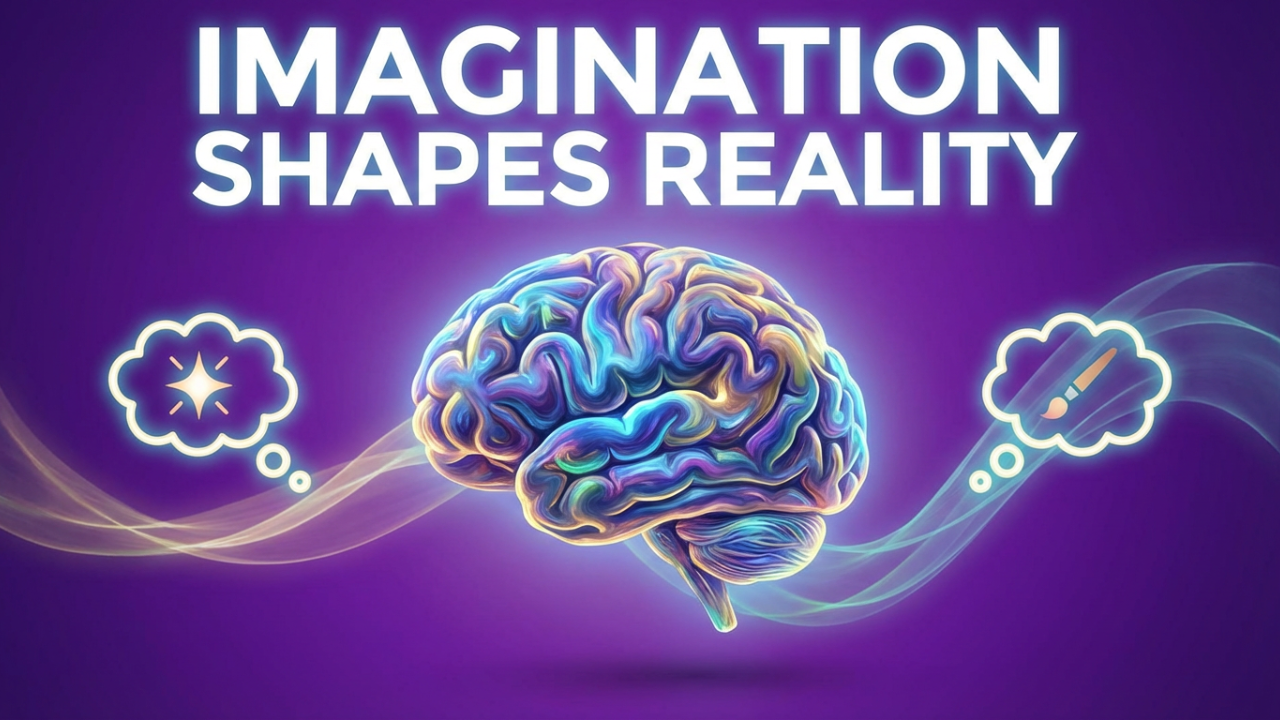
The world you experience isn’t an objective photograph. It’s a painting, and your imagination is holding the brush. The only question is, what are you painting?
Section 3: The Architect in the Skull
Knowing your brain has a “reality threshold” is one thing. Realizing that you can change it is another. Your brain isn’t a static piece of hardware; it’s a living network that’s constantly rewiring itself based on your experiences and thoughts. This is called neuroplasticity.
We used to think the brain was pretty much fixed after childhood. We now know that’s completely wrong. Think of your brain as a dense forest of neural pathways. The more you use a path, the wider and clearer it becomes. The paths you ignore get overgrown. Every single thought you have is a signal traveling through this forest, reinforcing certain pathways.
Now, let’s connect neuroplasticity with the predictive brain. Remember, your brain isn’t reacting to the world; it’s predicting it based on the neural pathways your past experiences have already carved out. If you’ve had a lifetime of negative experiences, your brain gets really good at predicting negative outcomes. It becomes so efficient at it that it starts building a reality to match. You walk into a party *expecting* rejection, and your brain primes you to see every neutral glance as disapproval, every pause in conversation as proof that you’re awkward. You are literally constructing the world you fear.
But here’s the game-changer: since imagination uses the same neural pathways as perception, your brain counts it as a real experience. Vividly and repeatedly imagining a different outcome is, to your brain, like actually experiencing it over and over. You’re carving new paths in the neural forest. You’re giving your predictive brain new data to work with.
Recent studies confirm that a whole network of brain regions, including high-level command centers in the prefrontal cortex, are constantly evaluating these signals to decide what’s real. For example, a region called the anterior insula seems to act as a “reader” of this activity, helping to integrate these reality judgments into your conscious awareness. The whole system is incredibly complex, but its goal is simple: efficiency.
Running a prediction and then making small corrections with sensory data uses way less energy than processing a tidal wave of raw information from scratch. Uncertainty is metabolically expensive. Your brain is trying to manage its “body budget,” and predictions are its favorite tool. Imagination, as the engine of prediction, is therefore one of the most powerful tools you have to manage that budget and direct your reality.
Let’s go back to the architect idea. Think of your past experiences as your available building materials. If all you have are bricks, you only build brick houses. Your brain gets great at predicting and building brick houses. But what if you want to build a house out of wood? You’ve never seen or touched one. The idea is faint at first, well below the reality threshold. But then you start to use your imagination. You visualize the grain of the wood. You imagine the smell of pine. You mentally construct the frame, piece by piece.
Every time you do this, you’re carving a new neural pathway. You are neurologically creating “wood” as a new building material. At first, it’s just a faint trail in the forest. But you keep visualizing it every day. The trail becomes a path; the path becomes a road. Your brain gets familiar with the concept. It starts adding “wood” to its predictive models.
Eventually, the neural blueprint for the wooden house becomes so strong it can compete with the old brick house model. You’ve given your brain a new plan. And now, your predictive brain starts highlighting things in the real world that match this new vision—you overhear a conversation about carpentry, you notice an ad for lumber. You have, quite literally, imagined a new world into being.
This isn’t just a feel-good metaphor. It’s a real, physical process. When you consciously imagine a different future, you are engaging in neurological training. You’re using the brain’s core features—its predictive nature and its plasticity—to become the architect of your own experience. You are physically changing the patterns of neural firing in your brain, telling it, “This. This is what we should build.” And because your brain can’t always tell the difference between a vivid simulation and the real thing, it listens.

This book is the Scientific Documentary of the kingdom of God
Section 4: Hacking Your Inner World
So, the science is clear: your brain builds reality from predictions, and you can change those predictions with your imagination. This isn’t just cool trivia; it’s the key to practical techniques you can use to reshape your life. Let’s move from the “what” to the “so what.” How do we actually hack our inner world to create real change?
Part A: Overcoming Fear and Trauma
Fear is a product of the predictive brain. If you have a traumatic experience like a car crash, your brain forges a powerful link between the cues of that event—the sound of screeching tires, the sight of an intersection—and a threat to your survival. From then on, your brain predicts DANGER when it encounters those cues and triggers a physical fear response.
The classic treatment for this is exposure therapy, where you gradually re-expose yourself to the threatening cues in a safe setting until the brain learns the danger prediction is wrong. But what if the trauma is too intense to relive?
This is where imagined exposure comes in. While the idea has been around for a while, modern neuroscience gives us a new understanding of why it works. Studies have shown that simply imagining a threatening stimulus can activate the same fear-regulation networks in the brain as seeing the real thing. Research on fear extinction has demonstrated that engaging brain regions like the ventromedial prefrontal cortex, which helps suppress threat responses, is key to overcoming fear—and this can be done through imagination.
This means you can sit in a safe room and mentally rehearse walking past the intersection where the crash happened. You can imagine the sights and sounds while consciously reminding yourself that you are safe right now. With repetition, you are teaching your predictive brain a new association. You’re updating the old memory. You’re overwriting the DANGER prediction with a new SAFETY prediction. You’re using your mind to physically change the fear structures in your brain, one mental rehearsal at a time.
Part B: Mastering New Skills
This exact same principle is the secret weapon of elite performers everywhere, from concert pianists to Olympic athletes. When you physically practice a skill, like a golf swing or a piano chord, you strengthen the neural pathways in your motor cortex. But neuroimaging studies have shown that vividly *visualizing* yourself performing that skill activates the motor cortex in almost the same way.
A classic study took people who had never played piano and split them into two groups. One group physically practiced a simple five-finger exercise every day. The other group never touched the piano; they just sat there and *mentally* rehearsed playing it. After a week, the physical practice group showed significant improvement and corresponding changes in their motor cortex. Incredibly, the mental practice group showed remarkably similar changes in their motor cortex and a stunning level of improvement when they finally got to play the piece.
Your brain has trouble telling the difference between a vividly imagined practice session and a real one. Athletes use this to run a race in their mind, visualizing every stride to build the neural blueprint for success. Surgeons mentally rehearse complex operations to improve their efficiency and reduce cognitive load when it counts.
You can apply this to anything. Want to be a better public speaker? Don’t just read your speech out loud. Visualize yourself on stage, feeling confident. See the audience engaged. Feel the words flowing. Hear the applause. You aren’t just “thinking positive”; you’re doing covert rehearsal, paving the neural pathways for the performance you want to give. You’re training your brain to predict success.
Part C: Changing Your Beliefs and Identity
Maybe the most profound use for all of this is changing your deepest beliefs about yourself. Your beliefs are just well-worn predictive models. If you believe “I’m not a confident person,” that belief acts as a filter for reality. Your brain will look for and create situations where your lack of confidence is confirmed.
But a belief is just a thought you keep thinking—a neural highway you’ve traveled a million times. Imagination is how you build a new one. A study from researchers at Harvard and the Max Planck Institute showed that when people imagined meeting someone they liked in a neutral place, their feelings about that place became more positive. The good feeling transferred from the imagined person to the real place, and this shift was visible in brain regions like the prefrontal cortex, which is involved in decision-making. Your imagination literally changed the value your brain assigned to a part of your reality.
So, let’s make this practical. Pick a limiting belief, like “I am not disciplined.” This is your brain’s current prediction. Now, let’s feed it new data.
For the next 30 days, take five minutes each morning to do this: Close your eyes and create a “scene of evidence” that proves the opposite. Don’t just repeat “I am disciplined.” That’s a weak signal. Create a vivid, sensory-rich imagined experience. Maybe you imagine yourself waking up the second your alarm goes off, feeling energetic. Maybe you visualize yourself easily choosing a healthy meal, feeling proud. Maybe you see yourself sitting down and staying focused on a hard project for an hour, feeling that sense of accomplishment.
Make it real in your head. What do you see? What do you hear? What do you *feel* in that moment of disciplined action? Pride? Strength? Anchor that feeling. By doing this over and over, you’re not lying to yourself. You are engaging in neurological reality-building. You are carving a new neural path and training your brain to make “I am a disciplined person” a possible prediction. You are building the identity, from the inside out, that will then create the results on the outside.
Conclusion
We started with a simple question: what if the line between seeing and imagining is just a trick of the brain? We’ve journeyed through the science, from old-school experiments to modern brain scans, and the answer is more profound than we could have guessed.
There is no firm line. There’s just a “reality threshold” in your mind, a mechanism that decides what’s real based on the strength of the signal. We’ve seen that your brain doesn’t just receive reality; it actively predicts and builds it, using your past as the blueprint for its simulations.
But here’s the most important part: your imagination is a neurological force. It uses the same circuits as perception and can physically change your brain. A vivid, repeated, sensory-rich imagined event is, as far as your brain is concerned, a real experience.
This hands the architect’s blueprints back to you. You are no longer just living in the house your past built; you get to draw the plans for the renovation. By using your imagination for mental rehearsal, you can train your brain to overcome fear, master skills, and build the neural circuitry of a new you. You can systematically give your predictive brain new evidence and teach it to build a reality that matches your intentions.
You are a prediction machine. The world you experience tomorrow is being built by the predictions you’re making today. And your imagination is the most powerful tool you have to direct that construction.
So, what world will you build?