
Title: Is It ADHD Or Anxiety
—
**(Intro)**
**Host:** You’re trying to work, but you can’t stop bouncing your leg, your thoughts are all over the place, and you’ve just read the same sentence for the fifth time. You feel this constant, nagging restlessness, and there’s a question looping in your mind: Is this anxiety, or is this the unique wiring of an ADHD brain? The confusion is real, and trust me, you are not the only one asking that question.
That’s why today, we’re going to get some real clarity. I’m here with Dr. Anya Sharma, a dual board-certified psychiatrist who specializes in adult ADHD and anxiety. We are finally going to break down the subtle but crucial differences between them and help you understand what might be going on inside your own head.
Dr. Sharma, thank you so much for being here. This is a topic that just floods my comments section. People feel so stuck, not knowing what’s happening in their own minds. They feel restless, distracted, overwhelmed… and the internet gives them two possible, and frankly, kind of scary labels: ADHD or anxiety. Where does all this confusion even start?
**Dr. Sharma:** Thanks for having me. The confusion is completely understandable because, on the surface, ADHD and anxiety can look incredibly similar. Both can wreck your focus, make you feel restless, and lead to serious emotional exhaustion. In fact, a lot of the hallmark symptoms overlap. Trouble concentrating, problems with sleep, that feeling of being constantly “on edge”—those are common to both.
I like to think of it like two different recipes that both start with flour, sugar, and eggs. The ingredient list looks almost identical, but one makes a cake and the other makes a pancake. The end result and, more importantly, the *process* are completely different. The core issue—the fundamental “why” behind the symptoms—is where the real distinction is.
**Host:** That’s a brilliant analogy. So, people aren’t just imagining the overlap; it’s a clinical reality.
**Dr. Sharma:** Exactly. And to make things even more complex, the two conditions love to show up together. Research suggests that about half of all adults with ADHD also have an anxiety disorder. So for a lot of people, it’s not a question of “Is it ADHD *or* anxiety?” but “Could it be ADHD, anxiety, or even *both*?” This high rate of comorbidity is a huge reason why getting a real, professional diagnosis is so critical.
**(Section 1: The Great Overlap – Why Are They So Confusing?)**
**Host:** Okay, let’s get into that overlap, because I think just validating that confusion is a huge first step for people who feel like they’re going crazy. You mentioned concentration, restlessness, and sleep. Can you break down how these show up in a way that makes them so hard to tell apart?
**Dr. Sharma:** Absolutely. Let’s start with the one I hear most often: difficulty concentrating.
Imagine you’re in a meeting. If you have an anxiety disorder, your mind isn’t focusing because it’s being hijacked by a flood of worried thoughts. You’re not listening to the speaker because your brain is screaming, “What if I say something stupid? Everyone probably thought my last comment was dumb. Am I going to get fired? Did I remember to turn off the stove?” Your attention is being consumed by fear and worry.
Now, let’s put someone with ADHD in that exact same meeting. Their mind might also wander, but not necessarily out of fear. They might be totally calm, but their brain is wired to seek stimulation, and this presentation is just… boring. So, their focus drifts. They’ll start noticing the pattern on the carpet, thinking about a more interesting project, planning their weekend, or get distracted by a conversation happening out in the hall. Their brain isn’t hijacked by worry; it’s just disengaged and looking for something more interesting to latch onto. The result is the same—inattention—but the internal reason is completely different.
**Host:** Wow. So with anxiety, the distraction is internal and based on threat. But with ADHD, it can be internal or external, and it’s all about stimulation.
**Dr. Sharma:** Precisely. It’s the difference between a brain on high alert for danger and a brain that’s on a constant search for something new.
Next up is restlessness. This is another big one. An anxious person often feels “keyed up” or “on edge.” They might pace around, tap their foot, or fidget. This is their body physically expressing all that internal tension and worry. Their body is stuck in a low-grade fight-or-flight mode, flooded with adrenaline because their brain perceives a threat, even if that threat is just a work deadline or a tough conversation.
For someone with ADHD, that restlessness often comes from hyperactivity. Their body just has a genuine need to move. Sitting still can feel physically uncomfortable. It isn’t necessarily tied to worry; it’s more like an internal engine that’s always running. For them, fidgeting can actually be a tool to *help* them focus. By giving their body a simple motor task to do, it can free up the brain to concentrate on listening or reading. So while the anxious person fidgets because they’re overwhelmed by worry, the person with ADHD might fidget to keep from being underwhelmed by boredom.
**Host:** That is a mind-blowing distinction. The exact same behavior—fidgeting—can be doing two completely opposite jobs. One is releasing overwhelm, and the other is fighting against underwhelm.
**Dr. Sharma:** You’ve got it. And we see a similar dynamic with sleep problems. Both people with ADHD and anxiety often say they can’t sleep because of a “racing mind.” But the important question is: what are those thoughts racing *about*?
For the anxious person, the racing thoughts are usually a carousel of worries. They’re replaying conversations, stressing about tomorrow’s to-do list, and imagining worst-case scenarios. It’s a state of dread that makes it impossible for their nervous system to shut down. They might even start worrying about not getting enough sleep, which, of course, just creates more anxiety.
For the person with ADHD, the racing thoughts might not be worries at all. Their brain has been struggling with regulation all day, and now that it’s finally quiet, it decides to throw a party. Suddenly, they’re hit with three new business ideas, an urge to rearrange the living room, a random memory from third grade, and a mental deep-dive into the history of the Roman Empire. It’s not dread keeping them awake; it’s a burst of creativity or a simple inability to find the “off” switch.
**Host:** This is so clarifying. It’s really about looking under the hood. The “what” might look the same—poor focus, fidgeting, insomnia—but the “why” is the whole story. Is the engine running on worry, or is it running on a different neurological wiring for attention and stimulation?
**Dr. Sharma:** That is the fundamental question. And it’s a question you have to explore symptom by symptom, situation by situation, to really see the pattern.
**(Section 2: The Core Difference – The “Why” Behind the “What”)**
**Host:** Okay, we’ve established that the root cause is the key. You’ve covered focus, restlessness, and sleep. What about emotional regulation? People with both conditions often report being “irritable” or having mood swings.
**Dr. Sharma:** This is a crucial one. Emotional dysregulation is a core feature of ADHD. For someone with ADHD, irritability often explodes from a place of low frustration tolerance. Imagine you’re trying to assemble furniture, the instructions are confusing, and you keep dropping the tiny screws. A neurotypical person might get annoyed and take a deep breath. A person with ADHD might feel a sudden, volcanic surge of frustration that feels completely overwhelming and out of proportion. Their brain has a hard time hitting the brakes on that emotional response. It’s not about fear; it’s about the brain’s management system—its executive functions—failing to regulate the emotion.
With anxiety, irritability usually comes from a different place. It’s the result of being in a constant state of high alert. Think about how you feel when you’re super stressed or haven’t slept—your fuse is short. For someone with an anxiety disorder, that’s their baseline. They’re so mentally and physically exhausted from the constant worrying that even a minor annoyance can feel like the last straw. So, with ADHD, the emotion is often a sudden, intense spike. With anxiety, it’s more of a slow-burn exhaustion that makes you agitated.
**Host:** Let’s apply this to social situations. So many people say they have “social anxiety.” How does that look different?
**Dr. Sharma:** This is a perfect example of how the same situation can be a nightmare for two totally different reasons.
A person with a classic Social Anxiety Disorder is driven by a fear of being judged negatively. When they walk into a party, their mind is running threat assessments: “Everyone’s looking at me. They can tell I’m nervous. What if I have nothing to say? I’m going to make a fool of myself.” This fear can be so paralyzing they avoid social events completely.
A person with ADHD might also struggle at that party, but the reasons are different. Any anxiety they feel is often a *result* of their ADHD symptoms. For instance, they have trouble following a group conversation because their attention keeps drifting. They miss the setup to a joke, and everyone laughs while they feel lost. Or, because of impulsivity, they might interrupt someone or blurt out something off-topic, and then immediately feel that sting of social awkwardness. Over a lifetime, these repeated social slip-ups can absolutely cause genuine social anxiety. But the root of the problem isn’t an inherent fear of being judged; it’s the real-time consequences of their executive function challenges.
**Host:** So, the person with social anxiety is worried about what others *will think*, while the person with ADHD is often reacting to the real difficulties their symptoms are causing in that moment.
**Dr. Sharma:** Exactly. One is a fear of a future bad outcome, like rejection. The other is a response to a present-moment struggle, like inattention or impulsivity.
**Host:** And what about disorganization and forgetfulness? I lose my keys and my first thought is, “Is this ADHD, or am I just so stressed that my brain is completely fried?”
**Dr. Sharma:** A daily dilemma for so many! With anxiety, forgetfulness is often a byproduct of being preoccupied. Your brain’s working memory—its “RAM”—is so full of worry loops that there’s no space left for details like where you put your keys. Your focus is turned inward on your fears, so you weren’t fully present when you set your keys down. It’s not a problem with your memory itself; your attention was just busy worrying.
With ADHD, forgetfulness and disorganization are core symptoms of executive dysfunction. The part of the brain that’s supposed to create systems and track things is just less efficient. It’s a persistent, lifelong challenge that’s there even when you’re perfectly calm and happy. Someone with ADHD might put their keys in the refrigerator not because they’re worried, but because their brain made a random connection, or their working memory just dropped the ball. The disorganization is chronic; it shows up everywhere, from their messy car to the 50 open tabs on their computer.
**Host:** So a good test might be asking yourself: do I only get this forgetful when I’m super stressed, or have I *always* been the person who’s searching for my wallet and my phone, no matter what my mood is?
**Dr. Sharma:** That’s an excellent way to frame it. The persistence of the symptom is a huge clue. ADHD is a neurodevelopmental disorder, meaning its symptoms typically start in childhood and are present across most situations. Anxiety can certainly start in childhood, but it can also develop later in life, and its intensity often depends on life stressors. An ADHD brain struggles to focus in a boring meeting, at a fun party, and while watching a movie. An anxious brain primarily struggles to focus when a stressor is activated.
**(Section 3: The Chicken or the Egg – How They Interact)**
**Host:** This leads right into the comorbidity you mentioned. If up to half of adults with ADHD also have anxiety, that sounds like a diagnostic nightmare. How do these two feed off each other?
**Dr. Sharma:** It’s less of a chicken-or-egg problem and more of a vicious cycle. They absolutely feed off each other.
First, let’s look at how ADHD can basically become a breeding ground for anxiety. Imagine going through life with untreated ADHD. You’re told you’re “lazy” because you can’t finish your homework. “Careless” because you’re always losing things. “Rude” because you interrupt people. You miss deadlines at work, not because you don’t care, but because you struggle with “time blindness.” After years of these experiences, of feeling like you’re constantly failing despite trying your best, what’s the natural result? Anxiety. You develop what we call “secondary anxiety.” You become anxious about opening your email because you’re afraid of what you missed. You get anxious before social events because you’re afraid you’ll say the wrong thing again. The ADHD creates the problem, and the anxiety is the emotional response to it.
**Host:** So the anxiety is a direct consequence of the real-world problems the ADHD is causing. It’s not some free-floating worry; it’s tied to real, repeated negative experiences.
**Dr. Sharma:** Exactly. And the worry is often proportionate to the chaos the ADHD is causing. Now, let’s flip it: anxiety makes ADHD symptoms so much worse. When you’re in an anxious state, it further weakens your executive functions. Think about it: can you think clearly or plan when you’re panicking? Of course not. For someone who already has a deficit there because of ADHD, adding anxiety is like pouring gasoline on a fire.
The inattention gets worse because now you have *both* a stimulation-seeking brain *and* a mind full of worry. The restlessness gets worse because you have the ADHD need to move combined with the nervous energy of anxiety. And procrastination, a classic ADHD struggle, becomes cemented. You’re already overwhelmed by the task (ADHD), but now you’re also terrified of failing at it (anxiety), so you just avoid it altogether. It’s a powerful feedback loop.
**Host:** A self-perpetuating cycle of chaos.
**Dr. Sharma:** A perfect storm. And this is why a correct diagnosis is so vital. If you only treat the anxiety, you might feel calmer, but you’re not fixing the underlying executive dysfunction. The person will keep missing deadlines and losing their keys, and the anxiety will just creep back in because the source of the problem is still there. On the other hand, if you only treat the ADHD, stimulants can be life-changing for many, but for some, they can increase that “on edge” feeling. An effective treatment plan has to see the whole picture.
**(Section 4: The Brain’s Perspective – A Look Inside)**
**Host:** Let’s get into the neuroscience a bit. You’ve mentioned the prefrontal cortex and amygdala. Can you give us a simplified tour of what’s happening in the brain?
**Dr. Sharma:** I’d be happy to. Think of your brain’s attention system as a security guard in a museum. In a typical brain, the security guard—that’s your prefrontal cortex—knows what’s important. It watches the valuable paintings and ignores the dust bunnies in the corner.
In the ADHD brain, the security guard is well-meaning but gets bored easily. There appears to be a difference in the dopamine and norepinephrine systems, which are like the guard’s coffee and radio. Without enough stimulation, the guard gets sleepy. Instead of watching the valuable art, they start counting ceiling tiles or wander off to look at a shiny doorknob. It’s a problem with the brain’s ability to regulate its own attention. It’s not a lack of willpower; it’s an issue with the wiring.
**Host:** So the ADHD brain is like a security guard who just needs more coffee to stay focused on the right things.
**Dr. Sharma:** In a sense, yes. And that’s why stimulant medication can be so effective—it’s like giving the guard just the right amount of coffee to do their job.
Now, the anxious brain. In this case, the security guard is hypervigilant. The brain’s fear center, the amygdala, is overactive—it’s like the museum’s alarm system is faulty and constantly going off. The guard hears a pin drop and thinks it’s a bomb. They see a shadow and are convinced it’s a thief. All their energy is consumed by scanning for threats, real or imagined. They can’t possibly pay attention to routine tasks because they are in a constant state of red alert.
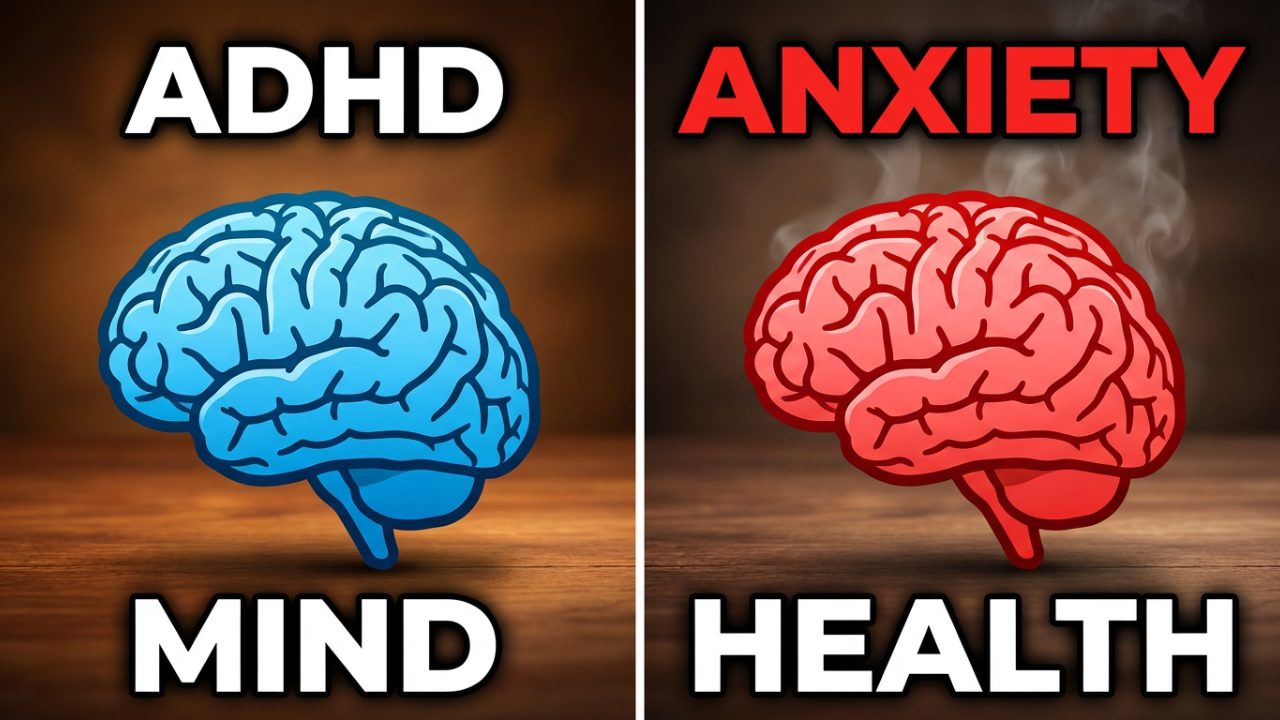
**Host:** So, one brain is under-aroused and looking for something to engage with, while the other is over-aroused and looking for threats.
**Dr. Sharma:** That’s a very effective summary. And when you have both? You have a security guard who is simultaneously bored out of their mind and terrified of everything. It is a deeply uncomfortable and chaotic place to be, which is exactly what people with both conditions describe. Their brain is flooring the gas pedal and slamming on the brakes at the same time.
**(Section 5: Unmasking the Real Issue – How to Be a Self-Observer)**
**Host:** This is all incredibly helpful. For the person watching who sees themselves in both descriptions, what are some things they can start observing in their own lives to gather more information before they see a professional? Not to self-diagnose, but to become a better observer of their own mind.
**Dr. Sharma:** That’s the perfect way to put it: becoming a better self-observer. Self-diagnosis is risky for all the reasons we’ve discussed, but gathering information is empowering. I often tell patients to become “symptom scientists.” The best tool for this is what I call the “Context Test.”
The key question to ask yourself is: *When* and *why* do my symptoms show up? Start a simple journal. Don’t just write “I was distracted today.” Add the context.
For instance: “I couldn’t focus at work during the 10 a.m. data entry task.” Then ask why. “Was I worried about something? Or was the task so mind-numbingly boring that I kept reaching for my phone just for a hit of stimulation?”
Another one: “I felt so restless during the movie tonight.” Then, ask for the context. “Was the movie stressful, making me tense? Or was it just slow, and my body felt an overwhelming urge to get up and do *anything* else?” If your symptoms of inattention and restlessness show up even in calm or enjoyable situations, that might point toward an ADHD pattern. If they’re almost always tied to feelings of worry or pressure, that might point more toward anxiety.
**Host:** That’s a very concrete tool. What else should people look for?
**Dr. Sharma:** Look back at your history. ADHD signs were almost certainly there in childhood, even if they were missed. Do your old report cards say things like, “Bright, but doesn’t apply himself,” “Daydreams in class,” or “Talks too much”? Have you *always* been the person who is chronically late, messy, and losing things? If it’s a lifelong pattern, that’s a huge clue for ADHD.
Also, think about your “why” for procrastinating. Do you put tasks off because you’re terrified you won’t do them perfectly, a classic sign of perfectionism and anxiety? Or do you put them off because starting a boring task feels physically painful, something known as “task paralysis” in the ADHD community? One is avoiding failure. The other is avoiding profound boredom.
By gathering this kind of specific, contextual information, you’re no longer a patient with a vague complaint. You become a collaborator in your own diagnosis, armed with data that can help a clinician see the true pattern.
**(Section 6: The Path Forward – Getting a Real Diagnosis)**
**Host:** Okay, so someone does this self-observation, they have their notes, and a better idea of what might be going on. What is the next step? Who should they see?
**Dr. Sharma:** The next, and most important, step is to get a formal evaluation from a qualified mental health professional. This could be a psychiatrist, a clinical psychologist, or a therapist with experience in both adult ADHD and anxiety. Don’t be afraid to ask them, “What’s your experience in telling the difference between adult ADHD and anxiety?”
A good diagnostic process should be thorough. It’s not a 15-minute chat and a prescription. A comprehensive evaluation will include a detailed interview about your symptoms, but also your entire life history—school, work, family, everything. They’ll likely use standardized rating scales or questionnaires for you and maybe a partner or parent to fill out. And in some cases, they may recommend neuropsychological testing, which directly measures cognitive functions like attention and impulse control.
**Host:** What would you say to someone who is scared to take that step? They’re worried about being judged or not being believed.
**Dr. Sharma:** That fear is so real and so valid. Many people, especially women and high-achievers, have spent their whole lives “masking” their symptoms and being told to just “try harder.” The idea of being vulnerable and getting dismissed is terrifying.
But I would say this: clarity is kindness. Living in that confusing, chaotic space is exhausting. Getting a diagnosis isn’t about getting a label; it’s about getting a user manual for your brain. It’s finally understanding the “why” behind your struggles, and that understanding is the first step toward self-compassion and finding treatments that actually work. An accurate diagnosis can be life-changing. It can reframe a lifetime of what you saw as personal failures into symptoms of a treatable condition. It gives you a path forward, so you can stop fighting against your brain and start working *with* it.
**(Conclusion & CTA)**
**Host:** Dr. Sharma, this has been incredibly illuminating. The biggest takeaway for me is that we have to look past the “what”—the symptom on the surface—and really investigate the “why.” Is the engine of your struggle fueled by worry and fear, or is it driven by a unique wiring for attention and stimulation?
**Dr. Sharma:** That’s the heart of it. And remembering that for many, it’s a mix of both. The goal is clarity, not just a simple label.
**Host:** Thank you again for sharing your wisdom with us.
For everyone watching, this conversation is a starting point. If this resonated with you, the next step is to take what you’ve learned to a professional.
We’d also love to hear from you. In the comments below, share one thing from this discussion that was a lightbulb moment for you. Reading each other’s experiences is incredibly validating and can make this all feel a lot less lonely.
And of course, if you found this video helpful, please subscribe and turn on notifications so you don’t miss our future deep dives into mental health.
Thank you for investing this time in understanding your mind. Be patient with yourself, and be proud that you’re seeking answers.