
Anxiety? You feel it. Maybe it’s a low hum of unease that follows you around, or maybe it’s a sudden, roaring fire of panic. It’s the racing thoughts, the constant worrying, that inescapable feeling of being trapped in a loop you just can’t break. Your heart pounds, your breathing gets shallow, and your mind floods with a thousand worst-case scenarios. It’s exhausting. And it feels permanent. You’ve probably been told to “think positive,” or to just “calm down,” but that advice rarely works. Sometimes, it feels like it just makes things worse.
But what if your brain’s most incredible feature—its ability to learn and adapt—is actually making your anxiety worse? What if the very system designed for growth has been hijacked, and you’ve accidentally become an expert at being anxious? It sounds strange, but it’s the hidden truth behind why so many of us get stuck in chronic anxiety and overthinking. In this video, we’re going to pull back the curtain on the science of how chronic worry physically forges fear pathways in your brain. More importantly, I’m going to give you a simple, evidence-based, 3-step process to finally break that cycle, take back control, and start reprogramming your mind for calm.

This book is scientific documentary of the Kingdom of God.
Section 1: The Problem – Decoding the Anxiety Loop
Before we can rebuild, we have to understand the architecture of the prison we’re in. For so many, anxiety doesn’t feel like a temporary state; it feels like an identity. You might call yourself an “anxious person” or a “natural worrier,” as if it’s a trait you were born with. That feeling of being fundamentally stuck is one of the most painful parts of the whole experience. It’s that little voice whispering, “This is just how you are. This will never change.”
But that voice is wrong. Chronic, looping anxiety isn’t a fixed personality trait. It’s a learned process. It’s a cycle that, through sheer repetition, has become brutally efficient. And understanding that cycle is the first step toward dismantling it. Let’s break down the anatomy of the anxiety loop, piece by piece. You’ll begin to see it not as part of you, but as a machine with moving parts—parts that can be understood, interrupted, and changed.
It all starts with a trigger. And a trigger can be almost anything. It could be an external event, like an upcoming presentation, a crowded store, or an ambiguous text from a friend. Or, and this is where it gets tricky, the trigger can be internal. It could be a random physical sensation—a slight heart flutter, a moment of dizziness, a weird twinge. It can even be a stray thought or a vague feeling that just pops into your head. For an anxious brain, the size of the trigger doesn’t matter. What matters is the meaning it assigns to it.
This brings us to stage two: misinterpretation. This is where the overthinking engine kicks into high gear. A non-anxious brain might feel a trigger, assess it, and move on. A faster heartbeat is just from climbing the stairs. That weird text means your friend is probably just busy. But a brain conditioned by anxiety doesn’t do that. It engages in what psychologists call “catastrophic thinking.” It jumps to the absolute worst possible outcome. A faster heartbeat isn’t a bodily quirk; it’s the start of a heart attack. The text isn’t a sign of a busy friend; it’s proof you’ve offended them and the friendship is over.
Why does the brain do this? It’s partly a survival mechanism called the negativity bias. Our brains evolved to pay close attention to threats. Our ancestors who obsessed over that rustle in the bushes were more likely to survive than those who ignored it. But in our modern world, this system goes haywire. It starts seeing mortal threats in work emails and social events. It scans for danger and finds it everywhere, even when it isn’t there.
Once your mind latches onto that catastrophic thought, stage three begins: the physiological response. This is where it stops being “just in your head.” Your brain doesn’t know the difference between a real threat and a perceived one. When your mind decides you’re in danger, it activates the amygdala, the brain’s tiny fear center. The amygdala sounds the alarm, flooding your system with stress hormones like adrenaline and cortisol.
The results are immediate and visceral. Your heart rate skyrockets. Your breathing becomes rapid and shallow. Your muscles tense up. You might feel dizzy, nauseous, or start to sweat. Every single one of these sensations is a real, measurable physiological event. This is so important to understand: you are not “making it up.” Your body is having a genuine fear response. The tragedy is that it’s responding to a danger that exists only in your mind.
This intense physical state leads to stage four: the behavioral response. When your body is screaming “DANGER,” your only goal is to make it stop. This leads to avoidance and safety-seeking behaviors. If you’re anxious about the presentation, you call in sick. If you’re panicked in the grocery store, you flee. If you’re worried about the text, you might compulsively apologize or check your phone every thirty seconds. These behaviors are completely logical if you truly believe you’re in mortal peril.
And here we get to the final piece of the puzzle, the part that locks the whole loop in place: short-term relief, long-term reinforcement. When you avoid the situation, your anxiety does go down. Fleeing the store brings immediate relief. Calling in sick staves off the panic. Your brain makes a simple but devastating connection: “I was in danger, I did that thing (avoidance), and I survived. Therefore, the avoidance is what saved me.”
You’ve just taught your brain that the situation was, in fact, as dangerous as you imagined. You have reinforced the neural pathway. You’ve proven the catastrophic thought correct. So the next time you face a similar trigger, the response will be faster and stronger. The cycle isn’t just repeating; it’s strengthening. Every time you run the loop, you are practicing anxiety. You are digging that neural channel deeper and wider. Overthinking is the fuel for this entire machine. Lying awake at night replaying an awkward conversation is like lifting weights for your anxiety pathways. You are actively rehearsing your brain’s ability to produce fear. This is how you get trapped in a prison where the bars are made of your own thoughts.
Section 2: The Mechanism – Neuroplasticity: Your Brain’s Double-Edged Sword
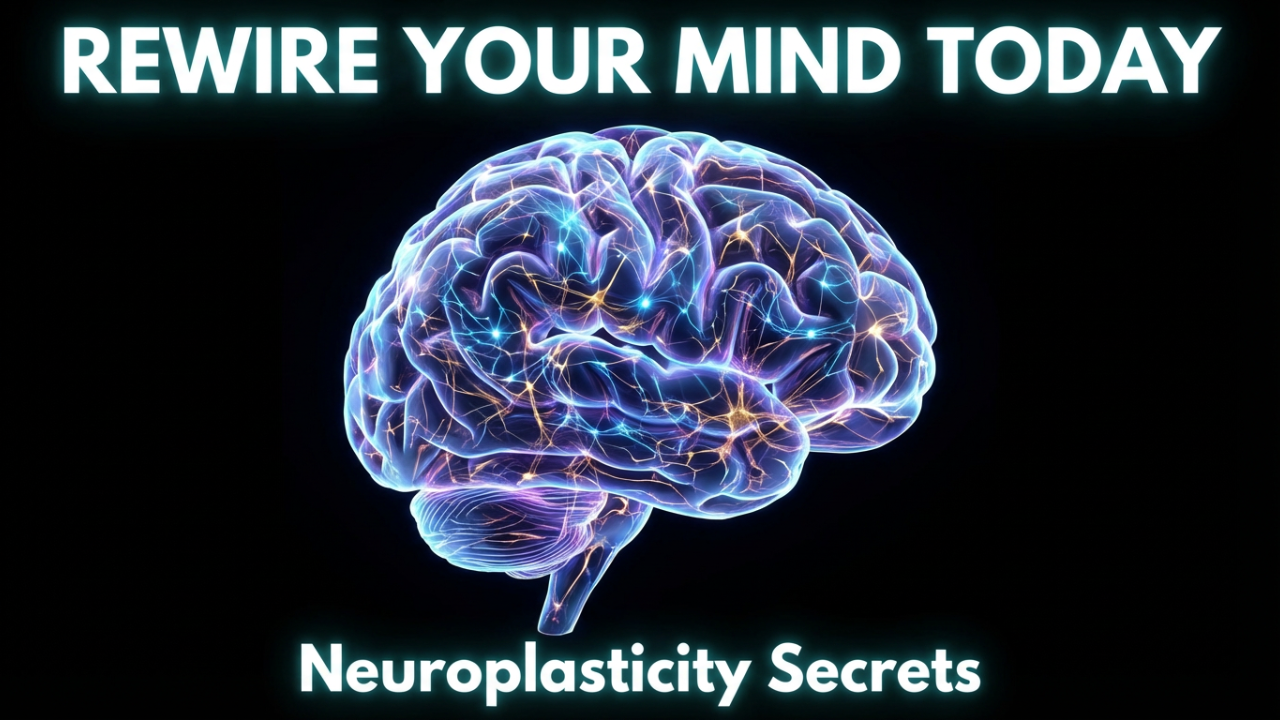
This brings us to the core of both the problem and the solution: neuroplasticity. For a long time, we thought the adult brain was more or less fixed. But a revolutionary truth has emerged: our brains are constantly changing and reorganizing themselves based on our experiences, thoughts, and actions. That is neuroplasticity.
Think of your brain as a dense forest. When you learn something new, it’s like taking the first step to forge a path. At first, it’s a faint trail, hard to walk. But if you walk that same path every day, your footsteps clear the way. The trail becomes packed down, easy, and automatic to follow. Neural pathways in the brain work in exactly the same way. The more you use a mental circuit, the stronger and faster it becomes. It’s the principle famously summarized as “neurons that fire together, wire together.”
This is how we learn any skill, from playing the piano to learning a language. Through repetition, you physically change your brain’s structure. But to understand your anxiety, you have to face a difficult truth: this is the very same mechanism that has been working against you. Every time you’ve worried, ruminated, or avoided something out of fear, you were walking that anxiety path. Through thousands of repetitions, you have, unintentionally, carved a deep, wide superhighway for anxiety in your brain. It’s become the default route.
Let’s look at the specific changes that chronic anxiety sculpts into the brain. This is where maladaptive neuroplasticity—the brain changing for the worse—becomes visible.
First, back to the amygdala, the fear alarm. In a chronically anxious brain, the amygdala doesn’t just work overtime; it can become hyper-reactive and more sensitive. Brain imaging studies suggest its volume can increase and its connections can strengthen, making it like a smoke detector that’s so sensitive it goes off from a piece of toast. Its threshold for what it considers a “threat” becomes dangerously low.
While the amygdala is getting more powerful, another critical region is being weakened: the prefrontal cortex, or PFC. Located right behind your forehead, the PFC is your brain’s CEO. It handles rational thinking, problem-solving, and emotional regulation. A key job of the PFC is to act as a brake on the amygdala. When the amygdala screams “PANIC!”, the PFC is supposed to step in and say, “Hold on, this isn’t a real threat. Calm down.”
In a brain shaped by chronic anxiety, the functional connection between the PFC and the amygdala becomes weak and unreliable. It’s not a physical break, but the communication line between the CEO’s office and the panicked mailroom gets staticky and ineffective. Your ability to step back and apply logic is impaired. When the panic starts, there’s no one at the helm to steer the ship back to calm waters.
There’s a third key player: the hippocampus. This region is vital for learning, memory, and—most importantly—context. A healthy hippocampus helps you tell the difference between a past threat and a safe present. But chronic stress floods the brain with the hormone cortisol, which can be toxic to the hippocampus. In cases of severe stress, like in PTSD or major depression, this can even cause the hippocampus to shrink, a process called atrophy. When the hippocampus is impaired, it loses its ability to provide proper context. The brain starts to overgeneralize fear, reacting to safe events today as if they are past traumas.
Finally, let’s talk about the construction material for these neural pathways: a protein called Brain-Derived Neurotrophic Factor, or BDNF. Think of BDNF as “Miracle-Gro” for your brain. It supports the health of neurons and encourages the growth of new connections. The problem? Studies consistently show that chronic stress and high cortisol levels lead to a significant drop in BDNF. It’s like trying to build a new, healthy road with a shortage of asphalt.
So, let’s put it all together. You have an overactive amygdala screaming “danger,” a weakened prefrontal cortex that can’t calm it down, an impaired hippocampus that can’t provide context, and reduced levels of the very protein you need to build new, healthy pathways.
Your brain isn’t broken. It has succeeded perfectly at the task you unwittingly gave it: it has become ruthlessly efficient at being anxious. This might sound discouraging, but it should be the most hopeful thing you’ve heard. Because if your anxiety was built, it can be un-built. If those pathways were forged, they can be abandoned. It’s time to become the active architect of your brain.
Section 3: The Solution – A 3-Step Process to Reprogram Your Brain
Welcome to the most important part of the video. This is where we move from understanding to action. We are going to engage in what’s called “self-directed neuroplasticity.” This is the conscious, intentional process of using your mind to change your brain. This isn’t about fighting anxiety, which just creates more tension. It’s about strategically building new alternatives. It’s about becoming a gardener of your own mind—allowing the old weeds of fear to wither while you intentionally plant and nurture new seeds of calm.
This is a skill. You wouldn’t expect a perfect golf swing after one lesson, and you won’t undo years of programming overnight. But with consistency, you absolutely will change the physical structure and default functioning of your brain. This three-step process is simple to remember and practical to use when anxiety strikes.
**Step 1: Recognize & Re-label (The Moment of Awareness)**
The first and most transformative step is to shift from being a *participant* in your anxiety to being an *observer* of it. Right now, when anxiety hits, you merge with it. It becomes “you.” “I am panicking.” The goal here is to create a tiny bit of space between your conscious self and the anxious process.
First, you **Recognize**. This is mindfulness in action. It’s the moment you catch it happening. Maybe it’s the first flicker of a “what if” thought or the first clench in your stomach. You simply notice it, without judgment. You say to yourself, “Ah, there it is. The anxiety program is starting to run.” Just that act of noticing is a huge step.
Next, you immediately **Re-label** it. This is a powerful technique from Cognitive Behavioral Therapy (CBT). Instead of identifying with the anxiety, you describe it as a separate neurological event. This isn’t just a word game; it actively shifts which parts of your brain are engaged. When you’re lost in anxiety, your emotional limbic system is in charge. When you consciously label what’s happening, you activate your prefrontal cortex—your thinking, rational brain. You’re literally shifting power from the panicked part of your brain to the calm part.
Here are some re-labeling phrases to practice:
* Instead of “I’m so anxious,” try: **”I am noticing my body is producing the feeling of anxiety.”**
* Instead of “This is a catastrophe,” try: **”This is just a thought, not a fact.”** or **”My brain is playing an old fear tape.”**
* Instead of “I’m losing control,” try: **”This is my amygdala misfiring. It’s uncomfortable, but it’s not dangerous.”**
By re-labeling, you’re doing two critical things. You’re validating the feeling—it is real—but you are invalidating the catastrophic interpretation. And you are de-identifying from it. The anxiety is not YOU; it’s an experience you are having. This moment of awareness is the first crack in the anxiety loop.
**Step 2: Interrupt & Shift (The Pattern Interrupt)**
Once you’ve re-labeled the pattern, the anxiety superhighway is still beckoning. Its pull is strong. So the second step is to create a deliberate pattern interrupt. You have to do something, physically or mentally, that breaks the momentum. Think of it like a train heading down the wrong track. Step 1 was noticing you’re on the wrong train. Step 2 is pulling the emergency brake and getting off.
Here’s a menu of powerful pattern interrupts:
* **Physical Interrupts:** Your mind and body are a two-way street.
* **Stand Up & Move:** If you’re sitting and worrying, just stand up. Walk to another room. Stretch.
* **Temperature Shock:** Splash cold water on your face. Hold an ice cube. The shock of the cold is a powerful sensory input that demands your brain’s immediate attention and can trigger the ‘diving reflex’, which naturally slows your heart rate.
* **Grounding:** Plant your feet firmly on the floor and pour all of your attention into that sensation. Press your hands against a wall and notice its texture and temperature.
* **Sensory Interrupts:** Overload the anxious thought with new information.
* **The 5-4-3-2-1 Technique:** This is a classic for a reason. Silently name: 5 things you can see, 4 things you can physically feel, 3 things you can hear, 2 things you can smell, and 1 thing you can taste. It’s impossible to do this and be lost in catastrophic thinking at the same time.
* **Breathing Interrupts (Vagus Nerve Stimulation):** This is one of the most direct biological hacks for anxiety. The vagus nerve is the main line for your “rest and digest” system, the body’s natural antidote to “fight or flight.” Stimulating it sends a direct signal to your brain to calm down.
* **The Physiological Sigh:** Endorsed by neuroscientists, this is your body’s natural de-stressor. Take a double inhale through the nose (one big, then a short top-up), followed by a long, slow exhale through the mouth. Do it twice.
* **Box Breathing:** Inhale for 4 seconds, hold for 4, exhale for 4, hold for 4. The rhythm itself is calming and focuses the mind.
* **Humming or Chanting:** The vibrations in your chest and throat from humming or singing gently stimulate the vagus nerve.
The goal here isn’t to solve the anxiety, just to stop the runaway train. You’ve created a pause. A moment of choice.
**Step 3: Create a New Path (Intentional Action & Refocusing)**
This is the most crucial step. You’ve noticed the old path. You’ve stopped yourself from running down it. Now, you must consciously turn and start blazing a new trail. If you just interrupt the old pattern and do nothing, the pull of the old path will eventually win. You have to replace the old behavior with a new, chosen one. This is where the magic happens. Remember: where attention goes, energy flows, and neural pathways grow.
Direct your attention toward a constructive or calming alternative. Here’s a menu of options. The key is to pick one and fully engage with it for just a few minutes.
* **Engage in a Focused Task:** Your prefrontal cortex loves a good task. Do a puzzle, organize a drawer, play an instrument, or continue your work. Focusing on an external goal pulls energy away from the amygdala and strengthens your PFC.
* **Practice Gratitude:** Gratitude and anxiety are neurologically incompatible; they use different brain networks. Intentionally bring to mind three specific things you’re grateful for, no matter how small. Feel the appreciation in your body. This shifts your brain’s focus from threat to safety.
* **Visualize a Safe Scene:** Your brain often can’t tell the difference between vivid imagination and reality. Close your eyes and picture a place you feel completely safe and calm. Engage all your senses. What do you see, hear, and feel? You’re giving your brain “reps” for a positive outcome, rehearsing a new neural response.
* **Choose New Self-Talk:** The old path was paved with catastrophic thoughts. The new path must be paved with compassionate and realistic ones. This isn’t toxic positivity. It’s balanced truth.
* Replace “I can’t handle this” with **”This feeling is uncomfortable, but I’ve gotten through it before. It is temporary.”**
* Replace “I’m going to fail” with **”I will do my best, and that is enough. I can handle the outcome.”**
Every single time you complete this three-step sequence—Recognize & Relabel, Interrupt & Shift, Create a New Path—you weaken the old anxiety superhighway by denying it traffic. And you strengthen a new, calm pathway by using it. At first, this new path will feel awkward. It will take effort. But with repetition, it will become your new default. The old anxiety trail will fade from lack of use, while your new path of resilience becomes a clear, open road.
Conclusion
Let’s bring this all together. For so long, you may have felt your anxiety was a permanent part of you. But now you know the truth. You felt stuck because your brain, through the power of neuroplasticity, simply got really good at running a fear program it learned from the past. It isn’t a character flaw; it’s a neurological process.
But the very power that built the prison can be used to tear it down. With the 3-step process of **Recognize & Re-label**, **Interrupt & Shift**, and **Create a New Path**, you now have the tools for self-directed neuroplasticity. You have a manual for becoming the conscious architect of your own mind.
This isn’t a quick fix. It’s a training regimen for your brain. There will be days you fall back onto the old path. That’s okay. The goal isn’t perfection; it’s persistence. Every time you practice, you make the new way a little stronger.
You are not broken. You are, and always have been, profoundly adaptable. And now, you have the knowledge to direct that adaptability towards calm, resilience, and freedom. Change is not only possible; it is your brain’s fundamental nature. The journey starts now.