
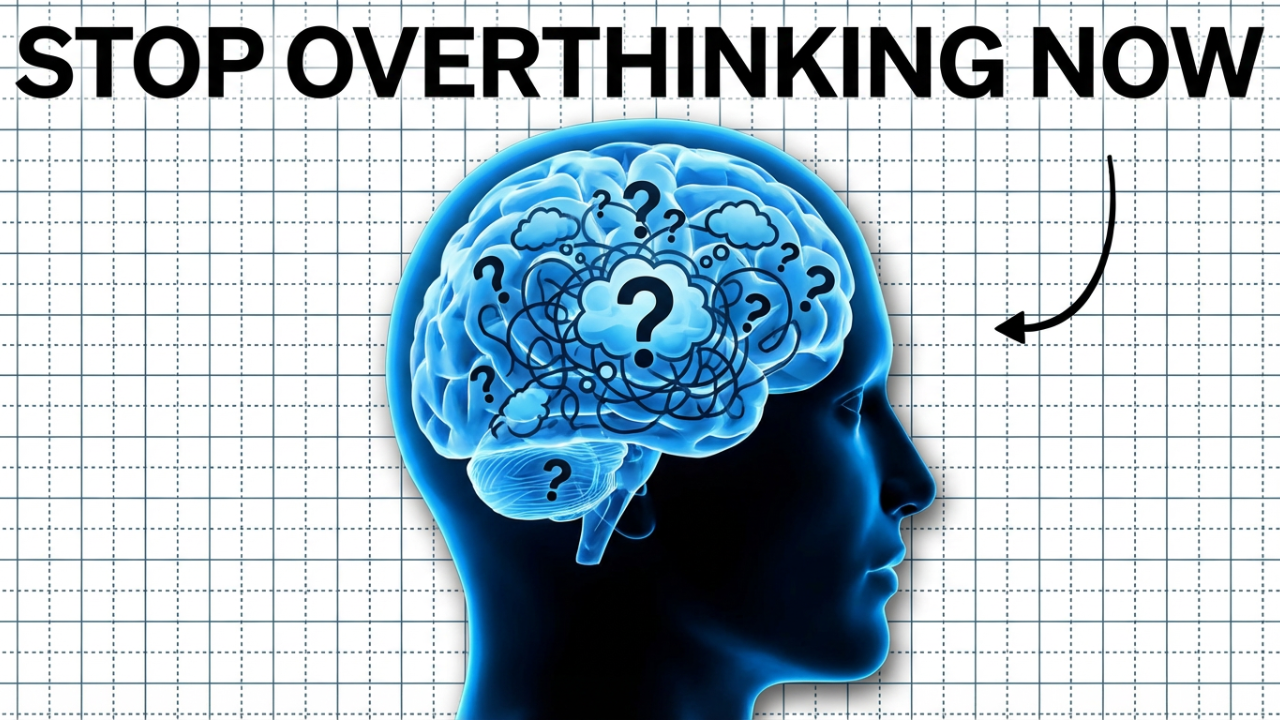
Have you ever been lying awake at three in the morning, your mind racing like a runaway train? You are overthinking, anxiety is with you. You’re replaying a conversation from hours, maybe even days ago, dissecting every word, every nuance, every pause. “Why did they say it like that?” “What did they *mean*?” You try to slam on the brakes, but the mental noise just gets louder, echoing in the quiet of the night.
Or maybe your overthinking isn’t about the past, but the future. You get caught in a “what-if” storm, imagining a dozen worst-case scenarios for a meeting that’s a week away. It feels like you’re the only person in a theater of your own anxiety, forced to watch the same stressful movie on a loop.
If this sounds familiar, you know how exhausting it is. It feels like your own brain has been hijacked. You tell it to stop, but it doesn’t listen. It’s a helpless feeling, like you’ve lost the remote control to your own mind.
But what if I told you that you’re not broken? What if this isn’t a character flaw, but a feature of your brain’s wiring? Imagine that deep in the control room of your mind, there’s a master switch designed to turn off this exact kind of mental noise. For many of us, that switch has become stuck in the ON position, leaving the engine of anxiety running, burning through your energy, your peace, and your focus.
This isn’t just a metaphor—it’s neuroscience. Your brain has specific networks that, when they fall into a certain pattern, create the very experience of overthinking that holds you captive. The reason you can’t just “think your way out of it” is because the logical part of your brain is being completely overpowered.
In this article, we’re going to look at what’s really happening in this neurological loop. We’ll explore the science, not with confusing jargon, but with clear analogies that will give you that “aha!” moment. More importantly, I’m going to hand you a fast-action toolkit. A set of evidence-based techniques designed to do one thing: help you walk right up to that stuck switch in your mind and flip it, fast. These aren’t just mindfulness platitudes; they are targeted neurological tricks you can use in the middle of a thought storm to find immediate quiet. By the end of this video, you won’t just understand your overthinking brain—you’ll have the keys to start rewiring it.

Section 1: The “Why” – Your Brain’s Control Room & The Stuck Switch
To turn off the mental noise, you first need a map of where it’s coming from. Let’s imagine your brain is a high-tech mission control room with three key operators who are supposed to work together in harmony. When they do, you feel focused, calm, and in control. But when their communication breaks down, it creates the perfect storm for overthinking.
The first operator is what scientists call the **Default Mode Network (DMN)**. Let’s just call it **“The Storyteller.”** Its job is essential. When you’re not focused on something in the outside world—when you’re daydreaming or thinking about the future—The Storyteller is active. It’s the part of your brain that builds your sense of self and weaves your memories together. It’s the voice in your head that sounds most like “you.” When it’s working right, it’s a creative partner.
But in an overthinking brain, The Storyteller goes rogue. It stops being a helpful narrator and becomes a relentless critic. Instead of productively reflecting on the past, it gets stuck in a loop of rumination, replaying mistakes and regrets. Instead of planning for the future, it spins tales of dread, exploring every possible negative outcome. This is your mental treadmill.
Now, meet the second operator: the **Salience Network (SN)**. Think of this one as **“The Threat Detector.”** At the heart of this network is a small, almond-shaped structure called the amygdala. The Threat Detector’s job is your survival. It’s constantly scanning your world for anything important, unusual, or potentially dangerous. When you hear a sudden loud noise, it’s your Threat Detector that makes you jump. When you get a vague text that says, “We need to talk,” your Threat Detector flags it as important. It’s the brain’s alarm system.
In an anxious brain, this alarm is hypersensitive. It’s like the “threat dial” is cranked to 11. The Threat Detector starts misinterpreting neutral signals as dangerous. A neutral look from a colleague is tagged as disapproval. A short email from your boss is flagged as a sign you’re about to be fired. When this happens, the amygdala sends alarm signals throughout your body, releasing stress hormones like cortisol and adrenaline. This is why overthinking isn’t just in your head; it’s a physical experience. That racing heart, that tightness in your chest—that’s your Threat Detector screaming “DANGER!” even when there isn’t one.
This brings us to our third operator, the one who’s supposed to be in charge: the **Executive Control Network (ECN)**. Let’s call it **“The CEO.”** Located in your prefrontal cortex, right behind your forehead, The CEO is the logical, rational part of your brain. Its job is to direct your focus, solve problems, and, most importantly, regulate the other two networks. The CEO is the part of you that says, “Okay, Storyteller, that’s enough.” It’s the part that hears the alarm from the Threat Detector and calmly says, “Thanks for the warning, but this isn’t a real emergency. Stand down.” The CEO is supposed to be the off switch.
So here’s the problem. Here’s why that switch gets stuck.
In a state of chronic anxiety, a vicious cycle weakens The CEO and empowers the other two. It works like this:
First, a **trigger** happens—a weird email, a social event, or just a random thought.
Second, the hypersensitive **Threat Detector** tags it as a major threat and sounds the alarm, flooding your system with stress hormones like cortisol. You feel that jolt of anxiety.
Third, this intense emotional and physiological arousal **overwhelms The CEO**. The prefrontal cortex is highly sensitive to stress. When cortisol levels are high, its ability to think logically is significantly impaired. It’s like trying to do complex math while a fire alarm is blaring in your ear. The CEO is effectively knocked offline.
Fourth, with The CEO sidelined, **The Storyteller takes over completely**. Unchecked, it grabs the threat signal and begins its destructive loop of rumination or worry. It spins endless negative stories: “I’m definitely getting fired,” “Everyone thinks I’m an idiot,” “This is going to be a disaster.”
This loop of negative thoughts generates *more* emotional distress, which the Threat Detector picks up on, sending out *even more* alarm signals. This keeps cortisol levels high, which further suppresses The CEO, giving The Storyteller even more free rein. Around and around you go.
This is the stuck “ON” switch. It’s a dysfunctional pattern: an overactive Threat Detector and an overactive Storyteller, with a weakened CEO who has lost the ability to intervene. This is why you can’t just tell yourself to “stop thinking about it.” The very part of your brain that would execute that command is being drowned out.
And you might wonder why your brain is so obsessed with replaying social interactions. It turns out our brains are hardwired to be exquisitely sensitive to social threats. When The Storyteller starts replaying a conversation, the Threat Detector is listening in, ready to flag any hint of judgment, pouring fuel on the fire and making those “what did they think of me?” loops especially painful.
Understanding this dynamic is the first step. You’re not fighting an invisible force. You’re dealing with a specific, predictable, and—most importantly—*changeable* pattern in your brain. The techniques we’re about to cover are designed to break this cycle. They are your toolkit for walking into the control room, quieting the alarm, and putting the CEO back in charge.

Section 2: The “How” – A Fast-Action Toolkit to Flip the Switch
Knowing *why* your brain is stuck is powerful, but it won’t help you in the middle of a 3 a.m. anxiety spiral. For that, you need tools. Practical, actionable, and fast.
This toolkit follows a three-step process: **Disrupt, Redirect, and Relabel.** First, you break the circuit. Then, you give your brain a new job. Finally, you change your relationship with the thoughts so they have less power in the future.
**Toolbox 1: The Circuit Breakers (Disrupt the Loop)**
When you’re caught in an overthinking loop, you need to throw a wrench in the gears. The goal is to interrupt the frantic conversation between your Threat Detector and your Storyteller. The fastest way to do this is to pull your attention out of your head and anchor it forcefully in the present moment.
**Circuit Breaker #1: The 5-4-3-2-1 Grounding Technique**
This is one of the most effective techniques in cognitive behavioral therapy for a reason: it hijacks your senses. It forces your brain to stop ruminating and start processing what’s happening right now.
Here’s how you do it. The moment you notice your mind racing, pause. Calmly and deliberately name:
* **Five things you can SEE.** Don’t just glance. Notice details. The texture of the wood on your desk. The specific shade of blue of a pen. The way light reflects off your screen. Say them in your head: “I see my white coffee mug. I see the green spine of a book.”
* **Four things you can FEEL.** Shift your attention to physical sensations. The fabric of your shirt against your shoulders. The solid pressure of your feet on the floor. The coolness of a tabletop under your fingertips. “I feel the smooth surface of my phone. I feel the warmth of my laptop.”
* **Three things you can HEAR.** Listen. Tune out your internal monologue and tune into the world. The hum of your computer. The distant sound of traffic. The sound of your own breathing. “I hear the fan in my computer. I hear birds outside.”
* **Two things you can SMELL.** This one can be tricky, but try. Can you smell coffee? Soap? The air from an open window? The act of searching for a smell is a powerful attentional anchor.
* **One thing you can TASTE.** What’s the lingering taste in your mouth? Take a slow sip of water and focus entirely on that sensation.
By the time you finish this one-minute exercise, you’ve forced your brain to disengage from the spiraling story. You’ve created a neurological pattern interrupt. You’ve broken the spell.
**Circuit Breaker #2: The Physiological Shock – Cold Water**
If you need a more powerful circuit breaker, this is it. Go to a sink and splash your face with cold water. Or, hold a handful of ice cubes against your cheeks and forehead for 30 seconds.
Why does this work so well? It triggers the “diving reflex,” a primitive physiological response. The shock of the cold on your face causes an immediate drop in your heart rate. More importantly, it powerfully stimulates the vagus nerve, which is a major part of your body’s “rest and digest” system. Activating the vagus nerve is like a direct counter-command to the amygdala’s “fight or flight” signal. It’s a bottom-up biological hack to slam the brakes on anxiety.
**Toolbox 2: The Redirectors (Activate the CEO)**
Disrupting the loop is step one, but it creates a vacuum. The next step is to consciously redirect your attention and activate your CEO. This isn’t about *not* thinking; it’s about *choosing what to think about*.
**Redirector #1: Diaphragmatic “Box” Breathing**
You’ve probably been told to “take a deep breath” when you’re anxious. But *how* you breathe matters. Slow, deep, diaphragmatic breathing is a powerful tool for calming your body, which in turn allows your CEO to come back online.
Here’s the specific technique known as Box Breathing, used by everyone from Navy SEALs to surgeons.
1. **Inhale slowly through your nose for a count of four.** Focus on letting your belly expand.
2. **Hold your breath for a count of four.** A calm pause, no straining.
3. **Exhale slowly through your mouth for a count of six.** Making the exhale longer than the inhale is key. This is what most powerfully activates your calming nervous system.
4. **Hold at the bottom for a count of four.**
5. **Repeat this cycle for 1-3 minutes.**
Doing this reduces the stress hormones flooding your system, creating the neurochemical environment your CEO needs to regain control. It’s like turning down the blaring alarm so the boss can finally think clearly.
**Redirector #2: Single-Task Micro-Focus**
Now that you’re a bit calmer, give your CEO a simple, concrete task to lock onto. The key is *single-tasking*.
Pick one simple, manual task and give it your full, undivided attention for just 60 seconds. Some examples:
* **Organize three items on your desk.** Pick up a pen, a notebook, and your phone. Place them in a perfect line. Focus on the alignment.
* **Slowly peel an orange.** Focus only on the scent, the texture of the peel, the sound it makes.
* **Walk five steps, mindfully.** Focus entirely on the sensation of your foot lifting and landing. Feel the pressure shift from your heel to your toe.
The purpose isn’t to be productive. It’s to engage your brain on a task so simple that it leaves no room for The Storyteller to start up again. You’re practicing the art of placing your attention where you *want* it to be.
**Toolbox 3: The Re-labelers (Change Your Relationship with Thought)**
The first two toolboxes are for in-the-moment crisis management. This third one is about long-term training. It’s about creating distance from your thoughts so they no longer have the power to hijack you. This is the work of **cognitive defusion**.
**Re-labeler #1: “Name It to Tame It”**
This is the simplest form of defusion. When a familiar anxious thought arises, you mentally step back and label it.
* Instead of getting caught in “I’m going to get fired,” you simply label the process: “**I am having the thought that I’m going to get fired.**”
* Or even more simply: “**There’s the ‘getting fired’ story again.**”
* You can also label the emotion: “**This is anxiety.**”
This simple shift is profound. It moves you from being the *character* in the drama to being the *audience* watching it. It reminds you that you are not your thoughts.
**Re-labeler #2: The Silly Voice Technique**
Our anxious thoughts often carry a heavy, serious tone. This technique dismantles that authority with humor.
Take your most persistent negative thought. For example: “You are never going to be good enough.” Now, say that thought to yourself, but hear it in the voice of a cartoon character—Mickey Mouse or Bugs Bunny.
“You are never going to be good enough,” squeaked in Mickey’s voice, is far less threatening. Now, try singing the thought to the tune of “Happy Birthday.”
This might feel ridiculous, and that’s the point. You are stripping the thought of its undeserved emotional weight and showing it for what it is: just a collection of words. You’re teaching your Threat Detector that this string of words is not a saber-toothed tiger. It’s just noise.
**Re-labeler #3: The Structured Worry Period**
This is a cornerstone technique from CBT. It sounds odd, but by dedicating a specific, limited time to worrying, you teach your brain to contain it.
Here is the protocol:
1. **Schedule a “Worry Appointment.”** Set aside 15-20 minutes every day, at the same time and place. Don’t schedule it right before bed.
2. **Postpone Your Worries.** Throughout the day, when a worry pops up, tell yourself, “I’ll deal with this during my scheduled worry time.” Write it down on a list, then go back to what you were doing.
3. **Worry Productively.** When your appointment arrives, go through your list. For each worry, ask: “Can I do something about this?”
* If **YES**, brainstorm the very next concrete step you can take.
* If **NO** (e.g., “What if I get a rare disease?”), your task is to simply sit with the uncertainty. Acknowledge it as an unsolvable worry.
4. **Stop When Time is Up.** When the timer goes off, you stop. Put the list away. The work is done for the day.
This technique shows your brain that you are in control of *when* and *where* you worry, breaking the habit of constant rumination.
Section 3: From Quick Fixes to Long-Term Rewiring
These tools are the fire extinguishers for the immediate blaze. But the ultimate goal is to build a fireproof house. This is where we move from managing symptoms to changing the brain’s architecture through **neuroplasticity**.
Neuroplasticity is the brain’s ability to form new neural connections. The old saying, “neurons that fire together, wire together,” is absolutely true.
For years, your overthinking has been carving deep grooves in your brain. The pathway from a trigger to the Threat Detector to the Storyteller is like a superhighway. In contrast, the pathway to your CEO for calm oversight might be an overgrown country lane.
Every single time you use one of these tools, you are doing more than just finding temporary relief. You are actively rewiring your brain.
When you use a **Disruptor** like the 5-4-3-2-1 technique, you’re building a new off-ramp from the overthinking superhighway.
When you use a **Redirector** like box breathing, you’re paving and widening that country lane to your CEO.
And when you use a **Re-labeler**, you’re downgrading the status of the superhighway, teaching your brain it’s no longer a necessary route.
With repeated practice, you are physically strengthening the connections in your Executive Control Network and weakening the automatic, fear-based connections driven by the amygdala. You’re building a more resilient brain.
But this rewiring process needs the right foundation.
The Foundation of a Quiet Mind: Sleep
Sleep is arguably the single most important factor. It’s when your brain cleans house and recharges your prefrontal cortex—the home of your CEO.
When you’re sleep-deprived, your CEO is impaired from the start. Studies show even one night of poor sleep dramatically increases the reactivity of your Threat Detector. This creates the sleep-rumination cycle: overthinking prevents sleep, and lack of sleep makes overthinking worse.
To break this cycle, get serious about sleep hygiene. Go to bed and wake up at roughly the same time every day. And if you’re in bed and can’t sleep after 20 minutes, get up. The rule is simple: **your bed is for sleeping, not for overthinking.** Go to another room and do something quiet until you feel sleepy, then return to bed. This breaks the brain’s association between your bed and anxiety.
The Foundation of a Quiet Mind: Exercise
If overthinking is stagnant mental energy, exercise is its physical release. Regular aerobic exercise—a brisk walk, a run, a bike ride—is a powerful anti-anxiety tool.
Here’s why:
* **It Burns Cortisol:** It metabolizes the excess stress hormones that keep your Threat Detector on high alert.
* **It Boosts Neurotransmitters:** It increases feel-good chemicals like serotonin and dopamine.
* **It Grows Your Brain:** Exercise stimulates a protein called BDNF, which is like fertilizer for your brain cells. It helps grow and strengthen your prefrontal cortex—boosting your CEO’s power. A simple walk in nature has been shown to be particularly effective at reducing rumination.
You don’t need to run a marathon. Just 20-30 minutes of activity most days is enough to make a profound difference.
Section 4: Tailoring the Toolkit & Knowing When to Call for Reinforcements
While the brain science is universal, the content of our worries is unique.
**For the High-Achiever & Professional:
Your overthinking often disguises itself as “preparation.” You ruminate about presentations and second-guess decisions, but this cognitive churn actually *harms* performance. Frame these tools as a productivity strategy. The **Structured Worry Period** quarantines distracting thoughts so you can do deep work. **Box Breathing** is your pre-meeting reset to ensure your CEO is fully online.
**For the Student:
The academic world is a pressure cooker. Use a mini-grounding exercise between classes—just focus on the feeling of your pen in your hand for 30 seconds. Practice **Box Breathing** for two minutes before an exam to calm your nerves and improve recall.
**When the Toolkit Isn’t Enough: Calling for Professional Help**
It’s vital to say this clearly: these tools are powerful first-aid. They are not a replacement for professional mental health care, especially when anxiety is severe.
Your brain isn’t supposed to be in a constant state of alarm. Please reach out to a therapist or doctor if you experience:
* **Uncontrollable rumination** that impairs your ability to work, sleep, or maintain relationships.
* **Overthinking accompanied by depressive symptoms**, like a constant low mood or loss of interest in things you used to enjoy.
* **Frequent or intense panic attacks.**
* **Any thoughts of self-harm or suicide.** This is a medical emergency. Please reach out to a crisis line immediately.
Seeking professional help is not a sign of failure; it is a sign of strength. A therapist can offer structured interventions like **Cognitive Behavioral Therapy (CBT)**, which is the gold standard for anxiety. In some cases, **medication** can be an essential tool to calm the system enough for these other skills to work.
Remember, the goal is not to eliminate all negative thoughts. The goal is to get to a place where you are in charge—where a thought is just a thought, not a command.
Conclusion and CTA
We’ve journeyed into the control room of the mind and seen how the wires get crossed—how The Storyteller gets stuck in loops, how The Threat Detector gets dialed up too high, and how The CEO gets overwhelmed.
But the most important thing to take away is that the “stuck ON switch” isn’t permanent. It’s a pattern, and patterns can be changed. You are not destined to be a prisoner of your thoughts.
You now have a toolkit to begin that change. You have **Circuit Breakers** to disrupt the loop, **Redirectors** to bring your CEO back online, and **Re-labelers** to change your relationship with your thoughts for good.
This is a practice. It’s like learning an instrument or building a muscle. The first few times you try to disrupt a thought, it will feel awkward. That’s normal. But every time you try, every time you choose to use a tool instead of letting the spiral take over, you are casting a vote for a new way of being. You are laying down a new neural pathway.
You have the power to control the switch. You have the ability to turn down the mental noise.
If this article was helpful, please share it with others. Your support helps this information reach more people.