
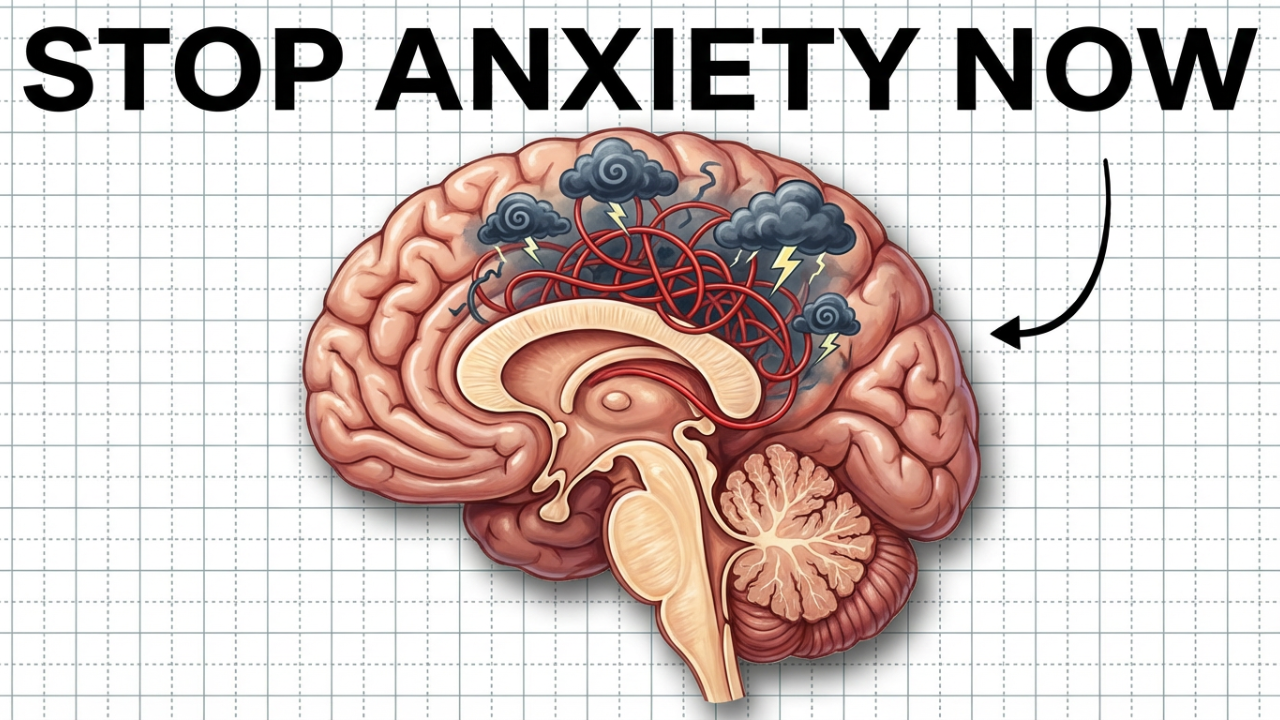
Does it ever feel like your brain just has a mind of its own? Like there’s some anxiety program you never asked for, running on a loop you just can’t seem to stop. It’s that constant stream of ‘what-ifs,’ the knot in your stomach, that feeling of dread that just colors everything. You’ve tried to fight it. You’ve tried to ignore it. You’ve tried to reason with it. But that anxious script just keeps playing, day in and day out. It starts to dictate where you go, what you do, and who you see. It can shrink your world, one avoided situation at a time.
What if I told you that you don’t have to just be a passive audience to your own mind? What if you could get off the stage, walk into the control room, and actually access the source code of that anxiety? What if you could become the programmer, instead of the program?
That’s exactly what we’re going to explore. We are going to pull back the curtain on the neuroscience of anxiety. We’re not just talking about coping with feelings; we’re talking about fundamentally changing the brain that produces them. We’re going to tap into one of the most hopeful and powerful discoveries in modern science: neuroplasticity. This is your brain’s natural, built-in ability to change, adapt, and form new connections. It’s the very mechanism that will allow you to access and rewrite the anxious program your brain has been running for years. Now, this isn’t a quick fix or a magic pill. This is a training manual for your own mind, grounded in science, and designed to give you back control.

Problem & Agitation
Before we get to the ‘how,’ we really have to understand the ‘what’ and the ‘why.’ What exactly is this anxiety program? And why does it feel so automatic, so powerful… so *real*?
For millions of us, anxiety isn’t just an occasional worry; it’s a constant, humming background noise that can swell into a deafening roar without warning. It can feel less like an emotion and more like a core part of your identity. You might even think, “I am an anxious person.” But this is one of the first lines of code we need to re-examine. You are not an anxious person; you are a person who is *currently* experiencing a state of anxiety, driven by deeply ingrained, automatic patterns in your brain.
Think of it like a path worn into a forest floor. The first time you had a really stressful or fearful thought, it was like taking a first step through the dense woods. Maybe it was a presentation at school, an awkward social encounter, or a moment of genuine danger. Your brain, in its effort to protect you, carved a tiny trail. The next time a similar situation came up, your mind, always looking for the most efficient route, took that same path. It was a little easier this time. After hundreds, or even thousands of repetitions, that path isn’t a faint trail anymore. It’s a deep, wide, well-trodden highway. Your thoughts, feelings, and reactions now travel down this highway automatically, without you even having to think about it.
This is the anxiety cycle. A trigger appears—it could be a real threat, but more often, it’s a perceived one, like an upcoming deadline, a crowded room, or even just a negative thought. This trigger launches the anxiety program. Your heart starts to pound, your breathing gets shallow, your muscles tense up. Your mind floods with worst-case scenarios. You feel an overwhelming urge to escape, to avoid whatever triggered it. And when you do? You feel a momentary sense of relief.
But here’s the really sneaky part of the program: that relief reinforces the entire loop. Your brain learns, “Aha, running away worked! That scary thing really *was* dangerous, and we stayed safe by avoiding it.” The anxious highway gets a fresh layer of pavement. The program becomes more efficient, more powerful, and easier to trigger next time. So avoidance, the very thing you do to feel better, is the fuel that keeps the anxiety engine running hot. Over time, this doesn’t just feel like a bad habit; it can feel like an unchangeable part of who you are. Your world gets smaller as the list of things you avoid gets longer. The program isn’t just running anymore; it’s running *you*.
And that’s the frustrating part. That exhausting, demoralizing loop of trying to outrun your own mind, only to find it waiting for you at every turn. It’s the feeling of being trapped in a script you didn’t write and don’t know how to stop. But here is the critical truth: the script *can* be changed. The hardware—your brain—is designed to be reprogrammed.
Section 1: The Brain’s Anxiety Code – The Science of the Amygdala and BNST
To become the programmer of your own brain, you first need to know the architecture of the system you’re working with. When we talk about anxiety, we’re not talking about some vague, mystical force. We’re talking about the specific, measurable activity of brain cells in particular parts of your brain. Two regions, in particular, are the lead actors in this drama: the **amygdala** and the **bed nucleus of the stria terminalis**, or **BNST**.
Think of these two structures as the core of your brain’s threat detection system. They work together, but they tend to have different, though related, jobs.
First up, let’s meet the **amygdala**. Imagine the amygdala as your brain’s hyper-sensitive smoke detector. It’s a small, almond-shaped cluster of neurons whose main job is to react to immediate, obvious, and sudden threats. It’s fast, it’s loud, and it prioritizes safety over accuracy. When you’re walking in the woods and see a stick that looks like a snake, it’s your amygdala that screams “DANGER!” before your conscious, logical brain has a chance to go, “Oh, wait, it’s just a stick.” This is the famous “amygdala hijack.” It triggers that classic fight-or-flight response: your heart pounds, your pupils dilate, and adrenaline floods your system. In people with anxiety, this smoke detector is often hyperactive. It’s set to maximum sensitivity. It doesn’t just go off for a fire; it goes off when you burn the toast. It treats everyday stressors—a critical email, a weird look from a stranger—as if they are life-or-death emergencies.
This isn’t just a feeling; it’s biology. Studies show that in conditions like Generalized Anxiety Disorder and PTSD, the amygdala shows heightened reactivity. It gets really good at linking neutral things to threatening outcomes, creating a huge library of “potential dangers.” It then blasts that “threat alert” to other brain regions, which creates the physical and emotional response we feel as fear and panic.
Now, if the amygdala is the smoke detector for immediate threats, the **BNST** is more like the anxious security guard who paces the hallways all night, worrying about *potential* future threats. The BNST is part of what’s called the “extended amygdala,” and it specializes in a different flavor of anxiety: the slow-burn, “what-if” kind. It’s not about the lion right in front of you; it’s about the *possibility* that a lion might be lurking somewhere in the shadows.
The BNST is what drives that feeling of unease, apprehension, and general dread that is so common in chronic anxiety. It’s responsible for thoughts like, “What if I fail the exam? What if they didn’t like what I said? What if something bad happens tomorrow?” While the amygdala screams, the BNST whispers, and its whispers can last for hours, days, or even weeks. In anxiety disorders, this internal security guard is permanently on high alert, convinced that disaster is always just around the corner.
These two regions don’t work in a vacuum. They form a powerful, interconnected circuit, feeding off of each other’s vigilance. Chronic stress makes this whole system even more reactive. When you’re constantly stressed, your body releases hormones like cortisol, which act like an amplifier, turning up the volume on the amygdala and BNST. At the same time, stress weakens the brain’s “brakes”—a calming neurotransmitter called GABA. This leads to a state where the threat-detection circuits are all gas and no brakes.
This is the anxious program in action: an oversensitive smoke detector (amygdala) and an overly worried security guard (BNST), bathed in stress hormones, with faulty brakes. This isn’t a personal failing. It’s a biological state. And because it’s a biological state, we can use biological tools to change it.

Section 2: Introducing the Editor – Neuroplasticity as the Solution
For a long time, the prevailing belief was that the adult brain was more or less fixed. We now know this is completely untrue. The brain is not a static machine; it’s a dynamic, living, and constantly adapting network. This ability to change is called **neuroplasticity**.
Neuroplasticity is the single most important concept for anyone looking to overcome anxiety at its source. It is the scientific basis for hope. It means that the anxious highways in your brain are not permanent. You are not “stuck” with the brain you have today. Through your thoughts, behaviors, and focus, you can act as the lead editor of your own neural code.
Think of your brain like a massive, intricate power grid. The connections between your brain cells are the wires, and the strength of those connections determines how easily information flows. When you repeatedly have an anxious thought or an avoidant behavior, you are strengthening the wires in that anxiety circuit. The pathway becomes more insulated, more efficient—the brain’s default route. It’s simply the path of least resistance.
Neuroplasticity is the process of laying down new wires and strengthening them, while letting the old, anxious wires fall into disuse. Every time you choose a new response, challenge an anxious thought, or face a fear, you are sending a little trickle of energy down a new, healthier pathway. At first, this new path feels weak and takes conscious effort. But with repetition, it becomes stronger and wider. Eventually, *it* becomes the new default. This is how we learn any new skill, whether it’s playing the piano or training your brain to be calm. The brain literally rewires itself based on how you use it.
So, how do we consciously direct this process? The key is to engage another critical part of your brain: the **prefrontal cortex (PFC)**.
The PFC, right behind your forehead, is the CEO of your brain. It’s your center for logical reasoning, planning, and emotional regulation. While the amygdala is the emotional, reactive alarm system, the PFC is the wise leader who can look at the situation and say, “Hold on. Let’s analyze this. Is this a real threat, or a false alarm?”
In an anxious brain, the communication from the PFC to the amygdala is often weak. The amygdala hijacks the system, and the PFC’s calming voice gets drowned out. The goal of rewriting our anxious code is to strengthen that top-down control from the PFC. Brain imaging studies of people undergoing treatments like Cognitive Behavioral Therapy (CBT) show this happening. As people learn to challenge their anxious thoughts and change their behaviors, you can literally see activity in their PFC increase, while hyperactivity in their amygdala decreases. They are physically strengthening the neural pathways that allow for a thoughtful response instead of an automatic reaction.
This isn’t just about “thinking positive.” It’s about systematically and intentionally engaging in practices that build a new brain. You are the architect. Neuroplasticity is the raw material. And the techniques we’re about to discuss are your tools. By using them, you’re not just managing symptoms; you are fundamentally changing your brain’s structure and function to create a lasting foundation of calm. You are rewriting the code, one line at a time.
CTA Mid-roll
We’ve explored the deep-seated “program” of anxiety and the incredible science of neuroplasticity that gives us the power to rewrite it. Now, we’re about to get into the most important part: the practical, step-by-step guide to actually *doing* it. This is where the real work—and the real transformation—begins.
But before we dive into the “how-to,” I want to offer you something to support you on this journey. I’ve created a free, downloadable workbook called “The Anxious Brain Rewiring Guide.” It has detailed exercises, thought record sheets, and checklists to help you put everything we’re about to cover into practice. This isn’t just a video; it’s the start of a process, and having a structured guide can make all the difference. The link is right there in the description below. Go download it, print it out, and use it as your personal manual as we walk through these next steps together.
Alright, are you ready to become the programmer of your own mind? Let’s get into the four essential steps to rewriting your anxious brain.
Section 3: The Rewriting Process – A 4-Step Guide
This is where theory becomes practice. Rewriting your brain’s anxious code isn’t a single event; it’s a process. We’re going to break it down into four clear, actionable steps. Think of it like this: De-bugging, Installing New Software, Running the New Program, and System Maintenance.
Step 1: De-bugging the System – Mindful Awareness
The first rule of changing any program is that you have to understand the existing code. You can’t fix a bug you can’t see. For our brains, this means developing **Mindful Awareness**.
Anxiety loves to run on autopilot, triggering reactions before you’re even consciously aware of what’s happening. The goal here is to bring that program from the background into the foreground. It’s about learning to observe your anxiety with curiosity instead of automatically reacting with fear.
Mindfulness, in this case, isn’t about emptying your mind or forcing yourself to feel calm. That’s a common misconception that just leads to more frustration. Instead, it’s about paying attention to the present moment, on purpose, without judgment. When you feel that familiar knot of anxiety, or when a “what-if” thought pops into your head, the practice is to simply… notice it.
Here’s how to start. The next time you feel a wave of anxiety, instead of getting swept away by it or trying to push it down, just pause. Take a breath and become a scientist of your own experience.
First, label it. Mentally say to yourself, “Ah, this is anxiety.” Or “I am noticing the thought that I might fail.” Or “I’m feeling tightness in my chest.” Just labeling an emotion has a powerful effect—it engages your prefrontal cortex, the thinking part of your brain, which helps calm the reactive amygdala. You’re shifting from being *in* the experience to *observing* it.
Then, get curious. What does it actually *feel* like in your body? Is it hot or cold? Is it vibrating or still? Where is it located? Notice the physical sensations without judging them as “good” or “bad.” They’re just sensations.
What thoughts are attached? Notice them like clouds passing in the sky. You don’t have to believe them or argue with them. Just watch them float by. “There goes the ‘I’m going to make a fool of myself’ cloud.” “Oh, look, the ‘Everyone is judging me’ cloud.”
This simple practice of non-judgmental observation does something profound. It creates a little bit of space between you and the anxiety. You start to see that you are not the anxiety; you are the one who is *aware* of the anxiety. You are the sky, and the anxiety is just a temporary weather pattern. This is how you start to see the code for what it is: a series of thoughts and sensations, not an absolute truth.
Step 2: Installing New Software – Cognitive Reappraisal & Reframing
Once you can see the anxious code running, the next step is to start writing new, more helpful code to replace it. This is the heart of Cognitive Behavioral Therapy (CBT), one of the most proven methods for rewiring an anxious brain. This step is all about actively challenging and changing the thought patterns that fuel the anxiety cycle. It’s called **Cognitive Reappraisal** or **Reframing**.
Anxious thoughts often follow predictable, distorted patterns—bugs in our mental software. Some of the most common ones are:
* **Catastrophizing:** Blowing a small negative event into a worst-case scenario. (“I made a typo in that email. My boss will think I’m incompetent and I’ll get fired.”)
* **Black-and-White Thinking:** Seeing things in all-or-nothing terms. (“If this presentation isn’t perfect, it’s a total failure.”)
* **Mind Reading:** Assuming you know what others are thinking—and it’s always negative. (“Everyone in this room thinks I’m so awkward.”)
* **Fortune Telling:** Predicting a negative future without any real evidence. (“I just know I’m going to have a panic attack if I go to that party.”)
The practice here is to become a “thought detective.” When you catch one of these automatic negative thoughts (thanks to your mindfulness in Step 1), you don’t just accept it as fact. You put it on trial. You question it and look for more balanced, realistic alternatives.
A simple Thought Record can be incredibly powerful:
1. **Situation:** What was happening when you felt anxious? (e.g., “Got an invitation to a party.”)
2. **Automatic Thought:** What was the first thought that popped in? (e.g., “I’ll have nothing to say and everyone will think I’m boring.”)
3. **Evidence For:** What facts actually support this thought? Be honest. Often, you’ll find the evidence is based on feelings, not facts.
4. **Evidence Against:** What facts contradict this thought? (e.g., “Last time I went out, I had a nice chat with Sarah.” “My friends invited me, so they must enjoy my company.” “I can’t possibly know what everyone will be thinking.”)
5. **Alternative/Balanced Thought:** Now, write a new, more realistic line of code. This isn’t about forced positivity; it’s about balance. (e.g., “I might feel a little awkward at first, and that’s okay. I can’t control what everyone thinks, but I can aim to talk to one or two people. It might even be nice.”)
Every time you do this, you are actively strengthening the connection between your logical PFC and your emotional amygdala. You’re weakening the old, anxious neural pathway and building a new, more balanced one. At first, the new thought might feel like you’re faking it. That’s normal. The old path is a superhighway; the new one is just a dirt track. But with practice, the new thought becomes more and more automatic. You’re installing new software.
Step 3: Running the New Program – Behavioral Activation & Exposure
You can’t just install new software and hope it works. You have to run the program to solidify the changes. In the brain, that means taking action. This is often the most difficult, but also the most crucial step: **Behavioral Activation & Exposure**.
Remember the anxiety cycle? Avoidance is the fuel. It confirms to your brain that the thing you feared really was dangerous. To break the cycle, you have to do the opposite. You have to systematically and intentionally approach the things you fear, proving to your brain, through direct experience, that you can handle them. This is called exposure therapy.
This doesn’t mean diving headfirst into your biggest fear tomorrow. That would be overwhelming. The key is **graduated exposure**. You create a “fear ladder,” breaking down your fear into small, manageable steps.
Let’s say you have social anxiety and your biggest fear is a large party. Your ladder might look something like this:
* **Step 1:** Text a friend to say hello.
* **Step 2:** Have a 5-minute phone call with a family member.
* **Step 3:** Go to a coffee shop and just sit for 10 minutes around other people.
* **Step 4:** Have a one-on-one coffee with a close friend.
* **Step 5:** Go to a small gathering with a few friends.
* **Step 6:** Go to a larger party for just 30 minutes with an exit plan.
* **Step 7:** Stay at the party for an hour.
You start at the bottom and only move up when a step feels challenging but doable. The goal isn’t to be anxiety-free during the exposure. You *will* feel anxious, and that’s okay. The goal is to stay in the situation long enough for your brain to learn a new lesson. When you face the fear and the catastrophe you predicted *doesn’t* happen, your brain registers what’s called a “prediction error.” The smoke detector went off, but there was no fire.
This creates a powerful form of neuroplasticity called **extinction learning**. You’re not erasing the old fear memory, but you are creating a new, stronger memory of safety and competence that overrides it. With each successful exposure, the new “safety” pathway gets stronger. You are actively running the new code, and your brain is updating its threat database in real-time. You are expanding your world again, one small, brave step at a time.
Step 4: System Maintenance & Upgrades – Somatic and Lifestyle Tools
Finally, once you have the new program running, you need to do regular maintenance to keep the whole system working smoothly. This step involves body-based (somatic) and lifestyle practices that regulate your nervous system from the bottom-up. These tools help calm your body directly, which then sends safety signals back up to your brain.
* **The Physiological Sigh:** This is one of the fastest ways to manually calm your nervous system in real-time, backed by neuroscientists at Stanford. It’s a breathing pattern you naturally do in your sleep. It’s two quick inhales through the nose, followed by a long, slow exhale through the mouth. (Inhale-inhale… extended exhale….) That double inhale pops open tiny air sacs in your lungs, allowing you to offload carbon dioxide more efficiently, which sends a rapid signal to your brain to slow your heart rate. Think of it as a manual reset button for your stress response. Try it three to five times whenever you feel a spike of anxiety.
* **Somatic Tools:** Your body holds stress. Simple tools can help release it. For example, **humming or singing** creates vibrations in your throat and chest that stimulate the vagus nerve, which acts as a major brake on your stress response. Another easy one is rhythmic, gentle tapping on your arms, or crossing your arms and tapping your shoulders—it can be incredibly grounding when your mind is racing. These body-based practices speak directly to the primitive parts of your brain in a language they understand: sensation.
* **Movement and Exercise:** Exercise is one of the most powerful tools we have for anxiety. When you move your body, especially with aerobic exercise like a brisk walk or run, your brain releases endorphins, which are natural mood elevators. It also boosts a protein called Brain-Derived Neurotrophic Factor (BDNF), which is basically fertilizer for your brain cells. BDNF helps you grow new neurons and connections, directly fueling the neuroplasticity we need to build those new, non-anxious pathways.
* **Nutrition and Gut Health:** Your brain and your gut are in constant communication. A diet rich in whole foods, omega-3 fatty acids (like in fish and walnuts), and antioxidants (from berries and leafy greens) provides the raw materials your brain needs to function at its best. Supporting your gut with healthy foods can have a real impact on your mood and anxiety levels.
* **Sleep:** Sleep is absolutely non-negotiable. It’s when your brain cleans itself out and, most importantly, consolidates memories. This is when the learning you did all day—the new thoughts you practiced, the exposures you completed—gets solidified into long-term neural circuits. Poor sleep, on the other hand, leaves the amygdala more reactive and the PFC less effective. Prioritizing 7-9 hours of quality sleep is one of the most important maintenance tasks you can do for your mind.
Conclusion
We’ve journeyed deep into the brain today, looking at the fast-acting amygdala and the worrying BNST. We’ve unmasked anxiety for what it really is: not who you are, but a deeply ingrained, yet changeable, neural program.
Most importantly, we’ve laid out a path forward. A path paved by the incredible science of neuroplasticity—the simple truth that your brain can and does change based on what you do and where you focus. You are not a victim of your brain’s old wiring. You are the architect of its future.
It all comes down to those four steps. **First, you De-bug** by mindfully observing your anxiety without judgment. **Second, you Install New Software** by challenging your distorted thoughts and writing new, more balanced ones. **Third, you Run the New Program** by facing your fears through exposure, proving to your brain that you are capable. **And Fourth, you perform System Maintenance** by using tools like breath, movement, and sleep to keep your nervous system resilient.
This process is straightforward, but it’s not always easy. It takes consistency, patience, and a whole lot of self-compassion. There will be days when the old program runs strong. That’s not a failure. It’s just part of the process of overwriting years of conditioning. See those moments as opportunities to practice your new skills.
Imagine, just for a moment, a future where that anxiety program no longer runs your life. Imagine waking up with a sense of quiet possibility instead of dread. Imagine saying “yes” to things you once avoided. Imagine feeling that familiar surge of anxiety, and instead of being swept away, you’re able to take a breath, nod at it like an old acquaintance, and choose your next move with intention. This isn’t a fantasy. This is the future you can build for yourself, one neural pathway at a time.
Your brain is the most powerful tool on the planet, and you have the ability to shape it. You have the science. You have the steps. The journey starts right now.
I would love to hear from you. What’s one small step you can take this week to begin rewriting your anxious code? Share it in the comments below. Reading about each other’s journeys creates a powerful sense of community and reminds us that we’re not alone in this.
If you found this helpful, please subscribe and turn on notifications, because we’ll be diving deeper into these topics in future videos. And don’t forget to download that free “Anxious Brain Rewiring Guide” from the link in the description. Thank you for investing this time in yourself. Be patient, be persistent, and be proud of every single step you take. You’ve got this.