
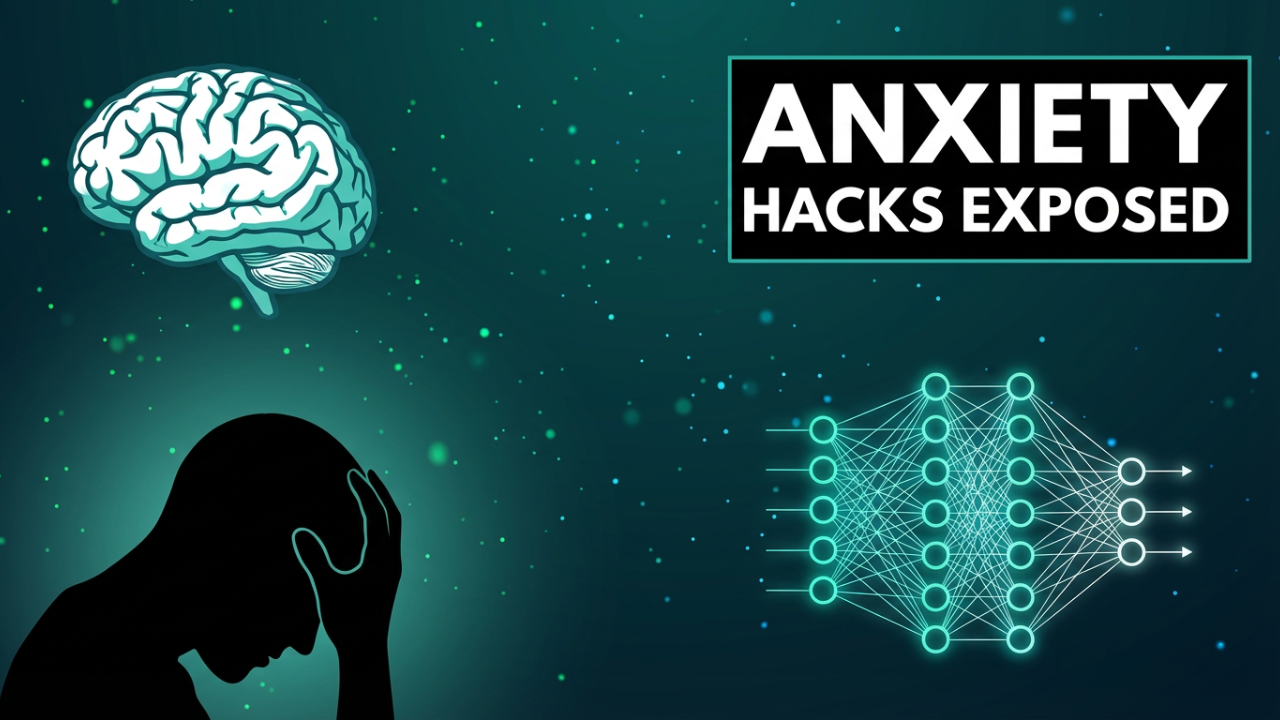
There’s a dark side to anxiety that we don’t talk about enough. It’s not just the feeling itself—the racing heart, the tight chest, the endless loop of worry. The truly dark part is that sinister realization that you are no longer in control. Your brain has learned to run an “anxiety program” on autopilot. It feels like you’re trapped inside your own mind, a prisoner to its tricks, forced to live by the rules of a code you never wrote. You find yourself avoiding opportunities, shying away from relationships, and shrinking your world, all to appease this ghost in the machine. It’s a silent, invisible cage, and it can feel like a life sentence.
But what if I told you that you could become a developer of your own mind? That the very operating system your brain uses to run this destructive program also contains the tools to delete it? What if you could use your brain’s own power—a scientific principle called neuroplasticity—to find that fear code, line by line, and overwrite it for good? This isn’t about coping. This is about how you can build a new pathway, a superhighway to lasting calm. This is the story of how you take back the controls.

This book is scientific documentary of the Kingdom of God.
Section 1: The Invisible Prison – Understanding the Anxiety Program
To dismantle this prison, you first have to understand its design. The anxiety you feel isn’t a defect; it’s a program running on incredibly powerful hardware. It’s a survival mechanism that’s gone haywire. At the center of this storm is a small, almond-shaped part of your brain called the amygdala. Think of the amygdala as your brain’s hyper-vigilant alarm system. Its job is to scan for threats and, when it detects one, to pull the fire alarm, flooding your system with stress hormones to get you ready for fight or flight. This system is ancient, primitive, and incredibly fast. It’s designed to react first and ask questions later, which is great if you’re being chased by a tiger.
The problem is, in our modern world, the “threats” are often a stressful email, a social gathering, or a negative thought about the future. Your amygdala can’t really tell the difference. To it, a perceived social rejection can feel just as dangerous as a snake in the grass. Now, normally, another part of your brain, the prefrontal cortex, steps in. This is the newer, more evolved part of your brain, right behind your forehead. It’s the CEO—the center for logic, reason, and emotional regulation. Its job is to look at the situation calmly and say, “Okay, amygdala, thanks for the warning, but this is just a party, not a life-or-death situation. You can stand down.”
But with chronic anxiety, something insidious happens. This line of communication starts to break down. The more the amygdala fires its alarm, the more sensitive it becomes. It develops a kind of trigger-happy tendency, seeing danger everywhere. At the same time, the prefrontal cortex, our voice of reason, can grow weaker and less effective at calming the alarm. Neuroscience now shows that chronic anxiety can literally reshape the structure and function of your brain. It’s not just “in your head”; it’s in your wiring. This creates a vicious feedback loop, what we often call the “anxiety cycle.”
Imagine a path through a forest. The first time you walk it, it’s tough. You have to push through branches and clear the way. But if you walk that same path every single day, it gets wider, clearer, and easier to travel. Eventually, it becomes the default path, the one your feet just naturally follow. Anxious thoughts and reactions work the exact same way. Every time you have an anxious thought, and every time you react by avoiding the thing that caused it, you are walking down that anxious path. You’re reinforcing that neural circuit. The temporary relief you feel from avoidance is a powerful reward that tells your brain, “See? Avoiding that was the right call. That situation really *was* dangerous.” This reinforcement strengthens the fear circuit, making it more likely your brain will take that same path next time.
This is the “anxiety program” in action. It’s a self-perpetuating code that runs automatically. You start to anticipate anxiety, which creates more anxiety. Your world begins to shrink as the list of things you avoid gets longer. You might stop going to parties because you fear being judged. You might turn down a promotion because you fear failure. You might even stop leaving your home because the world just feels too unpredictable. Each act of avoidance is another footstep on that well-worn path, carving it deeper into your brain. You feel trapped and out of control because, in a way, you are. You’re living by a script your brain has learned so well, it doesn’t need a prompter anymore. It’s running on an instinct that was designed to protect you but is now imprisoning you. But the same force that carved that path can also clear a new one. And that force is neuroplasticity.
Section 2: The Operating System – Your Brain’s Secret Weapon, Neuroplasticity
For a long time, the prevailing belief in science was that the adult brain was largely fixed. The thinking went that by the time you reached adulthood, your wiring was pretty much complete, and you were more or less stuck with the brain you had. That idea, however, has been radically challenged by one of the most revolutionary discoveries in modern neuroscience: neuroplasticity.
Neuroplasticity is the brain’s ability to change and reorganize itself by forming new neural connections throughout life. It’s the brain’s capacity to be molded and rewired by experience. Think of your brain not as a static computer, but as a dynamic, living network of over 100 billion neurons that are constantly talking to each other. Every thought you have, every emotion you feel, every action you take, strengthens certain connections between these neurons while weakening others. Neuroplasticity is the fundamental operating system that allows for all learning and memory. It’s how you learn to ride a bike, speak a new language, or master a new skill.
And critically, it’s the key to overwriting the anxiety program.
If anxiety carved a deep, automatic pathway in your brain through repetition, then neuroplasticity is the tool that allows you to carve a new one. This means that anxiety-induced changes in your brain aren’t necessarily a life sentence; the potential for reversal is built-in. This isn’t just a hopeful metaphor; it’s a biological possibility. Scientific studies have shown that targeted practices can produce measurable physical changes in the brain. These interventions have the potential to reduce the hyperactivity of the amygdala and increase the activity and connections in the prefrontal cortex, the brain’s regulation center.
This is the principle behind highly effective therapies like Cognitive Behavioral Therapy (CBT). CBT works because it is essentially a neuroplasticity-based treatment. It guides you to systematically challenge anxious thoughts and change avoidance behaviors. This process actively weakens the old, fear-based circuits and builds new, healthier, more rational ones. Research suggests that CBT can help restore healthy communication between the prefrontal cortex and the amygdala, effectively giving the “CEO” of your brain its power back.
The central message here is one of profound hope and agency. You are not just a passive victim of your brain’s wiring. Your brain is constantly listening to your experiences, thoughts, and actions. It’s waiting for instructions. The anxiety program got installed because of the instructions it received—of perceived threat and avoidance. But you can start sending it new instructions, today. You can intentionally and systematically engage in practices that will build new neural pathways for calm, confidence, and resilience.
This process is like training a muscle. At first, it’s difficult and requires conscious effort. The old habits, the old neural pathways, will feel more natural. But with consistency, the new pathway becomes stronger. The “calm” muscle gets bigger. Over time, the new, healthier response can become the new automatic default. You’re not just managing symptoms; you are fundamentally changing your brain’s architecture. You’re moving from being the prisoner of the anxiety program to becoming its architect. You have the ability to go into the system, find the faulty code, and rewrite it. This toolkit will show you exactly how.
Section 3: The Developer’s Toolkit – 5 Steps to Overwrite the Fear Code
This is where theory becomes practice. Overwriting the anxiety code isn’t a single act; it’s a process of implementing new commands, consistently and deliberately. We’re going to break this down into five actionable steps. Think of these as the fundamental tools in your neuroplasticity developer kit.
Step 1: The Observer – Recognizing the Malicious Code
The first and most critical step in rewriting any code is to see it clearly. You can’t change a program that’s running invisibly in the background. The anxiety program thrives in the dark; it operates on autopilot, merging so completely with your mind that you mistake its voice for your own. You don’t think, “I am having a thought that I might fail”; you think, “I *am* going to fail.” The program becomes your identity. The first step is to create separation.
This is the practice of **Mindfulness and Labeling**. Mindfulness is simply the act of paying attention to the present moment, on purpose, without judgment. When it comes to anxiety, this means learning to observe your thoughts and feelings as temporary mental events, rather than as reality.
**How to do it:** The simplest way to start is by labeling. When an anxious thought comes up, instead of getting swept away, you mentally step back and label it. For instance, if the thought “Everyone here thinks I’m an idiot” pops into your head, you pause. You don’t argue with it. You don’t believe it. You just label it: “That’s the anxiety program running. I’m noticing a thought about being judged.” Or more simply: “Label: Worrying thought.” Or, “I’m having the thought that people will think I’m an idiot.”
This simple act is incredibly powerful. It shifts you from being the thought to being the *observer* of the thought. It creates a tiny bit of space between the anxious thought and your response. In that space is your power to choose a different action.
**The Neuroscience:** Why does this work? When you’re lost in anxiety, your amygdala is highly active, and your emotional brain is in charge. The moment you step back and label the thought, you engage your prefrontal cortex—the logical, observing part of your brain. You’re literally shifting brain activity from the primitive, reactive centers to the more evolved, regulatory ones. Consistent practice strengthens these prefrontal pathways. Some studies suggest that regular mindfulness practice may lead to increased gray matter density in the prefrontal cortex and reduced reactivity in the amygdala. You’re building the neural machinery for emotional regulation.
**Practical Application:** Start small. Commit to ten minutes of mindfulness meditation each day. You can use a guided app or just sit quietly and focus on the feeling of your breath. When your mind wanders into anxious territory—and it will—your only job is to notice where it went and gently, without judgment, guide it back to your breath. Every time you do this, you’re doing one repetition of a neuroplastic exercise. You’re strengthening your “focus” muscle and weakening the “anxiety-autopilot” muscle. You’re learning to see the code, and that’s the first step to rewriting it.
Step 2: The Editor – Reframing and Rewriting the Script
Once you can observe anxious thoughts without being consumed by them, you can start the editing process. This is known as **Cognitive Reappraisal or Reframing**. It involves actively challenging the distorted stories produced by the anxiety program and replacing them with more balanced, realistic ones. Your anxious brain is a terrible storyteller; it only knows how to write tales of doom and gloom. Your job is to become a better editor.
The anxiety program relies on predictable thinking errors, or cognitive distortions, like:
* **Catastrophizing:** Blowing a small negative event into a worst-case scenario. (e.g., “I made a typo in that email; now my boss thinks I’m incompetent and I’ll get fired.”)
* **Black-and-White Thinking:** Seeing things in all-or-nothing terms. (e.g., “If this presentation isn’t perfect, it’s a complete failure.”)
* **Mind Reading:** Assuming you know what others are thinking, usually something negative about you. (e.g., “They haven’t texted back; they must be mad at me.”)
**How to do it:** The reframing process is a simple, three-step inquiry.
1. **Catch the Automatic Thought:** Use the labeling technique from Step 1 to identify the anxious thought. Write it down. For example: “I have to give a speech next week and I know I’m going to freeze up and humiliate myself.”
2. **Challenge the Thought:** Now, act like a detective. Examine the evidence. Ask yourself:
* “What’s the *actual* evidence that I will humiliate myself? Have I humiliated myself *every* single time I’ve spoken in public?”
* “What’s a more likely or alternative outcome?” (e.g., “I might be nervous, but I’ll probably get through it, just like I have before.”)
* “What’s the worst that could realistically happen? And could I handle it?”
* “What would I tell a friend who had this exact thought?”
3. **Create a Balanced Reframe:** Based on your detective work, write a new, more balanced, and compassionate thought. This isn’t about toxic positivity; it’s about finding a more accurate story. The reframe might be: “I’m feeling nervous about my speech, and that’s normal. I’ve prepared, and while I might stumble, I can get through it. My worth isn’t defined by one speech, and the goal is to communicate my ideas, not to be perfect.”
**The Neuroscience:** When you’re stuck in an anxious loop, you’re firing a specific neural pathway. By deliberately challenging that thought and generating a new one, you’re activating a different set of neurons. When you do this repeatedly, you begin to build and insulate a new neural pathway, a process involving something called myelination, which helps signals travel faster and more efficiently. Over time, it becomes easier and more automatic for your brain to take the new, balanced path. You’re creating a fork in the road, and with practice, making that new path the easier one to take.
Step 3: The Engineer – Building New Pathways Through Action
Observing and reframing your thoughts is crucial, but it’s only half the battle. Neuroplasticity is most powerfully driven by action and experience. You can’t just think your way out of anxiety; you have to *act* your way out. The anxiety program’s main strategy is avoidance. So, the most powerful way to overwrite it is with deliberate, controlled action *towards* your fears. This is the principle of **Exposure**.
Avoidance is the fuel for the anxiety cycle. When you avoid something you fear, you get a short-term hit of relief, which your brain reads as proof that the thing you avoided was truly dangerous. This reinforces the fear. Exposure reverses this. It involves gradually and repeatedly confronting your triggers in a controlled way to teach your brain a new lesson: “This thing you are screaming about is not actually a threat. You are safe.”
**How to do it:** Effective exposure isn’t about throwing yourself into the deep end. It’s about creating a “fear ladder.” You start with a small, manageable step and work your way up.
Let’s say you have social anxiety, and your biggest fear is attending a large party. Your fear ladder might look something like this:
* **Step 1:** For five minutes, just visualize yourself at a party, feeling calm.
* **Step 2:** Go to a coffee shop and just be around people for 15 minutes without having to talk.
* **Step 3:** Make eye contact and smile at one stranger.
* **Step 4:** Ask a cashier a simple question, like “How’s your day going?”
* **Step 5:** Go to a small get-together with a friend and stay for just 30 minutes.
* **Step 6:** Attend a larger event, with a pre-set goal of staying for one hour.
The key is to stay in the situation long enough for the initial spike of anxiety to start coming down on its own. This is called habituation. When you do this, you’re giving your brain new, disconfirming evidence. You’re sending a powerful message to your amygdala: “See? The alarm went off, but nothing terrible happened. We’re okay.”
**The Neuroscience:** This is perhaps the most direct form of rewiring, a process known as **extinction learning**. You’re not erasing the original fear memory. Instead, you’re creating a new, stronger memory of safety that competes with and eventually overrides the fear. Neuroimaging studies have shown that successful exposure therapy can lead to a decrease in amygdala hyperactivity. It literally helps calm the brain’s alarm system at a biological level. By taking brave action, you are physically weakening the fear circuit and strengthening a new circuit of confidence. You’re engineering a new reality for your brain.
Step 4: The Power Plant – Fueling Plasticity with Your Body
Your brain doesn’t exist in a vacuum. It’s part of an intricate, interconnected system: your body. To effectively rewire your brain, you need to create the best biological environment for neuroplasticity to happen. This step is about turning your body into a power plant for positive brain change.
**Technique 1: Physical Exercise.** For too long, exercise has been seen as generic advice. But from a neuroplasticity perspective, it’s a potent tool. When you engage in physical activity, especially aerobic exercise, your body releases a cascade of helpful neurochemicals. This includes endorphins, which boost your mood, but more importantly, it increases levels of a crucial protein called Brain-Derived Neurotrophic Factor, or BDNF.
Think of BDNF as “Miracle-Gro” for your brain. It is a powerful agent of neuroplasticity. BDNF supports the survival of existing neurons and encourages the growth of new neurons and synapses. Regular exercise is like fertilizing your brain, making it more receptive to the new pathways you’re trying to build. It’s not just a distraction from anxiety; it’s a biological catalyst for change.
**Technique 2: The Physiological Sigh.** While exercise creates a long-term pro-plasticity state, you also need real-time tools to manage sharp spikes of anxiety. One of the most effective, evidence-based breathing techniques is the physiological sigh. Researched by neuroscientists at Stanford, it’s a remarkably fast way to voluntarily calm your nervous system.
Here’s how you do it: Take two sharp inhales through your nose—one big one, then a shorter one on top to fully inflate the tiny air sacs in your lungs. Then, a long, slow, controlled exhale through your mouth. That’s it. One or two rounds can have a dramatic and immediate effect. The double-inhale maximizes lung inflation, and the long exhale offloads carbon dioxide efficiently, which signals the brainstem to slow your heart rate and help switch your nervous system from the “fight-or-flight” state to the “rest-and-digest” state. It’s like a built-in biological reset button.
**Technique 3: Rest and Consolidation (Sleep).** The final piece of the physiological puzzle is sleep. You can do all the work of observing, reframing, and exposing during the day, but the actual rewiring, the consolidation of those new pathways, happens primarily during deep sleep. Sleep is when your brain gets to work, cleaning house and strengthening what it has learned. The new, healthier patterns and safety memories you created are replayed and strengthened, making them more permanent. Poor sleep disrupts this process, sabotaging your efforts. Prioritizing 7-9 hours of quality sleep is non-negotiable if you’re serious about overwriting the anxiety program. It’s when the developer’s code is compiled and saved.
Step 5: The Architect – Designing a Brain for Calm
The final step is to shift from being a reactive developer, fixing bugs as they appear, to being a proactive architect, intentionally designing an environment that fosters calm. This is about long-term strategy and building a life that naturally promotes the brain state you want.
**Technique 1: Deliberate and Novel Learning.** Your anxious brain loves routine and predictability because it feels safe. But this can lead to rigid thinking, where you’re stuck in the same old ruts. A powerful way to break this is to learn a new, complex skill. This could be anything from learning a musical instrument or a new language, to taking up a challenging hobby like coding or chess.
When you force your brain to grapple with something new and difficult, you’re promoting widespread neuroplasticity. You’re building cognitive flexibility and forcing your brain to create entirely new networks. A brain that is flexible in one area is better equipped to be flexible when faced with an emotional challenge. It disrupts the rigid, automatic nature of the anxiety program and reminds your brain that it is, and always has been, a learning machine.
**Technique 2: The Art of Consistency.** Neuroplasticity is a double-edged sword. It’s the reason you got stuck in the anxiety program—through the consistent repetition of fear and avoidance. And it’s the only way you’ll get out—through the consistent repetition of these new, healthy practices. This is where most people stumble. They try mindfulness for a week, do one exposure, and when they don’t see a miracle, they conclude it doesn’t work and give up.
Rewiring your brain isn’t a quick fix. It happens gradually. You have to trust the process. You’re changing years, maybe decades, of mental habits. It will take time. The key is to be compassionate with yourself but relentlessly consistent. Every time you label a thought, you lay a brick. Every time you reframe a story, you lay a brick. Every time you face a small fear, you lay a brick. At first, it doesn’t look like much. But brick by brick, you are building a new fortress of calm in your mind. The old anxiety path doesn’t just disappear; rather, the new path of calm becomes so wide and efficient that your brain naturally starts to prefer it. That’s the moment control shifts. That’s when the new program becomes the default.
Section 4: The Science of Hope – Proof of a Rewired Brain
This whole framework, this idea of overwriting the fear code, can sound almost too good to be true. It’s easy to write it off as just wishful thinking. That’s why it’s so important to ground this hope in hard evidence. The beautiful thing about neuroplasticity is that it’s not a philosophical concept; it’s a measurable, physical phenomenon. Scientists can now literally see the brain change in response to these kinds of interventions.
Let’s go back to the core issue in anxiety: an overactive amygdala and an under-regulated prefrontal cortex. Multiple studies using fMRI scans have visualized what happens when people undergo treatments based on these neuroplastic principles. For instance, research on Cognitive Behavioral Therapy (CBT) for social anxiety has shown that after treatment, there can be a measurable reduction in amygdala hyperactivity when patients see their social triggers. Their brain’s alarm system can literally become less reactive. Some studies have even found that certain therapies may be correlated with physical changes, such as a reduction in the gray matter volume of the amygdala, and this change is linked to the patient’s reported decrease in anxiety.
The same is true for the prefrontal cortex. Practices like mindfulness meditation have been shown in some studies to increase the density of gray matter in the prefrontal cortex, the very area responsible for top-down emotional regulation. It’s the biological equivalent of strengthening the muscle that keeps your emotional responses in check.
This isn’t limited to behavioral therapies. The frontier of psychiatry is now focused on targeting neuroplasticity. The mechanisms of emerging treatments, from ketamine to psilocybin-assisted therapy, are still being actively investigated, but a leading hypothesis is that they work by rapidly boosting neuroplasticity. They appear to create a window of opportunity in which the brain is highly receptive to change by stimulating factors like BDNF—that ‘brain fertilizer’ we talked about—which allows for the rapid growth of new connections.
Even more futuristic approaches are emerging. Techniques like real-time fMRI neurofeedback allow people to see their own brain activity on a screen and learn to consciously regulate it. Others, like Transcranial Magnetic Stimulation (rTMS), use magnetic fields to non-invasively stimulate specific brain regions to enhance their function.
What all of this evidence points to is a single, powerful conclusion: your brain is not broken. It is adaptable. The experience of anxiety is the result of the brain learning a specific set of patterns, and it can be reversed by teaching it new ones. The feelings of being trapped and out of control are real, but they are based on a system that is fundamentally designed to change. This is the science of hope. It’s powerful evidence that you are not sentenced to a life of anxiety. You are equipped with a biological engine of change, and you have the power to turn it on.
Conclusion
We started this journey talking about the dark side of anxiety—that feeling of being trapped by a rogue program running your life. We’ve explored how this program gets written, through the powerful forces of fear and avoidance, carving deep, automatic pathways in your brain. But we’ve also uncovered a more powerful truth: neuroplasticity.
The brain’s operating system is neutral. It doesn’t prefer anxiety or calm. It simply strengthens the connections that are used most often. For a long time, the anxiety program has been running on repeat, strengthening itself with every worried thought and every avoided situation. But that can end now.
You now have the developer’s toolkit. You know how to be the **Observer**, labeling the anxious code without judgment. You know how to be the **Editor**, challenging the catastrophic stories and rewriting them with balance. You know how to be the **Engineer**, taking courageous action to build new experiences of safety. You know how to be the **Power Plant**, fueling your brain with the resources it needs to change. And you know how to be the **Architect**, designing a life that fosters long-term resilience.
This isn’t an easy path. It requires patience, self-compassion, and a deep commitment to consistency. There will be days when the old program boots up and runs strong. That’s okay. That’s part of the process. The goal isn’t perfection; it’s progress. Every time you choose to use one of these tools, you’re casting a vote for a new way of being. You’re making the path to calm a little wider, a little smoother, and a little more familiar.
Anxiety is a learned program. And anything that can be learned can be unlearned. You are not your anxiety. You are the consciousness that observes it. You are the architect of your own mind. You have the power to find the fear code, and line by line, you have the power to write a new story. The work starts now.