
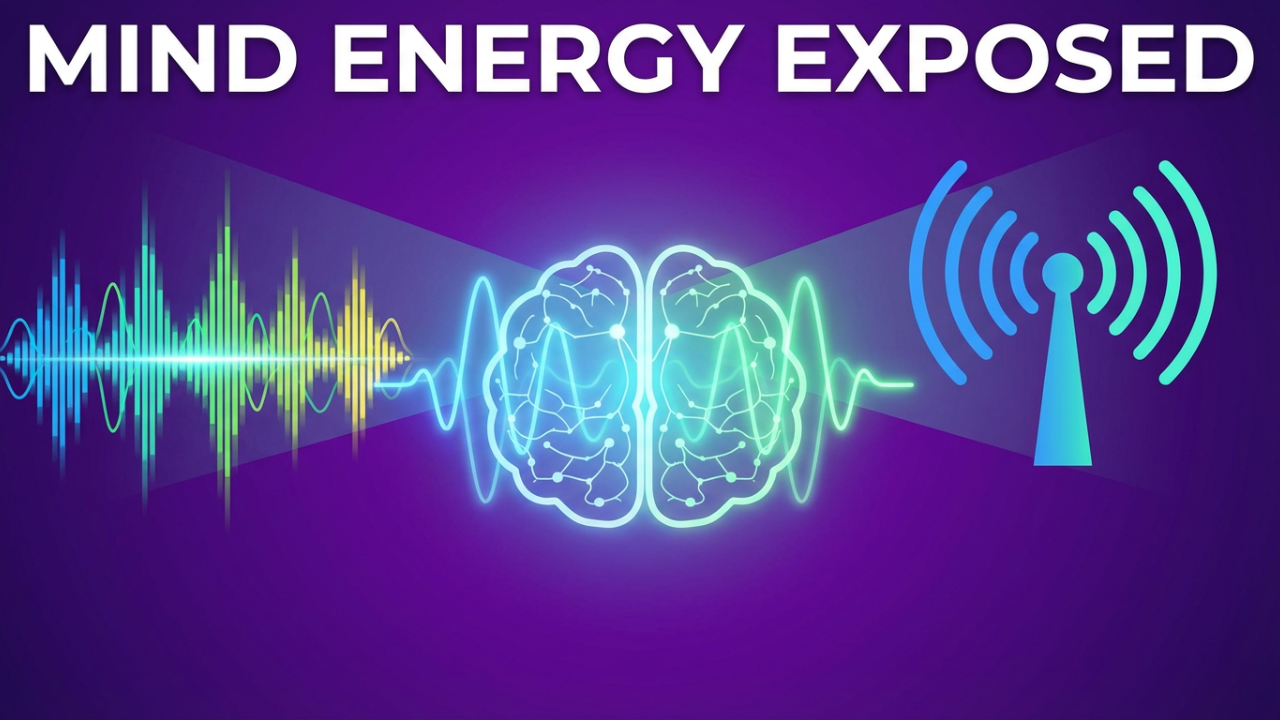
What if I told you that your reality—every thought, feeling, moment of deep sleep, and flash of brilliant insight—is shaped by an invisible symphony of electrical waves inside your head? What if the key to unlocking your full potential, from profound creativity to unbreakable focus, was already there, broadcasting a secret language you were never taught to understand?
This isn’t science fiction. This is the established, measurable, and fascinating world of your brain’s own energy and frequency. For centuries, we’ve spoken of the mind as a mysterious black box, using metaphors of computers or ghosts in the machine. But modern neuroscience is peeling back the layers of that mystery to reveal something far more elegant: a universe of rhythmic, electrical oscillations that power your consciousness. These are your brainwaves.
In this guide, we’re going to explore the very energy source of your mind and decode this secret language, frequency by frequency. We’re going on a journey from the slow, restorative pulses of deep sleep to the lightning-fast frequencies of peak performance. You’ll discover how each band of brainwaves, from Delta to Gamma, fundamentally shapes your reality, your capabilities, and your state of being.
This is more than just a science lesson. By understanding the energy in your own mind, you get a new lens through which to view yourself. You’ll learn why you feel tired, creative, or anxious, and how these states are tied to tangible, electrical patterns. More importantly, you’ll discover how you can begin to consciously influence these patterns. So, get ready to meet the hidden architect of your experience and understand the power of your brain’s energy and frequency.

SON OF LORD
Section 1: The Orchestra of the Mind – What Exactly Are Brainwaves?
Before we can work with our brainwaves, we first need to understand what they are. At its core, your brain is an electrochemical organ, a bustling city of around 86 billion specialized cells called neurons. These neurons are constantly talking to each other, firing tiny electrical signals to form thoughts, process information, and control your body. When millions or even billions of these neurons synchronize their firing into a coherent, rhythmic pattern, they generate a collective electrical field. This synchronized electrical activity, oscillating at a specific rhythm, is what we call a brainwave.
Think of it like an orchestra. A single violin is like one neuron firing—a distinct event, but its impact is small. Now, imagine the entire string section playing the same note in perfect unison. Suddenly, you have a powerful, resonant wave of sound that fills the hall. Brainwaves are the neurological version of this. They are the grand, sweeping harmonies produced by countless neurons working together, allowing your brain to coordinate its trillions of connections and function as one coherent whole.
These electrical oscillations aren’t just random noise; they’re the foundation of how your brain computes and creates consciousness. They are measured in Hertz (Hz), which just means cycles per second. A 10 Hz wave is completing ten full cycles every second. Scientists measure these waves using a non-invasive technique called an electroencephalogram, or EEG, by placing sensors on the scalp to detect these faint electrical fields.
So, why call it “brain energy”? Because these waves are a direct sign of the brain’s immense energy use. While the brain is only about 2% of our body weight, it burns a staggering 20% of our body’s oxygen and energy. This energy fuels the constant firing of neurons. Different brainwave frequencies reflect different states of energy usage. Slow waves, like in deep sleep, represent a low-energy, restorative state. Fast waves, seen during intense focus, reflect a state of high energy consumption and rapid information processing.
These brainwaves are categorized into five main types, moving from slowest to fastest: Delta, Theta, Alpha, Beta, and Gamma.
Understanding these bands is like learning the musical notes of your mind. Delta is the deep, silent bass drum providing the foundation for repair. Theta is the soulful cello playing the melodies of creativity and dreams. Alpha is the calming rhythm of an acoustic guitar, creating a bridge between action and rest. Beta is the fast-paced piano, handling the complex chords of active thought. And Gamma is the virtuosic flute, playing rapid notes that bind information together into moments of peak perception.
While neuroscience understands this as an electromagnetic phenomenon, some highly speculative theories on the frontiers of physics are exploring it from a different angle. These ideas propose that our consciousness might not be limited to just electrochemical firings. For example, some researchers on the fringe, like Hartmut Neven at Google’s Quantum AI Lab, have theorized that quantum phenomena could play a role in unifying our sensory inputs into a single experience. These ideas are far from established science, but they point to a profound truth: the brain’s energy is more complex than we ever imagined.
As we journey through each brainwave band, remember that your brain is constantly producing a mix of all these frequencies, like a full orchestra. However, one band will typically be dominant, defining your primary state of consciousness. Learning to recognize, and eventually influence, which band is dominant is the first step toward consciously shaping your mental world. Let’s begin with the slowest, deepest, and most fundamental frequency: the Delta wave.
Section 2: Delta (0.5-4 Hz) – The Foundation of Unconscious Restoration
We begin our journey at the foundation of consciousness, in the deep, slow rhythm of Delta waves. Oscillating between 0.5 and 4 cycles per second, Delta waves are the slowest of them all. If our brainwave spectrum were an ocean, Delta would be the powerful currents moving far beneath the surface—unseen, but fundamentally driving the entire system.
Delta is the signature wave of deep, dreamless sleep, the kind that leaves you feeling truly rested. When your brain is dominated by Delta waves, you’re almost completely unconscious of the outside world. But this isn’t a state of inactivity. The Delta state is a period of intense and critical work for your brain and body.
Think of it as the brain’s master reset and cleanup crew. During your waking hours, metabolic waste builds up from all that neural activity. The Delta sleep state is when your brain takes out the trash. During this deep sleep, the glymphatic system—the brain’s unique waste-clearance pathway—becomes much more active, flushing away toxins like beta-amyloid, a protein famously linked to Alzheimer’s disease when it accumulates.
But Delta waves do more than just housekeeping. This is the state where your body prioritizes physical healing and growth. Growth hormone is released, signaling your cells to repair tissues, build bone and muscle, and strengthen the immune system. This is why a deep night’s sleep is so critical when you’re recovering from an illness or injury; it’s the Delta waves orchestrating this physical restoration.
Furthermore, Delta is associated with regulating our most basic, unconscious bodily functions, like our heartbeat, blood pressure, and breathing. It represents the body’s primal intelligence, maintaining the fabric of life while the conscious mind is offline.
In a waking state, a significant presence of Delta waves is highly unusual in healthy adults, though it can appear in some cases of brain injury. However, these waves are naturally present in infants and very young children, whose brains are still in a massive state of growth and development.
From a psychological perspective, some schools of thought connect the Delta state to the deepest levels of the unconscious mind. This is theorized to be a connection to a collective unconscious, a state of empathy and instinctual understanding that connects us all. While speculative, it speaks to the profound depth represented by this brainwave state—a connection to the part of ourselves that operates beyond language and ego.
So, while you aren’t “aware” during Delta-dominant sleep, this state is absolutely essential for your conscious life. Without enough Delta wave activity, you wake up feeling groggy and mentally slow. Your immune system weakens and your ability to handle stress plummets.
Delta is the bedrock upon which all other states of consciousness are built. It’s the silent force of renewal that allows the brain to handle the high-energy demands of thinking and feeling. It proves that sometimes, the most important work happens when we completely let go. Before we can fly, we need solid ground to stand on. In the world of brainwaves, that ground is Delta.
Section 3: Theta (4-8 Hz) – The Gateway to Creativity and the Subconscious
As we slowly rise from the depths of Delta, we enter the twilight realm of Theta waves. Oscillating between 4 and 8 Hz, Theta is a slower frequency, but it’s very different from the unconsciousness of Delta. Theta is the state of dreams, deep meditation, profound creativity, and the subconscious mind coming out to play. If Delta is the silent ocean floor, Theta is the mysterious, dimly lit zone just above it, where strange and beautiful thoughts drift freely.
You experience Theta every night as you’re falling asleep and again as you’re waking up. It’s that hazy, dreamlike state where you’re not fully asleep but not quite awake. Ideas, images, and memories float by in a non-linear way. This is the gateway to your subconscious.
Theta is strongly associated with creativity and insight. Ever had a brilliant idea pop into your head in the shower or on a long drive? That’s the Theta state at work. When your conscious, analytical mind takes a backseat, the Theta mind emerges. It doesn’t think in straight lines; it makes connections between seemingly unrelated concepts, leading to those famous “Aha!” moments. It’s the state of insight, where the solution to a problem suddenly appears in your mind’s eye.
This brainwave is also the dominant frequency during many forms of meditation. Experienced meditators can generate strong, coherent Theta waves, which allows for a kind of “reprogramming” of the subconscious. In the relaxed, receptive Theta state, you’re more open to suggestion and can more easily change limiting beliefs or emotional patterns. It’s a state of heightened learning, much like how a child absorbs a language without conscious effort.
Theta is also the frequency of raw, unfiltered emotion. It connects us to our deepest feelings and memories, which is why deep therapeutic work often involves a shift into a Theta-dominant state. It allows us to access and process experiences that our conscious mind may have locked away.
Another key role of Theta waves is in memory consolidation. While you sleep, particularly during REM sleep which has a strong Theta component, your brain is busy sorting through the day’s experiences. It decides which memories to keep and how to integrate new information. The hippocampus, a brain region critical for forming new long-term memories, shows significant Theta activity during this process. It’s like a librarian diligently organizing the shelves of your mental library.
For many of us, consciously accessing the Theta state is a challenge. Our modern lives are so filled with external stimuli that our brains tend to live in faster frequencies. However, practices like meditation, daydreaming, or engaging in any creative activity that lets your mind wander can help you tap into this rich resource. Technologies like binaural beats, which can create a 4 to 8 Hz frequency difference between the ears, are also used to encourage the brain to enter a Theta state for creativity or relaxation.
In essence, Theta is the bridge between the conscious and the unconscious. It is the language of the subconscious mind, speaking in symbols, images, and feelings. Learning to access this realm, even for a few minutes a day, can unlock a profound source of insight, healing, and imaginative power.

This book is scientific documentary of the Kingdom of God.
Section 4: Alpha (8-12 Hz) – The Bridge of Calm, Wakeful Awareness
Moving up the spectrum from Theta, we arrive at the frequency of Alpha, which oscillates between 8 and 12 Hz. Alpha is a special and powerful state. It’s the bridge between our subconscious (Delta and Theta) and our conscious, thinking mind (Beta). Alpha represents a state of calm, wakeful relaxation. It’s the frequency of the present moment.
Imagine you’ve just finished a demanding task. You lean back, close your eyes, and take a deep breath. That feeling of letting go, of your mind becoming quiet but still alert, is your brain shifting into an Alpha-dominant state. Alpha is the brain’s neutral, or “idle,” gear. It’s a state of restful alertness, where the mind is clear and not engaged in intense problem-solving.
One of the most interesting things about Alpha waves is their relationship with our eyes. Simply closing your eyes is one of the most reliable ways to increase Alpha production, especially in the visual processing center at the back of the brain. This isn’t a coincidence. The Alpha rhythm helps inhibit unnecessary sensory information, allowing the brain to conserve energy. When you close your eyes, you cut off a huge source of sensory data, and Alpha waves rise to signal that the visual systems can take a break. This is why light meditation or just taking a moment to breathe with your eyes closed can feel so restorative.
This state of relaxed awareness is incredibly beneficial for stress reduction. Chronic stress keeps our brains locked in the fast-paced Beta frequencies. Shifting into Alpha provides a much-needed neurological break, helping to lower cortisol levels and reduce anxiety.
But Alpha isn’t just about being calm; it’s also a gateway to enhanced learning and creativity. The “flow state”—that feeling of being completely absorbed in an activity—often involves a strong presence of Alpha waves mixed with Theta. The Alpha component keeps you alert, while the Theta component allows creative thoughts to emerge. This combination creates a state of super-learning, where you can absorb information effortlessly. This is why cramming for an exam in a panicked state is so inefficient, while studying in a relaxed, focused Alpha state can be highly effective.
Alpha acts as a bridge to the subconscious. Because it borders the Theta frequency, a strong Alpha state makes it easier to dip into that wellspring of creativity without falling asleep. It allows ideas from the Theta realm to bubble up into conscious awareness. You’re relaxed enough for new ideas to come, but alert enough to catch them.
In our hyper-stimulated world, many of us have an Alpha wave deficiency. Constant notifications and multitasking keep our brains in a perpetual state of high alert, leading to mental fatigue and burnout. Deliberately cultivating the Alpha state is an antidote to this.
Techniques like deep breathing, spending time in nature, or listening to calming music are all natural ways to boost Alpha waves. Additionally, neurofeedback and brainwave entrainment often target the Alpha frequency (around 10 Hz) to help people learn how to enter this state of calm focus on demand.
Alpha is the calm center in the storm of our busy lives. It’s the frequency that allows us to recharge our mental batteries, reduce stress, and access the creative whispers of our subconscious. By learning to consciously access the Alpha state, you’re not tuning out; you’re tuning in to a more balanced, resourceful, and centered version of yourself.
Section 5: Beta (13-30 Hz) – The Frequency of Active, Waking Consciousness
Leaving the calm shores of Alpha, we now accelerate into the bustling city of Beta waves. Oscillating between roughly 13 and 30 Hz, Beta is the dominant frequency of our normal, waking consciousness. When you’re awake, alert, focused, and engaged with the world, your brain is humming with Beta activity. This is the frequency of the active, logical mind.
The Beta band is quite wide and is often broken down into three sub-categories.
First, we have **Low Beta**, or Beta1 (about 13-15 Hz). You can think of this as a state of relaxed but focused attention. It’s the state you might be in while reading an interesting book or having a light conversation. It’s a comfortable and productive mental space, a bridge between the relaxation of Alpha and the more intense focus of higher Beta.
Next is **Mid-Range Beta**, or Beta2 (about 16-22 Hz). This is the frequency of active thinking, problem-solving, and decision-making. When you’re concentrating on a task, analyzing data, or planning your day, you’re generating these waves. This is the “workhorse” frequency of the conscious mind, highly effective for getting things done.
Finally, we have **High Beta**, or Beta3 (from about 23 to 30 Hz). This is the frequency of highly complex thought and intense concentration. However, this state comes with a significant downside. An excess of High Beta activity is directly linked to stress, anxiety, fear, and feeling overwhelmed.
Think about the feeling of being on high alert: your heart is racing, your muscles are tense, and your mind is running through “what if” scenarios. This is your brain flooded with High Beta waves. This state evolved as our “fight or flight” response, designed to help us react quickly to threats. In this state, the brain is scanning for danger and over-analyzing everything.
While essential for short-term survival, living in a chronic state of High Beta is incredibly draining. It burns through our mental and physical energy, suppresses the immune system, and makes it impossible to access the slower, more restorative brainwave states. When your mind is stuck in this hyper-vigilant loop, it can’t relax, create, or properly heal.
So, Beta is a double-edged sword. Its lower range provides the focused energy we need to navigate daily life and achieve our goals. But its higher range becomes the frequency of anxiety and stress, trapping us in a cycle of worry.
The key to a healthy brain is the ability to shift between states flexibly. It’s about calling upon Beta’s power when you need it, but then downshifting into Alpha to relax or Theta to be creative. The problem for many isn’t that Beta is “bad,” but that they get stuck in it.
Understanding the different facets of Beta gives you a powerful tool for self-awareness. When you feel those tell-tale signs of anxiety, you can recognize it for what it is: your brain has shifted into High Beta. And with that awareness, you can take conscious action—like deep breathing or a short walk—to intentionally guide your brain back down the frequency ladder into a more balanced state.
Section 6: Gamma (30-100 Hz) – The Pinnacle of Perception and Consciousness
Our final destination is the fastest and most enigmatic frequency of them all: Gamma. Oscillating at a blistering pace of 30 to 100 Hz or even higher, Gamma waves are the pinnacle of brainwave activity. If Beta is the sound of the conscious mind thinking, Gamma is the sound of the conscious mind *igniting*. It is the frequency of heightened perception, peak performance, and consciousness itself.
Gamma waves are often described as the brain’s “high-performance mode.” They are associated with moments of intense focus, high-level information processing, and brilliant insight. That sudden “Aha!” moment is often accompanied by a burst of Gamma activity. This is because Gamma is thought to be the frequency that “binds” or synchronizes information from different parts of the brain into a unified whole.
Imagine your brain working on a complex problem. Different areas are processing sights, sounds, logic, and memories all at once. What weaves it all together into a single, seamless conscious experience? The leading theory is that Gamma waves are the master conductor. MIT Neuroscientist Earl K. Miller proposes these oscillations are the hidden code that turns raw neuron firings into coordinated thought.
This binding function is critical for high-level cognition. When you’re learning something complex, a strong Gamma response allows your brain to process the information at lightning speed and form lasting neural connections. It’s associated with accelerated learning and exceptional mental clarity.
Interestingly, some of the most compelling research on Gamma comes from studies of long-term meditators, like Tibetan monks. These studies found that experienced practitioners show extraordinarily high levels of Gamma activity, not just during meditation, but as their baseline state. This suggests the brain can be trained to operate at this peak frequency more consistently.
At the cellular level, generating Gamma waves is a sophisticated process driven by specialized neurons. When this system is working correctly, it produces coherent thought. When it’s disrupted, it can be linked to serious conditions like schizophrenia, highlighting how vital Gamma is for a unified perception of reality.
The experience of being in a Gamma state is often described as being “in the zone.” Athletes and musicians often enter this state during peak performance. It’s a state of total absorption where the sense of self seems to melt away and action flows effortlessly.
However, balance is key. Some research suggests that abnormally high Gamma in certain contexts might be linked with anxiety or a hyper-aroused state. But in its functional role, Gamma represents the brain firing on all cylinders.
So, how can you cultivate this peak state? Practices that require intense focus are key, with meditation being a primary tool. Pushing yourself with challenging activities can also trigger Gamma bursts. Research into 40 Hz light and sound stimulation has even shown promise in boosting Gamma production, with emerging studies exploring its potential benefits for conditions like Alzheimer’s.
Gamma waves represent the ultimate potential of the brain’s processing power. They are the sparks of genius, the sustained focus of a master, and the signature of a unified, heightened consciousness. They show us that our brain is a dynamic system capable of creating extraordinary moments of insight and peak experience.
Section 7: Brainwave Entrainment – Hacking Your Brain’s Frequency
So, we’ve explored these five brainwave bands. But what if you could actively guide your brain to produce more of a specific frequency? What if you could, on demand, encourage an Alpha, Theta, or Beta state? This is the science of brainwave entrainment.
Brainwave entrainment uses a phenomenon called the “frequency-following response.” The brain has a natural tendency to sync its own electrical rhythms to the rhythm of external stimuli, like pulses of sound or light. If you present the brain with a consistent rhythm, its own brainwave patterns will begin to align with that frequency. It’s like pushing a child on a swing; if you time your pushes right, you can guide the rhythm.
Let’s explore the most common methods.
The most famous technique is **Binaural Beats**. This occurs when you listen to two slightly different frequencies, one in each ear, using headphones. For example, if you play 400 Hz in your left ear and 404 Hz in your right, your brain perceives a third, phantom beat at the 4 Hz difference—a Theta frequency. Some studies show that listening to binaural beats for just 10 minutes can measurably increase corresponding brainwave activity, though the effects can be preliminary and vary from person to person.
A related technique is **Isochronic Tones**. These are single, distinct pulses of sound that turn on and off in a rapid rhythm. To entrain a 10 Hz Alpha frequency, you’d listen to a tone pulsing ten times per second. Many people find these tones more potent than binaural beats, and they don’t require headphones.
Entrainment isn’t limited to sound. **Visual Entrainment**, using flickering lights, is another powerful method. This can be very fast-acting, directly stimulating the visual cortex. However, this method must be used with caution, as it can potentially trigger seizures in individuals with photosensitive epilepsy.
Finally, the most advanced forms use **Electromagnetic Fields**. Techniques like Transcranial Magnetic Stimulation (TMS) are typically used in clinical settings to create electrical currents in specific brain areas, offering a highly targeted way to influence brainwave activity.
So how can this be applied practically? The applications are vast. You could try using a Beta frequency track (around 15-20 Hz) to promote focus for a work session. An Alpha track (around 10 Hz) could help you unwind after a stressful day. For creative brainstorming, a Theta track (around 6-7 Hz) might help you access your subconscious. Some studies even suggest that acoustic Delta wave entrainment can improve memory consolidation during sleep.
Today, countless apps offer entrainment tracks for specific goals. When starting, it’s wise to begin with shorter sessions to see how you respond.
Brainwave entrainment isn’t a magic bullet, but it is a powerful tool. It’s a way of actively participating in the regulation of your own mental state. It empowers us to move from being passive passengers in our minds to active conductors of our own neural orchestra.
Conclusion
We’ve traveled from the restorative currents of Delta to the lightning-fast flashes of Gamma, revealing how this hidden symphony of brainwaves powers our reality. This energy is the architect of our sleep, the source of our creativity, the engine of our focus, and the very thing that binds our perception together.
Understanding this is like being handed a map to your inner world. When you feel anxious, you can now recognize the frantic hum of High Beta and know you have tools to guide your brain back to the calm of Alpha. When you seek a creative breakthrough, you now understand the value of quieting the analytical mind to let the whispers of Theta emerge. You now appreciate the profound work that happens in the Delta state each night, repairing your mind and body. And you can aspire to the peak states of Gamma, knowing that moments of brilliant insight are achievable states of brain synchronization.
The discovery that these states can be actively influenced—through practices like meditation or technologies like brainwave entrainment—places remarkable power back into our own hands. We are not merely subject to our moods; we are active participants in their creation.
The science of brainwaves is constantly evolving, opening up new possibilities for treating disorders and unlocking human potential. Your brain is broadcasting this secret language every second of every day. And now, you have begun to learn how to listen. The ultimate question is not just what these frequencies are, but what you will choose to do with this knowledge. What reality will you choose to tune into?