
You’ve been told a lie. A beautiful, intoxicating lie that has sold millions of books and filled countless seminars. The lie is that the universe is some cosmic catalog, and if you just wish hard enough and keep your “vibration” high, it’ll deliver your dream life to your doorstep. You’ve been told the Law of Attraction is magic.
But then, you look at your life. The vision board is collecting dust, the affirmations feel hollow, and the life you ordered hasn’t shown up. A nagging question starts to creep in… “Why isn’t this working for me? What am I doing wrong?”
What if I told you the problem isn’t your vibration? What if the secret isn’t magic at all? What if the real power to change your life has been inside you the entire time, locked within the three-pound universe between your ears?
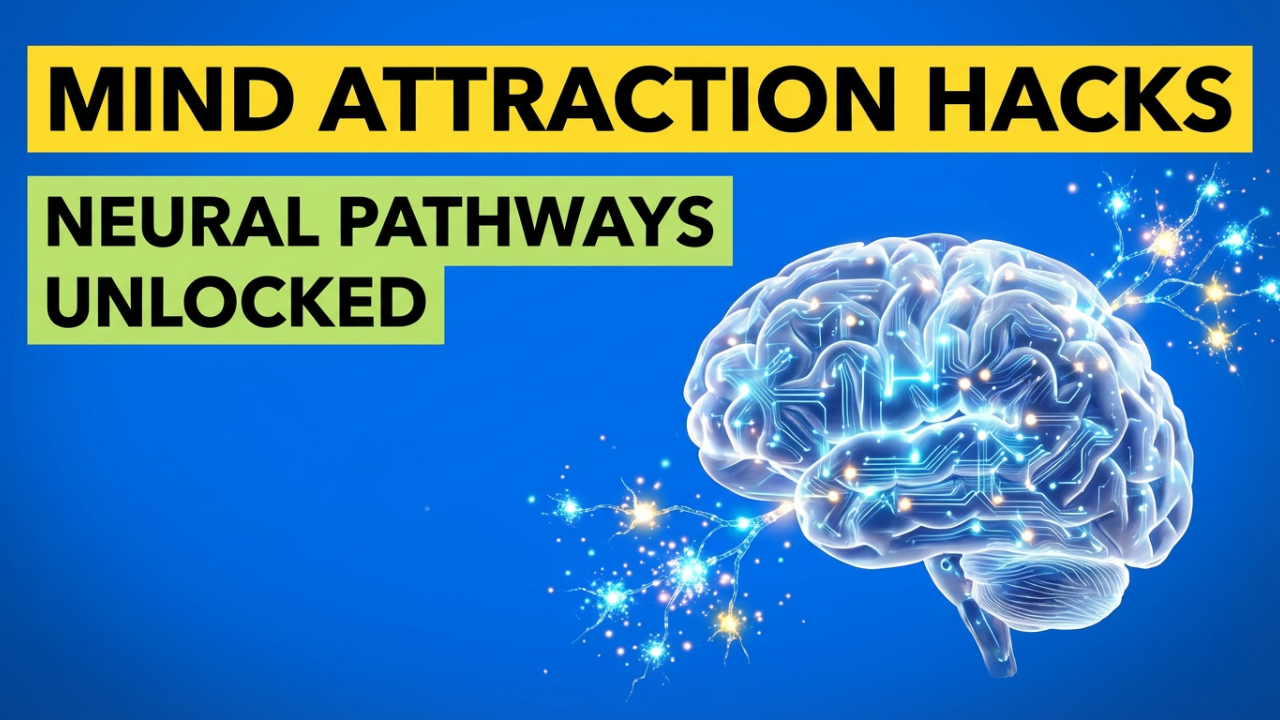
Here, we’re going to bypass the pseudoscience and wishful thinking and get into the hard science. We’ll explore how the principles people link to the Law of Attraction are actually reflections of a tangible, biological process. This is the story of how your thoughts don’t just float off into the ether; they physically forge, break, and remold the very structure of your brain. Forget manifesting. We’re talking about neuroplasticity. We’re going to deconstruct the myth to give you a blueprint for reality, based not on magic, but on the measurable science of your neural pathways.

SON OF LORD
Section 1: The Frustration of Magical Thinking
Let’s be honest about the popular version of the Law of Attraction. It paints a simple picture: you have a desire—for more money, a partner, a better job. You’re told to focus on it with unwavering faith. You make a vision board, you repeat affirmations, and you try to avoid any negative thoughts, worried you might “attract” bad things. The whole idea is that your thoughts send out a frequency, and the universe, like a giant mirror, sends back experiences that match it.
It’s a seductive idea because it feels simple and offers a sense of control in a chaotic world. But for most people, this formula leads to a cycle of hope followed by serious disappointment. When the promised results don’t show up, the philosophy has a cruel built-in excuse: it’s your fault. Your vibration wasn’t high enough. You had a hidden limiting belief. You let one moment of doubt ruin everything. This leaves people feeling powerless, not empowered—like spiritual failures, stuck and more convinced than ever that the life they want is out of reach.
The real reason this model fails is that it gets the “how” completely wrong. It places the power outside of you, in a mystical, unprovable “universe” that responds to “vibes.” Actual scientific inquiry has found no credible, peer-reviewed evidence to support the claim that thoughts, by themselves, can magically manipulate the world around you. The universe isn’t a delivery service. Thinking about a million dollars won’t make a million dollars appear in your bank account, just like worrying about a piano falling on your head won’t make one materialize from the sky.
And that’s the fundamental problem, the reason so many people either dismiss the concept as nonsense or are left feeling broken by it. They’ve been sold a map that’s missing the most important territory: the brain itself. They’ve been told to focus on the destination, without ever being taught how to build the vehicle that will actually get them there.
So, if it’s not a cosmic law, why do some people who practice these techniques seem to get results? Are they just lucky? Is it a coincidence? Not at all. The effects are real, but the explanation has been wrong. The practices tied to the Law of Attraction—intense focus, visualization, changing your beliefs—aren’t sending signals out to the cosmos. They’re sending signals *inward*. They’re kicking off a powerful, scientifically-backed process of deliberate self-creation. The answer isn’t in the stars; it’s in our neurobiology. To truly create change, we have to stop looking to the sky and start looking at the intricate wiring of our own neural pathways.
Section 2: Neuroplasticity – You Are the Architect of Your Brain
For a long time, the prevailing view in science was that the adult brain was a mostly fixed, static thing. You got a certain number of brain cells, and by the time you were an adult, the structure was pretty much set. We now know this is fundamentally wrong. The single most important discovery in neuroscience over the past century might just be the concept of neuroplasticity.
Neuroplasticity is simply the brain’s ability to reorganize itself by forming new neural connections throughout your entire life. This isn’t a metaphor; it’s a physical reality. Your brain isn’t a static block of concrete; it’s more like a dynamic, living jungle of 86 billion neurons.
Think of your brain like that jungle. Every time you think a thought, feel an emotion, or take an action, a little spark of electricity travels between neurons. If you walk the same path through the jungle over and over, what happens? First, you trample the grass. Then you wear a dirt path. With enough repetition, that path becomes a trail, then a road, and eventually, a multi-lane superhighway. It becomes effortless to travel that route.
This is exactly what happens in your brain. The thoughts you think most often carve the deepest grooves. That, right there, is the neuroscientific basis of a habit. When you worry constantly, you aren’t just having negative thoughts; you are physically reinforcing a “worry” circuit, making it easier and more automatic to worry in the future. If you practice gratitude every day, you are strengthening the neural pathways for gratitude, making it your brain’s go-to state. This is summed up perfectly by neuropsychologist Donald Hebb: “Neurons that fire together, wire together.”
This is happening every second of every day, whether you realize it or not. Your life, up to this moment, has been carving the landscape of your brain. Your default moods, your ingrained habits, your automatic reactions—these are all just well-traveled neural superhighways. This is why change can feel so hard. When you try to think a new thought or start a new habit, you are, in a very real sense, trying to hack your way through a dense, overgrown part of the jungle with a machete, while a brightly lit highway—your old habit—is sitting right there, calling you back. Your brain, being an efficiency machine, will always want to take the path of least resistance.
But here is the empowering truth: you are the one holding the machete. You also get to decide to stop paving the old highways and start building new ones. Through focused attention and repetition, you can consciously create new neural pathways. You can weaken the old, unhelpful circuits until they fall into disuse. You can literally, physically, rewire your brain to support the person you want to be.
And this isn’t just a theory—it’s an observable fact. We see it in stroke victims who regain function as their brains reroute commands around damaged areas. We see it in people who learn a new language or musical instrument, their brains physically changing to hold that new skill. And we see it in people who overcome years of negative thinking by intentionally creating new mental habits.
Grasping this one concept—that your brain is changeable and you are its primary architect—is the most critical step in moving from magical thinking to real, science-based personal transformation. The goal is no longer to magically attract things from the outside, but to methodically build the neurological hardware on the inside that will support new beliefs, new behaviors, and ultimately, a new reality.
Section 3: The Reticular Activating System (RAS) – Your Brain’s Gatekeeper
Now that we’ve established that you can physically change your brain, let’s look at one of the most fascinating pieces of hardware you have: the Reticular Activating System, or RAS. This bundle of nerves at the base of your brain is only about the size of your pinky finger, but its job is colossal. It acts as the gatekeeper, the bouncer at the nightclub of your conscious mind.
Your brain is bombarded with millions, if not billions, of bits of information from your senses every single second. The sight of the walls, the feeling of your chair, the hum of the fridge—if you had to consciously process all of this, you’d instantly short-circuit. The RAS prevents this by filtering out what it decides is irrelevant, only letting what’s important through to your conscious awareness.
But how does it decide what’s important? This is the key. You tell it what’s important. Your dominant thoughts, your goals, and your fears all act as programming instructions for your RAS.
Here’s the classic example: Have you ever decided you wanted to buy a specific car, say, a red Tesla? You do the research, look at pictures, and get your heart set on it. Then what happens? The next day, you see red Teslas everywhere. It feels like the universe suddenly spawned a dozen of them just for you.
But did it? Of course not. Those red Teslas were always there. You just never noticed them. Before you set that goal, your RAS filtered them out as unimportant. But once you told your brain, “A red Tesla is important to me,” your RAS got the memo. It changed its filtering rules and began flagging every red Tesla, pushing it into your conscious awareness.
This is the scientific reason why “things start to appear” for LOA followers. The opportunities, resources, and people don’t magically manifest. They were often already in your environment, but you were blind to them because your brain wasn’t programmed to look for them. Your RAS was filtering them out.
When you set a clear intention or focus on a goal, you’re not sending a vibrational order to the cosmos. You are giving a direct command to your own Reticular Activating System. You’re telling your brain’s filter what to pay attention to.
Think about what this means. If your dominant thought is “I’m always unlucky,” what are you telling your RAS? You’re programming it to scan the world for evidence that confirms this. It will actively highlight every setback and missed chance, and it will filter out the opportunities for luck and success right in front of you. Your reality becomes a self-fulfilling prophecy, not because of a universal law, but because of a neurological filter.
On the other hand, if you consciously decide to focus on “finding business opportunities” or “meeting helpful people,” you are re-tuning your RAS. It will start to notice a relevant conversation happening next to you in a coffee shop. It will draw your eye to an article or a post you would have otherwise ignored. It doesn’t *create* the opportunity; it *reveals* it.
This shifts the power dynamic completely. You’re no longer passively hoping the universe sends you something. You’re actively priming your own brain to see the resources and paths that are already there. The work isn’t in the wishing; it’s in the wiring. By managing your focus, you are taking manual control of your own perception of reality.
Section 4: The Power of Visualization – Rehearsing for Reality
One of the biggest techniques in the Law of Attraction world is visualization. People are encouraged to close their eyes and imagine their desired reality in vivid detail, feeling the emotions as if it were already real. The mystical explanation is that this “acting as if” sends a powerful signal to the universe. The neuroscientific explanation is far more practical—and frankly, more powerful. Visualization isn’t a magical request; it’s mental rehearsal.
Studies using fMRI scans, which measure brain activity, have given us a peek inside the brain during visualization. When you vividly imagine doing something, your brain activates many of the same neural circuits it would use if you were *actually* doing it.
Take the research on athletes. In one famous study, basketball players were split into three groups. One group physically practiced free throws every day. A second group did nothing. The third group simply spent time *visualizing* themselves making perfect free throws, without ever touching a ball. When they were tested, the group that only visualized had improved almost as much as the group that physically practiced.
How is that possible? Because for your brain, a vividly imagined experience is almost identical to a real one. When the visualization group mentally rehearsed shooting—imagining the feel of the ball, the arc of the shot, the sound of the net—they were causing their neurons to fire in the exact sequence for a perfect shot. They were strengthening that “perfect shot” neural pathway, building muscle memory in their brain without moving a muscle. They were practicing.
This isn’t just for physical skills. You can visualize a successful job interview, a public speech, or a tough conversation. By mentally walking through it, you’re pre-paving the neural pathways for success, which reduces anxiety and primes you to act effectively when the time comes.
There’s another key element here: dopamine. Dopamine is often called the “motivation molecule,” and it’s released when your brain expects a reward. When you visualize achieving a goal—crossing the finish line, getting the job offer—your brain can release a small hit of dopamine. This feels good, and it creates a powerful feedback loop. The visualization creates a feeling of reward, which motivates you to take the real-world actions to achieve the goal, which leads to more reward, and so on.
This is the opposite of the frustration cycle. Instead of feeling bad about what you don’t have, you’re generating positive emotions now by mentally stepping into that future success. Each visualization session is like another trip down that new path in your brain’s jungle. You are reinforcing the neural circuits of success, making them stronger and faster than the old circuits of doubt.
So, how do you do it right? It’s more than just daydreaming. Effective visualization is an active, focused process. Take 10 to 15 minutes a day. Close your eyes and create a detailed mental movie of your desired outcome. Don’t just watch it; engage all your senses. What do you see? What do you hear? How do you feel? Who is with you? The more vivid and emotional the visualization, the more “real” it feels to your brain, and the more effective it will be at building the pathways to get you there.

This book is scientific documentary of the Kingdom of God.
Section 5: The Heart-Brain Connection – Your Emotional Amplifier
For a long time, the brain was seen as the body’s sole commander-in-chief. But a growing field called neurocardiology is showing a much more complex relationship, especially between the brain and the heart. It turns out the heart isn’t just a pump; it’s an information-processing center in its own right, so much so that scientists sometimes call it the “heart-brain.”
Your heart contains about 40,000 specialized neurons that act a lot like the neurons in your actual brain. And here’s the wild part: the heart sends far more signals to the brain than the brain sends to the heart. There’s a constant, two-way conversation happening, but the heart’s voice is often louder.
This communication happens through nerves, hormones, and even pressure waves. But maybe the most significant pathway is electromagnetic. Research, particularly from the HeartMath Institute, has shown the heart generates an electromagnetic field that is up to 60 times greater in amplitude than the brain’s and can be measured several feet away from the body.
Why does this matter? Because this field changes based on your emotions. When you experience stress, anger, or anxiety, your heart’s rhythm becomes erratic and disordered. This incoherent pattern gets sent to your brain and actually impairs your ability to think clearly and creatively. It’s the physiological reason you feel “scattered” when you’re upset. You literally can’t think straight.
But when you cultivate positive emotions like gratitude, compassion, or love, your heart’s rhythm becomes smooth and orderly. This harmonious pattern is sent to the brain, and it does the opposite: it facilitates higher cognitive function and emotional stability. This state is called “heart coherence.”
This is where we circle back to the Law of Attraction. Practitioners always say it’s not enough to just think a thought; you have to *feel* the feeling. You have to embody the emotion of already having what you want. From a scientific perspective, this advice is spot on, but not for mystical reasons. When you generate a feeling of gratitude for the money you don’t yet have, or love for the partner you haven’t met, you are consciously creating heart coherence.
By doing this, you’re sending a powerful, orderly signal to your brain that says you are safe and resourceful. It moves you out of short-term, survival-based thinking and into a more creative, open-minded state. In a state of heart coherence, your RAS is more likely to spot opportunities instead of threats, and your ability to solve problems is enhanced. You are simply operating from a higher-performing biological state.
You can learn to do this on command. One of the easiest ways is to focus your attention on your heart, imagine your breath flowing in and out of that area, and consciously activate a feeling of gratitude. Holding this state for just a few minutes can shift your entire body and mind for hours. You’re not just “raising your vibration”; you’re optimizing your internal operating system by aligning your heart and brain to work together.
Section 6: Hacking Your Subconscious – Affirmations and Mirror Neurons
Let’s tackle another cornerstone of the LOA world: affirmations. The idea is to repeat a positive statement until you believe it. But as anyone who’s stood in a mirror saying “I am a millionaire” while their bank account is empty knows, it often feels like you’re just lying to yourself. And you are. Your conscious mind is making a statement that your subconscious, the home of your deepest beliefs, knows isn’t true. This creates a conflict, and the affirmation gets rejected.
So, are affirmations useless? Not if you understand how to use them as a tool for neuroplasticity. The goal isn’t to trick the universe; it’s to gradually update the programming of your subconscious. Neuroscience research shows that self-affirmation, especially when it’s believable and future-focused, can activate key reward centers in the brain.
Activating these regions helps buffer you against stress and can make you more open to information that challenges your old beliefs. So, instead of a blunt statement like “I am a millionaire,” a more effective affirmation might be, “I am learning the skills to build wealth every day,” or “I am capable of creating financial abundance.” These statements are easier to believe, they bypass the subconscious rejection filter, and they prime your brain to look for evidence that you are, indeed, capable and learning. Repetition, combined with genuine feeling, slowly carves a new neural pathway.
Now let’s talk about mirror neurons. These are brain cells that fire both when we perform an action and when we watch someone else perform that same action. If I pick up a cup of coffee, neurons in my brain fire. If you watch me do it, a subset of those same neurons will fire in your brain, as if you were doing it yourself. This is believed to be the neurological basis for empathy and learning.
Think about the old saying, “You are the average of the five people you spend the most time with.” This isn’t some mystical energy transfer. The science of mirror neurons gives us a concrete explanation. When you consistently surround yourself with optimistic, disciplined, successful people, your mirror neuron system is constantly firing as if you yourself are being optimistic, disciplined, and successful. You are neurologically rehearsing their traits. Their mindsets become more familiar to your own brain, which begins to build and strengthen the neural pathways for those very qualities.
The reverse is also true. If you’re always around people who complain and feel like victims, your brain will be neurologically rehearsing those states. This isn’t a judgment; it’s just a matter of neural input.
This gives you a powerful, science-backed strategy. You can intentionally “hack” your mirror neuron system. If you want to be more confident, don’t just affirm it; watch talks by confident speakers and study their body language. If you want to be a successful entrepreneur, listen to their podcasts and immerse yourself in their way of thinking. You’re not just gathering information; you’re giving your brain a model to mirror. You’re speeding up neuroplasticity by giving your brain a clear template of the person you want to become.
Section 7: Putting It All Together – Your Daily Brain-Rewiring Protocol
Okay, we’ve gone through a ton of science. We’ve deconstructed the myth of the Law of Attraction and replaced it with an empowering, science-backed model. But knowing all this is one thing; putting it into practice is where the real change happens. Here is a simple, daily protocol you can use to start consciously rewiring your brain. Consistency is far more important than intensity. Think of it as mental hygiene.
**1. Morning Intention Setting (Programming your RAS – 5 Minutes):** Before you touch your phone, take five minutes. Sit quietly and decide what’s important today. What opportunities do you want your brain to look for? It could be, “Today, I’ll look for chances to be helpful,” or “Today, I’ll notice evidence of my growing confidence.” Write it down or say it out loud. You’re giving your RAS its marching orders for the day.
**2. Focused Visualization (Building Pathways – 10-15 Minutes):** Find a quiet time to do your mental rehearsal. Close your eyes and step into the future you’re creating. See yourself having achieved a specific goal. Don’t just watch it like a movie; be in it. Feel the pride and joy. Hear the sounds. Make it as real as possible. You are paving that neural superhighway.
**3. Heart Coherence Breathing (Emotional Alignment – 5 Minutes, 3x a Day):** When you feel stress building, take a moment to reset. Place your hand on your heart. Imagine your breath flowing in and out of your chest as you slow it down. Now, consciously bring to mind a feeling of gratitude. Think of a person, a pet, or a memory that genuinely makes you feel warm. Hold that feeling for a minute or two. You are shifting your biology from stress to coherence.
**4. Affirmations with Feeling (Subconscious Reprogramming – Ongoing):** Ditch the affirmations that feel like lies. Choose believable, process-oriented statements. “I’m getting better at managing my money.” “I am worthy of a healthy relationship.” “Every day, I’m becoming more disciplined.” Repeat them during your commute or while you’re making coffee, and try to connect with the feeling behind the words. You are gently reprogramming your subconscious.
**5. Conscious Input (Mirror Neuron Hacking – Ongoing):** Be mindful of what you’re feeding your brain. The podcasts you listen to, the books you read, the people you follow—are these inputs aligned with the person you want to become? Make a conscious choice to consume content that models the traits you want to embody. You are choosing the templates your brain will mirror.
Remember, you might be undoing decades of automatic programming. This won’t happen overnight. It takes patience and repetition. But every time you consciously choose a new thought, practice a visualization, or shift into heart coherence, you are casting a vote for your future self. You are laying another stone on a new neural path.
Conclusion
We began by challenging a lie—the lie that your power is outside of you. We end with the truth. The power to change your life doesn’t come from a mystical force you have to plead with. It comes from the deliberate, scientific process of changing your internal world. It comes from your ability to rewire the very organ that builds your reality: your brain.
You are not a passive observer waiting for the universe to decide your fate. You are the architect. You are the neuro-sculptor. By applying these principles, you move from wishful thinking to willful action. You take your hands back on the controls of your mind. The frustration of “manifesting” is replaced by the empowerment of self-directed neuroplasticity.
So stop waiting for the life you want to be magically attracted to you. Start building the neurological foundation for it within yourself. Tell your brain what to look for. Rehearse your success until it becomes second nature. Align your heart and mind into a coherent state of creation. The power was never “out there.” It has been inside you all along.