
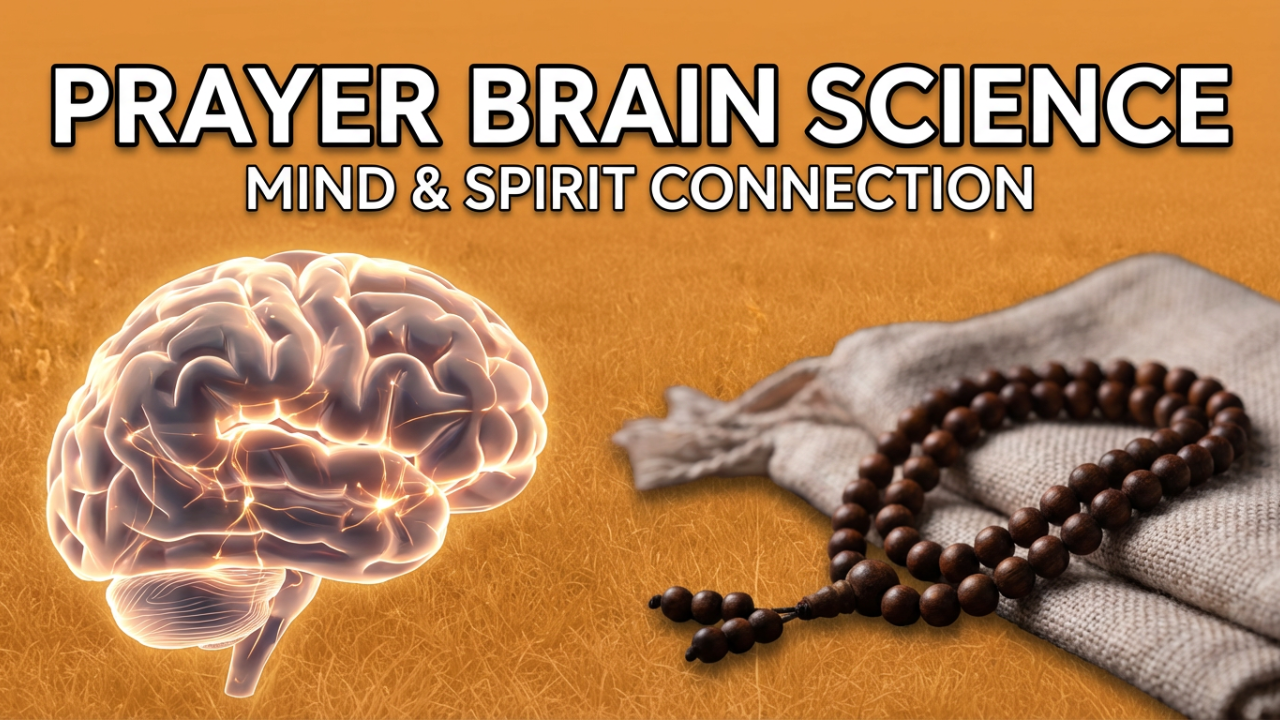
What if one of the oldest spiritual practices known to humanity was also one of the most advanced neurological exercises we’ve ever found? For thousands of years, people have bowed their heads in prayer to find comfort, ask for guidance, and connect with the divine. It’s been a cornerstone of spiritual life, an act of faith performed in the quiet of the heart. But now, in the 21st century, the worlds of faith and science—often seen as two lines that never cross—are meeting in the most intimate of places: the human brain.
Using incredible imaging technology, scientists are literally peering inside the minds of people as they pray. And what they’re finding is revolutionary. They’re discovering that prayer isn’t just a hopeful, spiritual wish. It’s a powerful and measurable neurological event. An event that doesn’t just feel good but actively and physically changes the very structure and function of your brain. We’re not talking about philosophy or theology anymore. We’re talking about biology—tangible, physical changes that you can see on a brain scan.
So, what if you could physically rewire your brain to reduce stress and feel more at peace, all in just 12 minutes a day? Scientists are discovering this isn’t science fiction; it’s the measurable result of prayer. In this article, we’re going to show you the brain scans and the science that shows how prayer can be a powerful tool for your mind. We’ll look at groundbreaking research that reveals how prayer can quiet your sense of self, boost your focus, and build a brain that is more resilient, compassionate, and at peace. Stay with us, because what you’re about to learn could change the way you think about prayer forever.
Section 1: The Modern Epidemic of a Stressed-Out Brain
Before we journey into the praying brain, let’s just acknowledge the world we’re all living in. We are swimming in an age of anxiety. We’re constantly bombarded by a relentless stream of information, notifications, deadlines, and social pressures. The result is a kind of chronic stress, a low-grade hum of fight-or-flight that has become the background noise of modern life.
This isn’t just a feeling; it’s a physiological reality. When you’re stressed, your body is flooded with hormones like cortisol. Your heart rate goes up, your blood pressure rises, your muscles get tight. This response was designed to save you from a physical threat, like a predator. But in our world, the “predators” are emails, bills, and negative news cycles. Your brain’s alarm system is constantly being triggered, with no “off” switch in sight.
This sustained state of alert can have devastating consequences. It messes with our ability to focus, disrupts our sleep, and erodes our emotional control. It fuels anxiety and is a primary driver of depression. We feel scattered, overwhelmed, and disconnected. We find ourselves scrolling through our phones looking for a distraction, a little hit of dopamine, but it often just leaves us feeling emptier. We are struggling with a fundamental problem: our brains weren’t built for the world we’ve created. We yearn for focus in an age of distraction and crave peace in a world of chaos.
For centuries, the proposed solution to this deep human ache has been spiritual. Turn inward. Connect with God. Pray. For many, this has been an act of pure faith. But for the skeptics, and even for some believers, a question has always lingered: Does it actually *do* anything? Is it just a psychological comfort blanket? This is where the story gets interesting, because science is now answering that question with a clear and definitive “yes.” Prayer is a powerful solution, and now we have the scientific validation to prove it.

SON OF LORD is a Scientific Institute
Section 2: The God Helmet and the Dawn of Neurotheology
The scientific quest to understand the spiritual brain didn’t start with today’s multi-million-dollar fMRI machines. It began with some stranger, more eccentric experiments. In the 1980s, a neuroscientist named Michael Persinger developed a device that became famously known as the “God Helmet.” It was basically a snowmobile helmet rigged with electronics that generated weak magnetic fields across the brain’s temporal lobes.
Persinger’s theory was that spiritual experiences—the feeling of a divine presence, of being one with the universe—weren’t necessarily supernatural. He believed they were products of the brain’s own electrical activity. His results were startling. A high percentage of his subjects reported feeling an “unseen presence” in the room. While Persinger’s work was controversial and other labs have had difficulty replicating his effects, it cracked open the door to a radical new idea: that our most profound spiritual experiences are tied to measurable patterns of brain activity.
This line of thinking gave birth to a brand new field: neurotheology, a discipline dedicated to understanding the link between the brain and our spiritual lives. But it would take another pioneer, armed with much better technology, to bring this research into the mainstream. That pioneer was Dr. Andrew Newberg.
Dr. Newberg, a neuroscientist at the Marcus Institute of Integrative Health, wanted to see what the brain was doing in real-time during its most profound spiritual moments. He began using SPECT imaging, a technology that tracks blood flow in the brain. In his experiments, he would inject a radioactive tracer into someone’s bloodstream while they were in deep prayer or meditation. This allowed him to take a snapshot of their brain activity at the peak of their spiritual experience.
He brought in Franciscan nuns practicing centering prayer and Tibetan monks lost in meditation. He even studied Pentecostals speaking in tongues. And across these different traditions, a consistent and extraordinary pattern started to emerge. Prayer wasn’t just quieting the mind; it was conducting a complex and unique symphony of neural activity. What he found would become the foundational discovery of neurotheology.
Section 3: The Praying Brain Unveiled: Focus Up, Self Down
When Dr. Newberg looked at the brain scans of people in deep prayer, he saw two remarkable things happening at the same time. Some parts of the brain were lighting up with activity, while other parts were going completely dark.
First, the bright spots. Newberg saw a dramatic increase in activity in the frontal lobes. The frontal lobes, especially the prefrontal cortex, are basically the CEO of your brain. It’s the part of your mind you’re using right now to understand these words. It handles focused attention, concentration, and planning. During prayer, this area kicks into high gear. The act of focusing your mind on God, concentrating on a verse, or forming your thoughts into a prayer is a powerful workout for your brain’s executive center.
This increased frontal lobe activity explains the sense of clarity and focus that people often report during and after prayer. You are literally training your brain to pay attention.
But it was the second finding that was truly stunning. While the frontal lobes were revving up, another key part of the brain was powering down: the parietal lobes. The parietal lobes, located near the back and top of your head, are responsible for giving you your sense of self and your orientation in the physical world. It’s the part of your brain that tells you where your body ends and the rest of the world begins.
During the peak moments of prayer, Newberg’s scans showed that activity in the parietal lobes plummeted. They went dark. The neurological machinery that creates your sense of a separate, physical self was going offline. And the result? The brain’s perception of the boundary between self and other, between you and the universe, begins to dissolve. This neurological event perfectly matches the subjective experience reported by people of faith for thousands of years: the feeling of “losing oneself” in prayer, of feeling at one with God, or a sense of unity with everything.
This isn’t just a feeling or a metaphor. It’s happening neurologically. Your brain is actively de-creating your sense of self, allowing for an experience of profound connection. Dr. Newberg had captured the physical signature of self-transcendence on a brain scan. It was incredible validation, showing that these profound states weren’t delusions but were rooted in real, measurable brain changes. Science was now showing that prayer had the power to simultaneously sharpen your focus and dissolve your ego.
Section 4: The 12-Minute Miracle: How Prayer Rewires Your Brain for Good
Dr. Newberg’s discoveries were groundbreaking, but they only showed what the brain looks like *during* prayer. The next question was even more profound: can a consistent prayer practice permanently change the brain’s structure? The answer, coming from a wealth of new research, is an emphatic yes, and it all comes down to a property of the brain called neuroplasticity.
For most of the 20th century, scientists thought the adult brain was basically fixed. We now know that’s completely wrong. The brain is remarkably “plastic,” meaning it can reorganize itself, create new neural pathways, and change its structure based on our experiences and even our thoughts. The old saying, “neurons that fire together, wire together,” is the core principle of neuroplasticity.
This is where the research gets really practical. Studies by neuroscientists like Dr. Andrew Newberg have shown that even a small amount of daily prayer can make a big difference. His research found that just 12 minutes of daily, focused prayer or meditation over an eight-week period can create measurable changes in the brain that show up on a scan.
Think about that. In less time than it takes to watch a sitcom, you can start to physically upgrade your own brain. So what exactly is changing? Consistent practice leads to increased activity in key brain regions like the anterior cingulate cortex, a hub for empathy and compassion. By consistently praying, especially prayers involving compassion for others, you’re essentially doing reps for the empathy circuits in your brain. You’re building a more compassionate brain.
Another incredible change happens in the cortex, the brain’s wrinkly outer layer. Studies show that long-term prayer can increase “gyrification,” or the folding of the cortex. More folds mean more surface area, which helps the brain process information more efficiently. This is linked to better decision-making and emotional regulation.
And perhaps most importantly for our stressed-out world, this 12-minute practice strengthens the connection between your prefrontal cortex (the thinking part) and the amygdala (the fear and stress center). A stronger connection here means your brain’s “CEO” has more control over its “alarm system.” You become less reactive to stress. The things that used to trigger immediate anxiety no longer have the same power. This builds on the work of researchers like Dr. Caroline Leaf, who has shown how intentionally directing our thoughts through practices like prayer can drive this kind of positive neuroplasticity. These aren’t temporary effects. Dr. Richard Davidson, another leading neuroscientist, found that even novice meditators showed significant brain and immune system improvements after just two months of practice. You are actively participating in your own creation—sculpting your brain into something new.
Section 5: Your Brain on God: The Neuroscience of a Divine Relationship
One of the most profound aspects of prayer is the idea of a personal relationship with God. It’s not a monologue shouted into the void; it’s a dialogue, an intimate connection. For centuries, this has been the language of faith. Now, neuroscience is revealing that the brain treats this relationship as something astonishingly real.
When scientists used fMRI scans to look at the brains of people in personal, conversational prayer, they saw a network of regions linked to social cognition blaze to life. Specifically, prayer activated brain areas in the “Theory of Mind” network. This is the network we use to understand that other people have their own thoughts and feelings. It’s what you use to empathize with a friend or guess what a loved one is thinking. The fact that this network activates during prayer is stunning. It suggests the brain processes a conversation with God just like a conversation with another person.
Prayer also activates a critical brain system known as the Default Mode Network (DMN). The DMN is the brain’s “storytelling” network. It’s most active when you’re reflecting on your past, thinking about your future, or contemplating your own sense of self. During prayer, the DMN becomes highly engaged as the mind evaluates the self in the context of this divine relationship.
The key brain regions involved here—the medial prefrontal cortex, the precuneus, and the temporoparietal junction—all work together to help us understand ourselves and relate to others. Studies found that the pattern of activation in these regions during prayer was remarkably similar to when a person was thinking about a loved one. Neurologically, the brain was treating God as an attachment figure. The feeling of being known, heard, and loved by God isn’t just a poetic idea; it’s being encoded through the same pathways your brain uses for its most important human relationships.
This helps explain why prayer can be so powerful in combating loneliness. When you pray, your brain fires up the very circuits designed for social connection. Science is showing that when you pray to a personal God, your brain responds as if that person is truly there with you, listening.

This book is the Scientific Documentary of the Kingdom of God
Section 6: Liberating Your Mind for a Better Life
In our hyper-stimulated world, our attention is our most precious resource. The constant flood of information and worry creates a tremendous “mental workload.” Your brain is like a computer with too many programs running. It slows down and can’t perform its most important functions well. This is where prayer delivers one of its most practical benefits: it systematically reduces this mental workload.
Cognitive psychology research has demonstrated this with clever experiments. In “dual-task” challenges, where people have to focus on two things at once, researchers found that highly religious individuals who prayed regularly performed significantly better. Why? Because their baseline level of mental chatter was lower. Prayer had effectively cleared up their cognitive “RAM,” freeing up processing power.
Another powerful example comes from the “Stroop test.” In this test, you’re shown the name of a color, but the word is printed in a *different* color (like the word “BLUE” in red ink). You have to name the ink color, not read the word, which creates a cognitive conflict. Studies have shown that people who pray regularly do better on the Stroop test, indicating enhanced attention and cognitive control. Their practice of focused attention has strengthened the neural circuits that filter out distractions.
This cognitive liberation also has a fascinating effect on problem-solving. Research suggests that certain types of prayer can bias our attention toward finding solutions. When we bring a specific problem to God in prayer, our brains actively rehearse the problem in a new context. This process can reduce rumination—that unhealthy cycle of getting stuck on a negative thought—and instead prime the brain to notice solutions in our environment.
This cognitive boost even extends to our physical well-being. By calming the body’s stress response, prayer has been shown to enhance immune function. One remarkable study found that people who meditated produced more antibodies in response to a flu vaccine compared to a control group. By quieting the mental noise, prayer allows the body’s natural defense systems to work more efficiently. It’s a form of mental decluttering that leaves you with more mental bandwidth to be present with family, focus at work, and simply enjoy life.
Section 7: A Shield Against the Darkness: Prayer’s Power Over Anxiety and Depression
While the cognitive benefits are impressive, prayer’s most profound impact may be on mental health, specifically against anxiety and depression. A growing mountain of clinical evidence shows that prayer is not just a comfort but a potent intervention with lasting positive effects.
Some of the most compelling evidence comes from clinical studies. One such study investigated the effects of direct, person-to-person prayer on individuals suffering from depression and anxiety. The intervention involved six weekly prayer sessions. The results were staggering. Participants showed significant decreases on the Hamilton Depression and Anxiety Scales, which are clinical measures of symptom severity. But the truly remarkable finding was how long the effect lasted. When researchers followed up with these individuals a full year later, the improvements were not just maintained; they had, in some cases, even increased, with participants reporting sustained reductions in their symptoms and increased optimism. This wasn’t a fleeting high; it was a deep and lasting transformation.
This clinical data is backed up by large-scale population studies that consistently find lower rates of anxiety and depression among individuals who pray daily. So, what’s happening neurologically? It starts with stress reduction. As we’ve learned, prayer helps lower the stress hormone cortisol and activates the parasympathetic nervous system—our body’s “rest and digest” mode. This provides an immediate antidote to the physical agitation of anxiety.
But it goes deeper. Prayer provides a powerful sense of hope and purpose, two of the strongest psychological shields against depression. It encourages a cognitive shift, reframing life’s difficulties within a larger, meaningful spiritual context. It also allows for emotional release. Articulating one’s fears and sorrows to a loving, divine presence can be profoundly cathartic.
Prayer also directly counters the sense of isolation that fuels mental illness. By fostering a sense of connection to God, it reminds the individual that they aren’t alone. This is especially potent in group prayer, which adds the powerful therapeutic benefits of community. In a world where mental health challenges are on the rise, science is confirming that this ancient spiritual discipline may be one of the most accessible and effective tools we have to protect our minds and heal our hearts.
Section 8: Not All Prayer Is Created Equal: Finding Your Neurological Sweet Spot
As the science of neurotheology matures, it’s revealing a more nuanced picture. Researchers are finding that different forms of prayer activate the brain in different ways, offering a tailored set of benefits. Understanding these variations can help you find the type of prayer that best meets your needs.
First, there is **Contemplative or Meditative Prayer**. This is a quieter, more receptive form, often focused on stilling the mind and resting in God’s presence. Neurologically, this type of prayer is excellent for calming the mind and body. It activates the prefrontal cortex for focus while quieting the noisy chatter of the Default Mode Network. Research shows it’s particularly effective at driving neuroplasticity, leading to structural changes that enhance emotional regulation.
Next, we have **Gratitude and Adoration Prayer**. This is when you focus on thanking God or on the goodness of God. This form is a direct neurological antidote to anxiety. Anxiety is, by nature, focused on future threats. Gratitude forcefully shifts your attention to what is positive in the present. This has been shown to boost positive emotions and reduce anxiety by shifting focus away from the self.
Then there is **Petitionary or Personal Prayer**. This is where we bring our personal needs and problems to God. This type of prayer is incredibly effective at biasing your attention toward solutions. It helps break the cycle of helpless rumination and engages the problem-solving centers of your brain. One fascinating study on long-term members of Alcoholics Anonymous found that when they recited AA prayers after being shown images designed to induce alcohol cravings, they reported significantly less craving. Their brain scans showed increased activity in areas related to attention and emotion control.
Finally, there is **Group or Person-to-Person Prayer**. This is when we pray with others. This form adds a powerful social dimension, combating isolation and fostering a deep sense of belonging. Remember the clinical trial for depression? The most significant and lasting results were seen with person-to-person prayer, highlighting the combined power of spiritual and human connection.
The *attitude* of prayer also matters. Researchers suggest that prayer rooted in a trusting connection with a loving God tends to produce the most benefits. In contrast, prayer that is desperate or born from fear can sometimes amplify anxiety. The key seems to be reinforcing a sense of divine connection. By understanding these differences, you can consciously choose the type of prayer that will most effectively reshape your brain and spirit.
Section 9: Faith and The Final Frontier
We have journeyed through the astonishing landscape of the praying brain. We’ve seen how a simple act of faith can light up the focus centers in our frontal lobes and quiet the parts of our brain that define our sense of self. We’ve learned how just 12 minutes of daily prayer can physically rewire our neural circuits for more compassion and resilience through the miracle of neuroplasticity. We’ve discovered that our brains treat a relationship with God as neurologically real, firing up the same social networks we use for our deepest human bonds.
The evidence is overwhelming: prayer is a potent neurological event. But this raises a profound question. Does this science somehow diminish the mystery of faith? Does explaining prayer mean we are explaining it *away*?
Pioneers in this field, including Dr. Andrew Newberg himself, argue the exact opposite. He has stated that these findings don’t disprove the existence of God or the reality of a spiritual realm. Science can show us *what* is happening in the brain, but it cannot answer the ultimate question of *why*. Is the brain generating these experiences on its own, or is it a divinely designed receiver, an antenna built to tune into a spiritual reality that exists outside of us? Science cannot, and may never be able to, answer that question.
What this research *does* do is provide powerful validation for people of faith. It affirms that their spiritual practices are not empty rituals but transformative activities with real, beneficial impacts. It bridges the perceived gap between the physical and the spiritual, showing our brains and our souls are inextricably linked. Our spiritual health is our mental health. As Dr. Caroline Leaf often says, science is a process of discovering the wonder of how we are designed. Neurotheology is simply the latest chapter in that book of discovery—a tool that lets us appreciate the intricate design of a brain built for connection, transcendence, and a relationship with its Creator.
Conclusion
So, what’s the big takeaway from all this? Prayer is not passive. It is not just wishful thinking. It’s one of the most active and transformative things you can do for your mind, body, and spirit.
For millennia, faith has taught that prayer changes things. Now, science is showing us that the first thing it changes is *you*. It physically remodels the architecture of your brain, building a mind that is more focused, compassionate, and peaceful. It activates the social circuitry of your brain, validating the deepest feelings of relationship with the divine. It calms the storms of anxiety and lifts the fog of depression.
This new science doesn’t replace faith; it reinforces it. It provides a “wow” factor, a stunning glimpse into the intricate and beautiful way we’ve been made. It shows us that the call to “be transformed by the renewing of your mind” isn’t just a spiritual metaphor—it’s a neurological possibility available to every single one of us. The science is in. The only question left is, what will you do with it?