
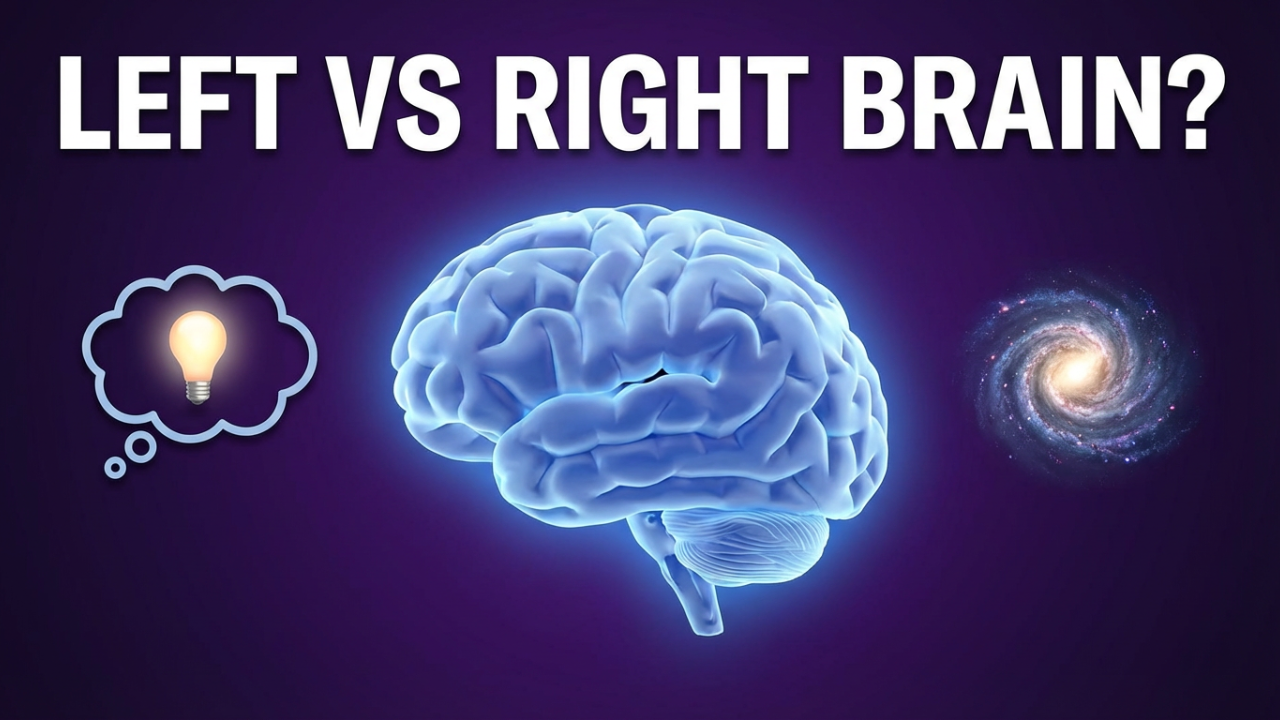
Which side of the brain is responsible for imagination? Are you a logical, analytical ‘left-brain’ person? Or a creative, imaginative ‘right-brain’ person? For decades, we’ve been told we’re one or the other. It’s a concept that has wormed its way into everything from personality quizzes to corporate training, a handy label to explain why your brother is an accountant and you’re a painter.
But what if I told you that’s a complete myth?
A lie, built on 60-year-old science that’s been almost entirely overturned. The idea that your creative spark is neatly tucked away in the right half of your brain isn’t just a slight oversimplification; it’s a profound misunderstanding of how the most complex object in the known universe actually works. This belief isn’t just wrong; it might be holding you back from your full creative potential by making you think a huge part of your own mind is off-limits.
The real source of imagination is far more powerful, dynamic, and surprising than this simple split suggests. It’s not locked in one half of your head. In this article, we’re going to dismantle this decades-old neuromyth, piece by piece. We’ll travel back to the fascinating, Nobel Prize-winning experiments that birthed the idea, and then we’ll jump to the cutting-edge of neuroscience to reveal where your best, most innovative ideas *actually* come from. The answer isn’t in one side of your brain, but in the intricate, beautiful dance that happens between multiple networks across your *entire* brain. Understanding this won’t just make you sound smart at a dinner party; it will give you a new framework for how to think, problem-solve, and unlock the imagination you’ve always had.
Section 1: The Anatomy of a Lie
So, how did we all get it so wrong? Why is an idea that most modern neuroscientists consider an urban myth still so baked into our culture? You’ve seen it everywhere. Quizzes promise to tell you your dominant hemisphere. Consultants charge a fortune to teach teams how to “unleash their right-brain thinking.” We label ourselves so casually: “Oh, I can’t draw, I’m too left-brained,” or “He’s a classic right-brain type, always daydreaming.”
The myth is seductive because it’s simple. It takes the baffling complexity of our minds and sorts it into two tidy boxes. In one corner, the left hemisphere: the diligent, logical, analytical thinker. It handles language, math, and step-by-step processing. It’s the part of you that does your taxes and follows a recipe.
In the other corner, the right hemisphere: the free-spirited artist. It’s imaginative, intuitive, and holistic. It gets music, recognizes faces, and sees the big picture. It’s the part that daydreams, gets lost in a painting, or sparks a game-changing idea.
This clean split is incredibly appealing. It gives us a simple out for our weaknesses and a simple badge for our strengths. But like most things that sound too good to be true, it is. The twist is that the origin of this myth isn’t pop psychology; it comes from legitimate, Nobel Prize-winning science, which makes the story so compelling.
To find the seed of this idea, we have to go back to the 1960s and meet Dr. Roger W. Sperry, a neuropsychologist studying a unique group of patients. These patients had a form of severe epilepsy, with seizures so catastrophic that doctors tried a radical, last-resort surgery: a corpus callosotomy. Surgeons would sever the corpus callosum—a massive superhighway of about 200 million nerve fibers connecting the brain’s left and right hemispheres. The goal was to stop a seizure’s electrical storm from spreading from one side to the other.
The surgery worked remarkably well for the epilepsy. On the surface, the patients seemed completely normal. They could walk, talk, and live their lives with no obvious changes. But Sperry suspected something more profound was going on. He guessed that by cutting the connection, the two hemispheres were now operating almost independently, like two separate minds in one skull.
To test this, he and his student, Michael Gazzaniga, designed a series of brilliant experiments. A “split-brain” patient would look at a divided screen. An image, say a key, would be flashed to their right visual field. Because of how the brain is wired, that info goes only to the left hemisphere, the primary hub for language. When asked what they saw, the patient would easily say, “I saw a key.”
But then, they’d flash an image—say, a spoon—to the patient’s left visual field. This information went exclusively to the non-verbal right hemisphere. When asked what they saw, the patient would reply, “I saw nothing.” Their language-dominant left brain was literally blind to what the right brain had just seen.
But this is where it gets wild. If the patient was then asked to reach under a partition with their left hand—which is controlled by the *right* hemisphere—and pick out the object, they would unhesitatingly grab the spoon. The right brain knew the spoon was there all along; it just couldn’t form the words to say so. In another test, if the right hemisphere saw the word “cup,” the person couldn’t say the word, but their left hand could draw one.
These studies were revolutionary. They proved for the first time that the two hemispheres had specialized functions, a concept called lateralization. Sperry’s work showed the left was indeed dominant for language and analytical thought, while the right hemisphere excelled at visual-spatial tasks. It was this “kernel of truth” that pop culture grabbed and ran with.
The media and pop psychology took this specific, nuanced finding from an extraordinary group of patients with surgically altered brains and stretched it into a sweeping theory of personality for everyone. The careful observation that “the left hemisphere handles language” got twisted into “the left hemisphere *is* logical.” The finding that “the right hemisphere handles spatial tasks” was exaggerated into “the right hemisphere *is* creative.”
This is where the story went off the rails. The idea that these specializations meant we had a dominant side was a leap the science never supported. The scientists were describing specialized functions, not a battle for control of our personality. But the myth was born, and it was just too catchy to die. It ignored the fact that in a healthy brain, those hemispheres are in constant, instantaneous communication. They don’t work in isolation; they work as a tightly integrated team. It would take decades and new technology to finally prove just how wrong that catchy idea really was.

SON OF LORD- Scientific Institute
Section 2: The Myth Crumbles – The Dawn of Modern Brain Imaging
If Roger Sperry’s work was the seed, how do we know for sure the tree it grew into was a weed? How can we be so positive you’re not left-brained or right-brained? The answer comes from looking. For the first time, we developed tools to watch the living, thinking brain in real-time.
For most of history, our understanding was limited. We could study patients with brain damage, like Sperry did, or do autopsies. We couldn’t see inside a healthy person’s head as they solved a math problem or daydreamed. That all changed with neuroimaging technologies, especially functional Magnetic Resonance Imaging, or fMRI.
Think of an fMRI machine as a biological detective. It doesn’t read thoughts. It tracks blood flow. When a brain region gets more active, it demands more oxygen, and blood flow increases to deliver it. The fMRI machine is incredibly sensitive to these changes. By scanning the brain every couple of seconds, scientists can create a dynamic map, showing which parts of the brain “light up” during a specific task. For the first time, we could give someone a creative challenge and just watch what happened.
If the myth were true, the results would be obvious. Do a logical task, the left hemisphere lights up. Do an imaginative task, the right hemisphere activates. That would have been the ultimate proof.
But that’s not what happened. Not even close.
As study after study rolled in, a totally different picture emerged. When people performed virtually *any* complex task, whether logical or creative, they used regions across *both* hemispheres. The brain wasn’t a divided office with accounting on the left and art on the right. It was a bustling, open-plan workspace where specialists from all departments collaborated on every single project.
The final nail in the coffin of the left-brain/right-brain personality myth came in 2013. A team of neuroscientists at the University of Utah, led by Dr. Jared Nielsen, put the idea to its most rigorous test ever. They didn’t just look at a few people. They analyzed the resting-state fMRI scans from a massive public database of 1,011 individuals, aged 7 to 29.
They analyzed brain activity while people were just resting, not doing anything. The idea was to see if, at baseline, some people simply had more active networks on one side. They divided the brain into over 7,000 regions and hunted for the neurological signature of a “left-brained” or “right-brained” person.
After crunching this mountain of data, their conclusion, published in the journal *PLOS ONE*, was unequivocal. They found zero evidence for the idea that people have a dominant brain hemisphere that defines their personality. Yes, certain tasks use specific areas more—that’s the lateralization Sperry discovered. But critically, these localized hubs did not add up to a global, hemisphere-wide dominance.
In the researchers’ own words, their data was “not consistent with a whole-brain phenotype of greater ‘left-brained’ or greater ‘right-brained’ network strength.” This was over a thousand brains. The myth wasn’t just unsupported; it was directly contradicted by a huge pile of evidence.
So what’s really going on? If dominance isn’t the key, what is? The emerging science points to a far more interesting answer: connection. Studies looking at highly creative people found something fascinating. The most creative individuals didn’t have a more dominant right hemisphere. Instead, they had stronger, more efficient connections *between* their hemispheres. Their brains were better at teamwork.
Highly creative people weren’t more “right-brained.” They were more “whole-brained.” Their ability to generate novel ideas didn’t come from suppressing the logical left and unleashing the creative right. It came from the seamless and rapid integration of what both hemispheres offer. It’s how well the different, specialized parts of the brain talk to each other that matters most.
This discovery flips the old model on its head. The goal isn’t to favor one side. It’s to build a better bridge. This new understanding opens up a far more powerful way of thinking about where imagination comes from. It’s not a location. It’s a process. A dynamic, whole-brain process involving distinct, but interconnected, brain networks. Imagination is everything.
Section 3: The Real Machinery of Imagination – The Brain’s Three Networks
So, we’ve busted the myth. Imagination isn’t a ‘right-brain’ thing. But that leaves us with a much better question: if it’s not about hemispheres, then what IS it about? Where does a new idea or a creative solution actually come from?
The answer, according to modern neuroscience, is in large-scale brain networks. Think of these not as places, but as “teams” of different brain regions scattered across both hemispheres. These regions fire up together to get specific jobs done. It’s like a company with a marketing team, an engineering team, and a management team. They might sit in different parts of the building, but they’re all connected and working on the same project.
When it comes to creativity, scientists have zeroed in on three major networks: the Default Mode Network, the Executive Control Network, and the Salience Network. Understanding how these three teams cooperate is the real secret to the birth of an idea.
Part A: The Imagination Network (The “Dreamers”)
First up is the most important network for raw imagination: the **Default Mode Network**, or DMN. The name is a giveaway. For years, scientists thought when you were just resting, your brain was mostly quiet. But when they put people in fMRI scanners and told them to “do nothing,” they were shocked to see a specific network light up with intense activity. This was the brain’s “default” mode.
What was it doing? Mind-wandering, daydreaming, recalling memories, imagining the future, and thinking about what others are thinking. In other words, it was doing everything we call imagination. The DMN is your rich inner world.
In our company analogy, the DMN is the “blue-sky thinking” team. The dreamers. Their job is to generate as many ideas as possible, no filter, no judgment. They connect distant, unrelated concepts in a spontaneous, free-flowing way. This is the network that’s humming when you have a great idea in the shower, or when the solution to a problem you’ve been stuck on just pops into your head on a long walk. During these moments of relaxed attention, the DMN is free to sift through memories and simulate new possibilities. This network is the engine of “divergent thinking”—the ability to create many different ideas from one starting point. It asks “What if?” without worrying about “How?” It is, essentially, the brain’s imagination network. Imagination creates reality.
Part B: The Executive Control Network (The “Editors”)
If the DMN were the only team, we’d be lost in an endless stream of daydreams. A million half-baked concepts with no follow-through. That’s where the second team comes in: the **Executive Control Network**, or ECN.
If the DMN is the brainstorming team, the ECN is the team of engineers and sharp-eyed editors. This network is active when you’re focused, solving a problem, or paying close attention to the world. Its main hubs are in the parts of your brain right behind the sides of your forehead.
The ECN’s job is to take the chaotic output from the DMN and evaluate it. It’s the voice that says, “Okay, interesting idea, but is it practical? Does it fit our goals? How can we refine this?” This network is responsible for “convergent thinking”—taking a wide range of info and narrowing it down to a single, best solution. It provides focus, order, and critical judgment.
For a long time, scientists noticed that these two networks, the DMN and ECN, often work in opposition. When one is active, the other is suppressed. This makes sense—it’s hard to focus intensely on a complex problem (ECN) while also letting your mind wander (DMN). This was once seen as a barrier to creativity, but we now know the key isn’t one network winning. It’s the ability to fluidly switch between them.
Part C: The Salience Network (The “Switchboard”)
This brings us to our final team: the **Salience Network**. This network is the crucial mediator, the switchboard operator managing the conversation between the Dreamers (DMN) and the Editors (ECN).
The Salience Network constantly monitors your internal world (DMN thoughts) and the external world (your senses). Its main job is to decide what is “salient,” or important, and deserves your attention. When you’re daydreaming and a random idea from your DMN is especially new or exciting, it’s the Salience Network that “tags” it. It says, “Hey, pay attention to this one!” It then helps to quiet the DMN and bring the Executive Control Network online to focus on, evaluate, and develop that idea.
So, the true creative process looks like this:
1. **Generation:** You relax your focus, letting your **Default Mode Network** generate a storm of new, spontaneous ideas.
2. **Detection:** Your **Salience Network** acts as a filter, noticing a promising idea from the stream of consciousness.
3. **Evaluation:** The Salience Network then acts like a switch, turning down the DMN and firing up the **Executive Control Network** to put that idea under the microscope and turn it into a concrete plan.
This isn’t a straight line; it’s a rapid, iterative dance. Highly creative people aren’t just good at generating ideas (DMN) or evaluating them (ECN). Their genius lies in their brain’s ability to coordinate these networks. They can enter a state of open, spontaneous thought, but when a worthy idea appears, they can grab it, switch gears, and apply focused, critical thinking to bring it to life.
This model is so much more empowering than the old myth. It shows imagination isn’t a fixed trait in one part of the brain. It’s a dynamic, whole-brain process. It means the logical accountant and the free-spirited artist have the exact same neural machinery. The difference might just be how they’ve trained these networks to dance together. And the best part is, this dance is a skill. It’s something anyone can learn to do better. Imagination is creative.
Section 4: The Surprising Role of Dopamine and Disinhibition
We’ve established that imagination is a complex dance between brain networks. But what’s the music that sets the tempo? This leads us to neurotransmitters, specifically the crucial and often misunderstood role of dopamine.
Dopamine is famous as the “pleasure molecule,” involved in motivation and reward. When you eat a great meal or hit a goal, a dopamine release makes you feel good and want to do it again. So, more dopamine must equal more creativity, right? More “aha!” moments?
The real story is far more counterintuitive. The link between dopamine and creativity isn’t a simple “more is better” equation. It’s about balance, and sometimes, even *less* is more.
One groundbreaking study looked at how dopamine function related to creative abilities. They found a surprising twist: people who scored higher on creativity tests actually had a *lower* density of certain dopamine receptors in specific brain regions. To put it simply, in key areas, *less* dopamine activity was correlated with *more* creativity.
How could that be? It revolves around “associative processing”—the foundation of creativity. Creativity is often about connecting seemingly unrelated ideas. Dopamine, in many ways, acts as a filter. High levels in some circuits help you focus and filter out distractions. But what if one of those “distractions” is the seed of a brilliant idea?
The study suggests that lower dopamine function in certain areas may “loosen the filter.” It makes the brain less likely to stick to familiar, worn-out mental paths. This allows for “remote associations,” making your brain more likely to make leaps between distant concepts. A brain with a slightly less rigid filter is more open to novelty. This lines up with findings that link creativity to the personality trait ‘Openness to Experience’. People who are naturally more open are willing to entertain unusual ideas, perhaps reflecting their underlying neurochemistry.
This doesn’t mean dopamine is “bad” for creativity. It’s still essential for the motivation to start a project and the rewarding feeling of solving it. The key is the dynamic balance. You need moments of lower dopaminergic control to let your Default Mode Network roam free, but you also need moments of higher control to engage your Executive Control Network and refine an idea.
This brings us to another fascinating idea: **disinhibition**. Your brain has both an accelerator and a powerful braking system. To function, your brain must constantly inhibit, or suppress, tons of incoming information and internal chatter. Without it, you’d be totally overwhelmed.
Some research suggests that a key part of creativity involves a temporary, controlled release of these brakes—a process called “disinhibition.” One study on figural creativity found that in most people, the left frontal lobe actively *inhibits* parts of the right hemisphere, maybe to keep our visual processing grounded in reality.
However, the study also proposed that this inhibition can be dialed down. For instance, extensive artistic practice might train the brain to selectively reduce this inhibition, “unleashing” the right hemisphere’s visual processing power for creative work. This could be one reason why the more you practice drawing, the more imaginative your work becomes. You are literally training your brain to turn down its “reality filter” in a controlled way.
This is also seen in rare, extreme cases of “sudden savants”—people who acquire extraordinary new skills, often artistic, after a brain injury. In some cases, damage to one brain area seems to have a “disinhibitory” effect on another, unlocking abilities that were previously suppressed. While these cases are tragic, they offer a powerful clue about the brain’s hidden potential and the constant push-and-pull between excitation and inhibition that governs our minds.
So, the chemical story of imagination is one of delicate balances. It’s not about flooding your brain with a “creativity chemical.” It’s about creating the right conditions for different networks to come online at the right time. This nuanced view takes us even further from the simple right-brain story and into a much richer understanding of the mind as a dynamic, self-regulating chemical system.

This book is the Scientific Documentary of the Kingdom of God.
Section 5: How To Build a More Imaginative Brain
We’ve debunked the myth, toured the brain’s creative networks, and peeked at the neurochemistry. This brings us to the most practical question: So what? Now that we know how imagination *actually* works, can we get better at it?
The answer from neuroscience is a resounding YES.
This is all thanks to one of the most empowering discoveries in brain science: neuroplasticity. We used to think the adult brain was fixed. We now know that’s completely false. Neuroplasticity is the brain’s incredible ability to reorganize itself by forming new neural connections throughout life. Every time you learn a new skill or have a new thought, you are physically rewiring your brain.
This means your capacity for imagination isn’t a fixed trait. It’s a skill. And like any skill, it can be trained. By understanding the network model of creativity, we can use targeted exercises to strengthen the specific circuits involved. Here’s a practical, science-backed guide to building a more imaginative brain.
1. Feed Your Imagination Network (The DMN)
The Default Mode Network is your idea generator. To get more creative output, you need more creative input and more time to process it. In our hyper-connected world, we are starving our DMN. We fill every spare moment, terrified of being bored. But boredom isn’t a bug; it’s a feature. It’s the mental space where the DMN does its best work.
* **Actionable Tip: Schedule “Do Nothing” Time.** Intentionally carve out time to let your mind wander freely. Go for a walk without your phone or any audio. Take a longer shower. Stare out a window. It might feel unproductive at first, but you’re performing a critical neural function: charging your creative battery.
2. Train Your Executive Network (The ECN)
A powerful DMN without a strong ECN leads to a head full of daydreams and nothing else. Your Executive Control Network is your focus muscle. Strengthening it helps you catch the ideas from your DMN and hold onto them long enough to develop them.
* **Actionable Tip: Practice Focused-Attention Meditation.** Mindfulness isn’t just for relaxation; it’s a direct workout for your ECN. The simple act of repeatedly bringing your focus back to your breath trains the exact circuits for cognitive control. Studies show regular practice can boost the ECN’s connectivity, making you better at filtering out distractions.
3. Strengthen The Connection (Master The Dance)
This is the most crucial part. True creative magic lies in the cooperation between the DMN and the ECN, orchestrated by the Salience Network. You need to get these networks used to working together.
* **Actionable Tip #1: Master Divergent Thinking Exercises.** This directly trains your DMN to be more flexible. Try the “Alternative Uses Task.” Pick a common object, like a brick, and give yourself two minutes to list as many unconventional uses as you can: a doorstop, a paperweight, a bookend, a tiny table for a dollhouse. Don’t judge, just generate. This forces your brain past its normal limits and builds new associative pathways.
* **Actionable Tip #2: “Cross-Train” Your Brain.** Do things that inherently require brain integration. Learning a musical instrument is a perfect example. It requires creative, auditory processing plus precise, sequential motor control. Juggling, learning a new language, or trying a new complex recipe all force different networks to communicate in new ways, strengthening your whole brain.
* **Actionable Tip #3: Deliberately Alternate Between Modes.** Try this creative twist on a productivity hack. Set a timer for 25 minutes and do pure, unfiltered brainstorming (DMN mode). When the timer goes off, take a 5-minute break. Then, set it again for 25 minutes and switch to pure editor mode (ECN mode). Analyze, critique, and refine your ideas. By consciously switching between these modes, you’re training your Salience Network to be a more effective and flexible switch. Imagination is stronger than senses.
4. Modulate Your Neurochemistry for Creativity
You can also influence your brain’s chemical environment to be more conducive to creative thought.
* **Actionable Tip: Prioritize Sleep and Exercise.** Sleep isn’t downtime. It’s when your brain consolidates memories and forms novel connections. Many “aha!” moments happen right after waking up because the brain has been working on the problem offline. Regular aerobic exercise also helps modulate neurotransmitters like dopamine and boosts factors that encourage the growth of new neurons, literally making your brain healthier and more plastic.
By adopting these practices, you’re not just hoping to be more creative. You are systematically improving the function of the very neural networks that science has identified as the true source of imagination. You are becoming a better architect of your own mind.
Conclusion
For over half a century, a simplistic myth has shackled us. We’ve labeled ourselves, boxed ourselves in, and told ourselves we only had access to half of our mental toolkit. Today, we’ve replaced that myth with a new, more powerful truth.
Imagination is not a place. It’s not a hemisphere. It’s a process. It is a dynamic, beautiful dance between the part of your brain that dreams and the part that builds. It’s a collaboration between spontaneous idea generation and focused evaluation. This modern understanding is infinitely more empowering, because it reveals that imagination isn’t a gift for a lucky few, but a skill built into the wiring of every single human brain.
The most logical analyst among us has a powerful Default Mode Network ready to brainstorm. The most scattered artist has an Executive Control Network capable of intense focus. The secret is not to choose a side, but to train the team. It’s about building a better bridge, not a higher wall.
So the next time you hear someone call themselves ‘right-brained’ or ‘left-brained’, you’ll know the real, more complex, and more hopeful story. You don’t have a ‘creative’ side and a ‘logical’ side. You have a creative brain.
If this article shattered a long-held belief or changed how you think about your own mind, please share it with someone who still believes the myth. The better we all understand how our brains actually work, the more creative and innovative we can all become. For more science that empowers you to understand yourself better, make sure to subscribe and click that notification bell so you don’t miss our next exploration. For more information on imagination check our YouTube Channel.