
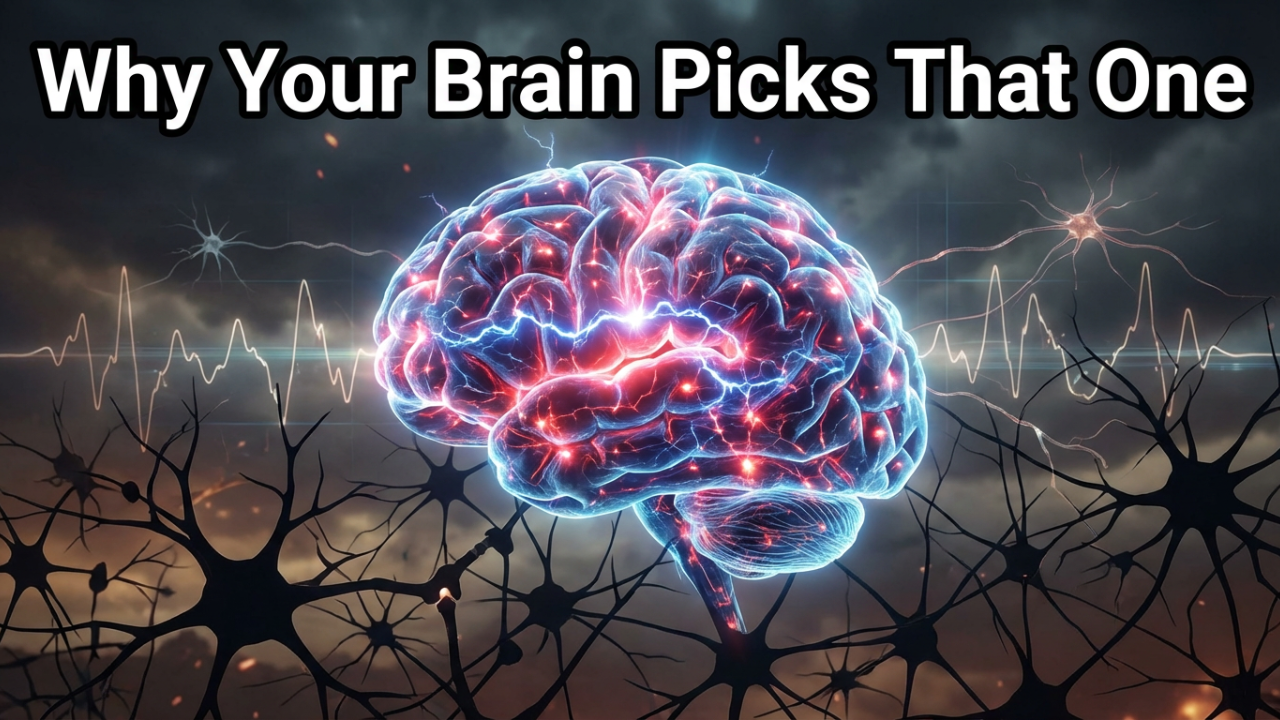
You see them across the room, and then it happens. Your heart starts to pound, your palms get sweaty, and you just can’t look away. It feels like magic, but it’s not. It’s a powerful chemical reaction firing off inside your brain. In this article, we’re going to break down the exact neurochemical cocktail your brain mixes the moment you see your crush, turning a simple glance into an undeniable feeling of desire.
Introduction
That feeling—the one that makes you feel giddy, nervous, and totally alive all at once—is one of the most universal human experiences out there. We write poems about it, we sing songs about it, and we definitely spend sleepless nights thinking about it. We call it having a crush. But what if I told you that this mysterious emotion is actually a carefully planned series of events, a biological program run by your very own brain?
We love to think of attraction as a matter of the heart, or maybe even fate. Science, however, tells a different story. It’s a story of neurotransmitters, hormones, and ancient brain circuits all firing in a kind of perfect, chaotic harmony. Your brain doesn’t “choose” a crush the way you’d choose a coffee. Instead, it goes through a rapid, almost involuntary transformation. It’s a process that prioritizes pursuit and connection over pretty much everything else—including, sometimes, rational thought.
Today, we’re going to trace the entire lifecycle of a crush inside the brain. We’ll break it down, step by step, from that first glance to the deep, obsessive thoughts that can keep you up at night. We’ll look at the specific chemicals that make your heart race, the brain regions that light up like a fireworks display, and why it all feels so incredibly intense. This isn’t just about understanding love; it’s about understanding a fundamental part of yourself. So, get ready, because we’re about to decode the science of a crush.

SON OF LORD- Scientific Institute
Section 1: The Spark (Initial Attraction and Lust)
It all starts in a fraction of a second. Before you’ve even had a conscious thought, your brain has already made an assessment. This first stage, which the renowned anthropologist Dr. Helen Fisher calls “Lust,” isn’t just about physical desire. It’s a primal evaluation, driven by your senses and kicked into high gear by a flood of hormones.
One of the most powerful triggers is sight. When you see someone you find striking, your visual system sends an immediate signal to the brain’s reward centers. This isn’t just appreciating beauty; it’s a biological event. Your brain instantly processes countless data points: facial symmetry, signs of health like clear skin, and body language that signals openness. One study even found that direct eye contact, especially with a smile, can dramatically increase feelings of attraction because it signals that the person might be open to connecting.
In these first few seconds, your brain doesn’t ask for permission. It unleashes a potent chemical mix. Within moments of that first glance, your brain gets a jolt from the sex hormones—testosterone and estrogen—which ignite the initial flames of desire. These hormones don’t just prime your body for reproduction; they prime your brain for what’s next, narrowing your focus and creating a powerful urge to know more. This is quickly followed by surges in two key neurotransmitters: dopamine and norepinephrine.
This reaction isn’t a conscious choice. It’s an ancient, evolutionary script designed to quickly identify potential mates. Your brain is essentially running a rapid-fire calculation: “Is this person a viable candidate?” It’s processing nonverbal cues and vocal tonality to see if the person seems receptive. If the signals are positive, your brain flags this person as someone to engage with. If the gut-response is negative, your brain registers a signal to avoid them.
Think of it as your brain’s internal casting director. It sees someone and says, “You. You’ve got the look. Let’s see what happens.” This immediate chemical surge is the spark that lights the fuse for the bigger explosion to come. It’s the neurological equivalent of love at first sight, and it happens before you even know what hit you.
Section 2: The Butterflies (The Neurochemical Cascade of Attraction)
You’ve had the spark. Now comes the fire. This next stage is where the crush truly takes hold, turning that initial interest into exhilarating, heart-pounding infatuation. This is the “Attraction” stage, and it’s powered by that potent duo of neurotransmitters that hijack your brain’s reward system, making you feel euphoric, energized, and completely captivated.
First up is **dopamine**, the famous “pleasure chemical.” When your brain releases dopamine, it activates its reward circuit. So when you see your crush, think about them, or get a text from them, you get a rush of dopamine, creating a feeling of pure ecstasy. This chemical rush activates some of the same reward pathways in the brain that are targeted by addictive substances, which helps explain why having a crush can feel so addictive. Your brain gets a reward, and it desperately wants more. It’s this dopamine hit that motivates you to pursue your crush, to seek them out, and experience that pleasurable feeling again and again.
Working right alongside dopamine is **norepinephrine**. This chemical is related to adrenaline, and it’s responsible for all those physical sensations we associate with a crush. It’s norepinephrine that makes your heart race, your palms sweat, and your cheeks flush. It puts your body on high alert, creating a sense of excitement and focused attention. Ever find yourself unable to eat or sleep when you have a new crush? You can thank norepinephrine for that. It’s the chemical that gives you that restless energy, that feeling of being so giddy you could bounce off the walls. Researchers have even compared this state to a “fight or flight” response; your body is reacting as if your crush is a life-altering event—because, in a way, your brain thinks it is.
And what about that classic “butterflies in your stomach” feeling? That sensation is part of this whole chemical storm. Another compound that’s sometimes mentioned in popular science is **phenylethylamine**, or PEA. Sometimes called the “love drug,” PEA is a natural stimulant that may contribute to the feelings of excitement and happiness, adding to that fluttery, on-edge feeling that defines a new crush.
So, while you’re feeling this magical, overwhelming emotion, your brain is undergoing a predictable chemical cascade. Dopamine is making you feel incredible pleasure and motivating you, while norepinephrine is putting your body on high alert. It’s a powerful, intoxicating mix that feels wonderful, and it’s also the gateway to the next, much more intense, phase of the crush.
Section 3: The Obsession (Limerence and the Thinking Brain)
This is the stage where a crush goes from a fun, fluttery feeling to an all-consuming preoccupation. You can’t stop thinking about them. Every song on the radio seems to be about them. You find yourself daydreaming about future conversations and replaying past interactions over and over. This obsessive state isn’t a sign of weakness; it’s a direct result of another major neurochemical shift, this time involving **serotonin**.
While dopamine and norepinephrine levels are spiking, your serotonin levels actually *drop*. Serotonin is a key neurotransmitter for regulating mood, appetite, and—crucially—obsessive thoughts. Interestingly, studies have shown that the serotonin levels of people newly in love are remarkably similar to the levels found in patients with Obsessive-Compulsive Disorder (OCD). This is why you can’t get them out of your head. The lower serotonin levels contribute directly to the intrusive, maddeningly preoccupying thoughts that define a full-blown crush. Your brain is, in a very real chemical sense, obsessed.
This state of involuntary, obsessive infatuation has a name: **Limerence**. Coined by psychologist Dorothy Tennov in the 1970s, limerence is defined by an intense longing for your crush to like you back. Everything you do becomes colored by this desire. A positive interaction can send you into a state of euphoria, while a perceived slight can lead to agonizing despair. Limerence thrives on uncertainty. That constant “do they or don’t they like me?” question is what fuels the obsessive thought loop.
This obsession may also feel amplified by a cognitive bias known as the **Baader-Meinhof Phenomenon**, or the frequency illusion. This is when you learn something new—or, in this case, become fixated on a person—and suddenly you start seeing it everywhere. You hear their name, you see their car, you notice someone wearing the same jacket. Your brain is actively scanning the environment for anything related to your crush. This happens because of two processes: selective attention and confirmation bias. Your brain has decided this person is important, so your attention prioritizes any information related to them. Then, your confirmation bias kicks in, interpreting each sighting as proof of their significance in your life, which just reinforces the obsession.
The brain regions at the heart of this are deep within the reward circuit. The **Caudate Nucleus**, a region involved in reward detection, becomes highly active. This part of your brain is packed with dopamine receptors, and it keeps you focused on the reward—your crush. The **Ventral Tegmental Area (VTA)**, the brain’s main dopamine factory, is also working overtime to reinforce these obsessive feelings.
So when you feel like you’re going a little crazy, when you can’t focus because your mind keeps drifting back to them, know that it’s not just you. It’s your brain in a state of limerence, fueled by low serotonin and a hyperactive reward system.
Section 4: The Brain on Mute (Suppressed Judgment and Why “Love is Blind”)
You’re in deep. Your brain is buzzing with dopamine, your heart is racing with norepinephrine, and your thoughts are obsessively circling your crush. At this point, you might notice something else: you’re not exactly thinking clearly. In fact, your ability to critically judge this person seems to have been… temporarily suspended. Your friends might point out some obvious flaws or “red flags,” but you just don’t see them. Or if you do, they don’t seem to matter.
This isn’t you being naive; it’s a key feature of the brain on a crush. The old cliché “love is blind” is actually neurologically accurate. During the intense attraction phase, activity in certain parts of your brain decreases significantly. Specifically, the **Prefrontal Cortex**—the sophisticated, rational part of your brain responsible for critical thinking and social judgment—quiets down.
This deactivation is crucial. The prefrontal cortex is like the brain’s CEO, making calculated decisions. When its activity is suppressed, your ability to make sound judgments about other people is impaired. This is why you might overlook behaviors in your crush that you would normally find unacceptable. Your brain, in its pursuit of that dopamine-fueled reward, is essentially muting the voice of reason.
Another critical brain region that takes a backseat is the **Amygdala**, your brain’s fear and threat detection center. During attraction, the amygdala also becomes less active. This reduction in fear and negative emotional processing contributes to that “starry-eyed” feeling. You feel less critical, less anxious, and more trusting. This likely has an evolutionary purpose: to make it easier to form a bond by allowing you to overlook a potential partner’s imperfections, which might otherwise stop a relationship from ever starting.
This combination—a quieted prefrontal cortex and a dampened amygdala—creates the perfect storm for idealization. You see your crush not as they are, but as a flawless version of themselves. Your brain isn’t just ignoring the negative; it’s actively filling in the gaps with positive assumptions. It’s a wild example of how our drive to connect can literally change the way we perceive the world, and the people in it.
Section 5: The Sensory Symphony (How All Five Senses Choose Your Crush)
While the initial spark might be visual, choosing and deepening a crush is a full-body experience, orchestrated by all five of your senses. Your brain doesn’t just rely on what it sees; it gathers data from every sensory input to build a complete profile of your attraction. Each sense plays a critical role in reinforcing that dopamine reward loop, making the attraction even more potent.
Let’s start with **smell**. Smell is incredibly primal and deeply linked to memory and emotion. While the science on human pheromones isn’t totally settled, research strongly suggests that we perceive natural body odors that influence attraction. The theory is that your nose might even pick up on genetic information related to the immune system, subconsciously guiding you toward someone whose genetic makeup complements your own. Beyond that, if you have a positive experience with someone whose scent you enjoy, your brain creates a lasting association, connecting that person’s specific scent with feelings of pleasure.
Next up is **sound**. The sound of a person’s voice can be a huge factor in attraction. Studies have shown that people tend to find certain vocal pitches more attractive. For example, heterosexual women often prefer men with lower-pitched voices, while heterosexual men tend to prefer women with higher-pitched voices. You might even subconsciously alter your own voice to be more appealing when you’re talking to someone you’re attracted to.
**Touch** is perhaps one of the most powerful senses for intensifying a crush. Simple physical contact, like a light touch on the arm or a hug, triggers the release of both dopamine and oxytocin. Dopamine reinforces the pleasure, while oxytocin, the “cuddle hormone,” starts to build feelings of trust and bonding. One fascinating experiment showed that participants who briefly held a cup of hot coffee rated a stranger as “warmer” and more generous than those who held iced coffee. This shows how our physical sensations can leak into our social judgments.
Finally, even **taste** plays a role, though maybe more indirectly. One surprising study showed that when participants ate something sweet before viewing a photo of a potential partner, they reported a greater desire for a relationship with that person. The brain may misattribute some of the pleasure from the sweet taste to the person being viewed. And of course, there’s the first kiss—a critical moment where taste and smell combine to provide a wealth of information about compatibility. A bad first kiss can be such a powerful sensory veto that it can extinguish a crush on the spot.
Each of these senses is a stream of data feeding your brain, all working together to confirm that, yes, this person is worth the obsessive thoughts and the racing heart.

This is the Scientific Documentary of the Kingdom of God
Section 6: The Stress Factor (Why Falling in Love Feels Like a Crisis)
Amidst all the euphoria and excitement, there’s another, more surprising chemical at play: **cortisol**, the body’s primary stress hormone. It seems strange, right? Why would something that feels so good also trigger a stress response? But if you’ve ever felt anxious or on-edge about a new crush, you’ve experienced this firsthand.
When you’re falling for someone, your body perceives the situation as a kind of “crisis.” It’s a moment of great significance and uncertainty, and your systems get ready to cope with the emotional intensity. This triggers your adrenal glands to release cortisol, the same hormone that spikes when you’re facing a deadline or are in a dangerous situation.
This elevated cortisol has a few key effects. First, it works with norepinephrine to create that state of hyper-arousal—the racing heart, the nervous energy, and the feeling of being acutely “on.” It’s part of what makes you feel so alive, but it’s also what can make it feel stressful.
Second, and perhaps most importantly, cortisol has a direct relationship with serotonin. As your cortisol levels rise, your serotonin levels tend to drop even further. Remember how low serotonin leads to obsessive thoughts? The stress of falling for someone actually makes this effect worse. It becomes a powerful feedback loop: the obsession creates stress, and the stress deepens the obsession.
Studies have found that people in new romantic relationships have significantly higher cortisol levels than people in long-term relationships or those who are single. This stress response is tied to the uncertainty of the early stages. The novelty, the anxiety about whether they like you back, and the intensity of it all signal to your body that this is a high-stakes situation that requires your full, undivided—and stressed-out—attention. This might explain why a new crush can be both exhilarating and agonizing at the same time.
Section 7: The Reinforcement Loop (How Your Brain Learns to Love)
A crush doesn’t just exist in a vacuum. It grows and strengthens through interaction. Every time you have a positive experience with your crush—a shared laugh, a good conversation, even just a friendly smile—your brain reinforces the attraction, hardwiring it into your neural pathways. This is the reinforcement loop, and it’s how a fleeting attraction becomes a powerful fixation.
At the heart of this process is dopamine, but here, it’s not just providing pleasure; it’s acting as a powerful teaching signal. This is known as **incentive salience**. Dopamine’s role in the brain’s reward pathway creates a learning mechanism. It teaches your brain to associate the immense reward (the good feeling) with the cues that predict that reward.
Here’s how it works: You see your crush, your brain releases dopamine, and you feel good. The next time, your brain anticipates that reward and releases dopamine even before you interact, creating motivation and desire. Soon, other cues get tied to the reward, too. The notification sound of a text from them, their unique scent, or even the name of the cafe where you met—all of these can become triggers that release dopamine and make you crave connection.
Neuroscientists call this reinforcement learning. As you spend more time with your crush and get positive social feedback, your brain learns a new rule: “This person is a source of reward. Interacting with them is a good thing. I should do this more.” Each positive interaction strengthens this circuit, making the desire to connect with them even stronger. Your brain is effectively being rewired to prioritize this person.
This is also where the line between a crush and a deeper connection starts to blur. Your brain is no longer just reacting; it’s actively learning, building a pathway that says, “This is important. This is good. Let’s do more of this.”
Section 8: The Connection (From Crush to Attachment)
The wild, dopamine-fueled rollercoaster of a crush can’t last forever. If it did, we’d never get anything done. If the connection with your crush continues to grow, the brain’s chemistry begins to shift again, moving from the fiery intensity of attraction to the warm, steady glow of attachment. This is the final stage, where the brain transitions from “wanting” to “belonging.”
This transition is orchestrated by two new key players: **oxytocin** and **vasopressin**. These powerful hormones are crucial for forming long-term, stable relationships.
**Oxytocin**, the famous “cuddle hormone,” is released during moments of physical intimacy and social connection. This includes everything from hugging and holding hands to deep, meaningful conversations. As oxytocin levels rise, it fosters feelings of trust, calmness, and contentment. Where dopamine created an addictive pleasure, oxytocin creates a feeling of profound security and attachment. It’s the neurochemical glue that bonds people together. Fascinating studies on prairie voles, which are monogamous, show that oxytocin is essential for them to form lifelong pair bonds. While humans are far more complex, scientists believe a very similar mechanism helps build our long-term bonds.
Working alongside oxytocin is **vasopressin**. Also released during close moments, vasopressin is linked to behaviors like protectiveness and the desire to commit to a partner. In males, it plays a strong role in generating feelings of responsibility and attachment. Together, oxytocin and vasopressin shift the entire chemistry of the relationship.
As these bonding hormones take center stage, the influence of dopamine and norepinephrine begins to cool down. The sleepless nights and obsessive thoughts slowly fade, replaced by a sense of deep comfort and companionship. The excitement isn’t gone, but it’s no longer the driving force. The relationship is now sustained by a different kind of chemistry—one built on trust, empathy, and a quiet, powerful bond.
Conclusion
So, there you have it. The journey from a single glance to a deep connection isn’t magic, but a stunningly complex process inside the brain. It begins with a spark of lust, fueled by hormones and sensory data. This ignites the fire of attraction, dominated by the pleasure of dopamine and the excitement of norepinephrine. That fire leads to obsession, or limerence, as serotonin levels drop and your brain becomes fixated on one person.
All the while, your brain’s judgment centers take a step back, letting you see your crush through rose-tinted glasses. Your senses work together to reinforce the attraction, while the stress hormone cortisol keeps you on high alert. Finally, if the connection lasts, all that reinforcement gives way to the deep, calming bond of attachment, orchestrated by oxytocin and vasopressin.
The whole experience—as chaotic and overwhelming as it feels—is a predictable and fascinating part of being human. The next time you feel your heart pound when you see that special someone, you’ll know it’s not just a feeling. It’s a powerful neurochemical cocktail, mixed perfectly by your brain. And while knowing the science might not take away the mystery, it makes the beautiful, complicated ways we connect with each other that much more amazing.