
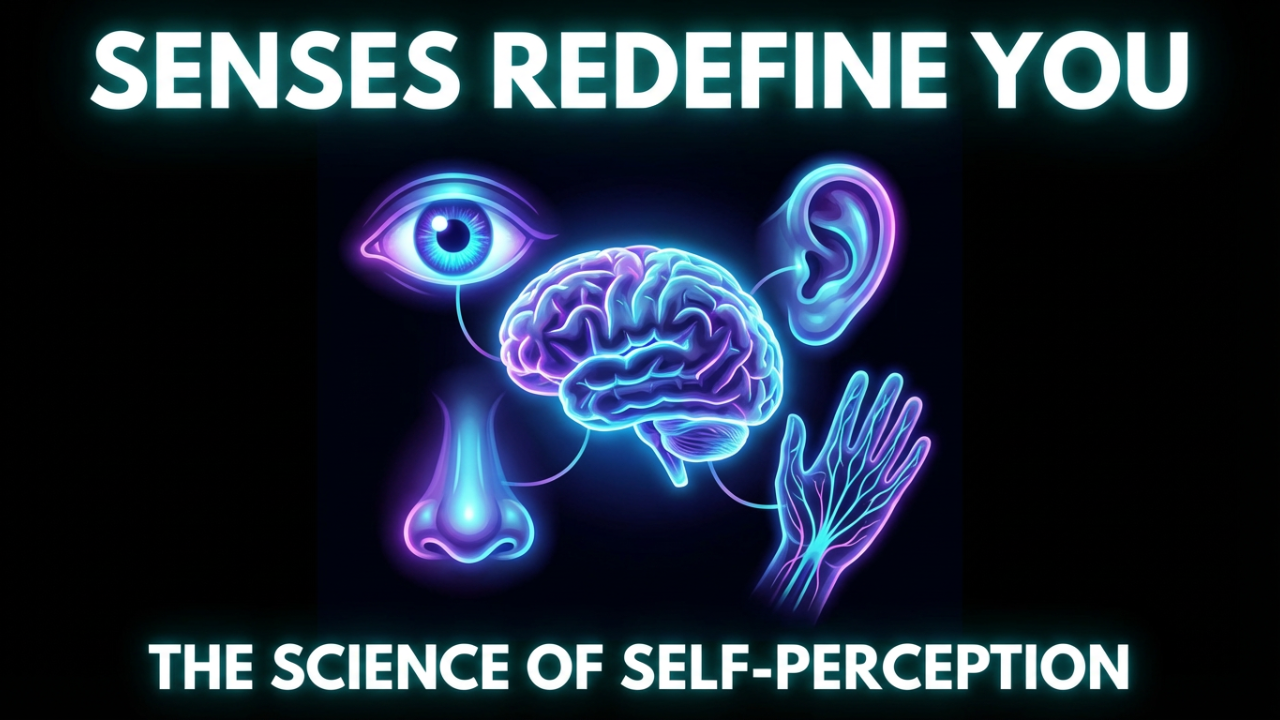
Have you ever been stopped in your tracks by a simple smell? That fleeting scent of an old book, or a specific perfume in a crowd, and suddenly you’re not just *remembering* a person… you *feel* like the person you were when you knew them. It’s not just a memory; it’s a full-body experience. A kind of involuntary time-travel, where a single sensory input can rewrite your emotional state and even your sense of who you are. A song from your teenage years doesn’t just remind you of being 16; for a few minutes, it *reinstates* that feeling, that identity. That specific, potent mix of angst, hope, and invincibility washes over you, and your entire self-perception shifts.
This isn’t magic; it’s neuroscience. It happens because your senses have a direct, unfiltered hotline to your brain’s emotional core. You may feel in control of your thoughts, your identity, your *self*. But what if I told you that who you believe you are, from moment to moment, is being constantly and powerfully manipulated by the sights, sounds, and smells around you? What if your self-image is far less a product of conscious thought, and far more a biological reaction to the sensory world?
In this article, we’re going to unravel this personal mystery. We’ll uncover the hidden science connecting your senses directly to your brain’s emotional center. You’ll discover how a simple smell or sound can instantly rewrite the story you tell yourself about who you are, on a biological level. And most importantly, you’ll learn how to use this knowledge to consciously and deliberately build a stronger, more resilient sense of self. Get ready to understand your own mind in a way you never have before.

SON OF LORD
Section 1: The Problem – The Deceptive Reality Your Brain Creates
To begin, we need to confront a startling truth, one that forms the bedrock of modern neuroscience: The world you experience is not the world as it truly is. Let that sink in. What you see, hear, and feel isn’t a perfect, high-fidelity recording of objective reality. Instead, it’s a grand, elaborate construction—a story your brain tells itself to help you survive.
Leading neuroscientists like Anil Seth call this a “controlled hallucination.” Now, that word “hallucination” can be a bit misleading. It doesn’t mean the world around you is fake or that the chair you’re sitting on doesn’t exist. It means your perception of it isn’t passive. Your brain doesn’t just sit back and absorb incoming data like a camera. It is an active and relentless prediction machine. Millisecond by millisecond, your brain makes its best guess about what’s out there, based on a cocktail of incomplete sensory information, past experiences, and evolutionary programming. When you walk into a room, you don’t painstakingly analyze every photon of light to build an image from scratch. Your brain *predicts* the room will be there based on memory, and then uses your senses to check and refine that prediction. We don’t see the world as it is; we see it as we *expect* it to be.
This process is a masterpiece of evolutionary efficiency. Constantly analyzing every bit of data from scratch would be slow and incredibly draining. Making rapid predictions based on prior beliefs is what kept our ancestors alive. That rustle in the grass wasn’t just a sound; it was predicted to be a predator, triggering a life-saving fear response long before the eyes could confirm it.
But here’s the critical part: these predictions can be wrong. They are just guesses, after all. The most common way we experience these predictive errors is through optical illusions. You’ve seen them—the lines that look like different lengths but are actually identical, the images that seem to move but are perfectly still. These aren’t just fun tricks; they’re windows into your brain’s predictive process. They reveal the built-in assumptions and shortcuts your brain uses to construct your reality. The illusion works because it plays on your brain’s expectations and wins.
Now, let’s turn this profound idea inward. If our perception of the *outside* world is an active, biased construction… what does that say about our perception of our *inner* world? Your self-image—your sense of who you are, your confidence, your anxieties, your worth—is also not a fixed, objective truth. It is a controlled hallucination, constructed from within. It’s another one of your brain’s best guesses, a story it tells itself about “you.”
And this is where the problem lies. The data your brain uses to build the story of “you” is heavily influenced by your senses. The harsh, flickering fluorescent lights of an office, the oppressive low-frequency hum of a refrigerator, the comforting scent of baking bread, the feel of a scratchy sweater against your skin—these aren’t just background noise. They are active inputs that your brain is using to update its prediction of not just the world, but of your place within it.
This explains so much about the human experience. It’s why you can walk into a room and suddenly feel a wave of anxiety for no apparent reason. Your brain has picked up on a subtle sensory cue—maybe a smell or a quality of light—that it previously associated with a stressful experience, and it has updated its prediction of your internal state to “anxious.” It’s a prediction error about your own well-being. It’s why a certain song can make you feel instantly powerful; the auditory input triggers a cascade of neural associations linked to past moments of triumph, and your brain rebuilds your self-image, temporarily, as a more confident person.
We feel as though we’re at the mercy of these phantom mood swings and inexplicable shifts in self-worth because we don’t realize what’s happening under the hood. We believe our sense of self is a product of our conscious, rational mind. But in reality, it’s being continuously shaped by a much older, more primitive system—one that ties our identity directly to the sensory data of the present moment. We’re not in full control, because we don’t understand the rules of the game. So, to get that control back, we need to journey deep into the brain and understand the mechanisms at play.
Section 2: The “Why” – Journey into the Brain’s Sensory Core
To solve the mystery of how a smell can trigger an identity crisis or a sound can build you up, we have to follow the information. We need to trace the path of a sensation from the outside world, through your nerves, and into the deepest, most ancient parts of your brain. What we find is a complex and elegant system, a biological switchboard that routes, prioritizes, and transforms raw data into the rich tapestry of your perceived reality and your very sense of self.
At the center of this operation for most of our senses is a small, egg-shaped structure deep in the brain called the thalamus. Think of the thalamus as a highly sophisticated sorting center or a grand central station for sensory information. When signals from your eyes, ears, skin, and tongue arrive, it’s the thalamus’s job to modulate this traffic, directing visual information to the visual cortex, auditory information to the auditory cortex, and so on. It helps decide what gets our attention, prioritizing what it deems important. Sensory information reaches emotion-processing centers like the amygdala, but typically only after being processed by the thalamus and the relevant cortex, adding a few crucial milliseconds for our higher-level brain functions to get involved.
But one sense breaks this rule. One sense plays by its own, more ancient, set of laws. And that sense is smell.
**Smell: The Direct Hotline to Emotion and Memory**
Unlike sight, sound, taste, and touch, a significant portion of the information from your nose bypasses the thalamus entirely. When odor molecules enter your nasal cavity, they’re converted into electrical signals that travel up the olfactory nerve directly to the olfactory bulb at the front of your brain. From there, the signals have a uniquely direct connection to two critical structures for emotion and memory: the amygdala and the hippocampus.
The amygdala is your brain’s emotional rapid-response center, handling feelings like fear and joy. The hippocampus is the master architect of your long-term memories. Because of this direct wiring, smell doesn’t get filtered and analyzed by higher-order cognitive regions first. It hits the raw, primal centers of emotion and memory almost instantaneously. This is why a smell can trigger such a powerful and immediate emotional response and such a vivid, detailed memory. That “involuntary time-travel” we talked about? This is the biological mechanism behind it. The scent of your grandmother’s pie doesn’t just *remind* you of her house; it activates the exact same neural network that was encoded when you were a child, bringing the emotion, the context, and the memory back with visceral force.
Now, while this direct pathway is incredibly powerful, it’s not an exclusive superhighway. Olfactory information does travel to other parts of the brain involved in conscious thought. But it’s this unique, privileged access to the limbic system that gives smell its almost supernatural ability to influence our mood and identity. And what about the sheer variety of smells? For a while, you might have heard the mind-boggling idea that humans can distinguish a trillion different odors. While that specific number has been debated and scaled back by more recent science, the core point is undeniable: the human olfactory system is exquisitely sensitive, capable of discriminating between a vast world of scents, each holding a potential key to our past selves.
**Sight: The Architect of Our Perceived Self**
If smell is the visceral time-traveler, sight is the grand architect of our self-image, especially our physical self. Vision is our dominant sense, and our brain dedicates a huge amount of processing power to it. But again, what we see is not what is there; it’s what our brain constructs. This is profoundly true when it comes to body image.
Conditions like anorexia nervosa and body dysmorphic disorder (BDD) offer a tragic but illuminating window into this. Individuals with these conditions don’t just *think* they look a certain way; they can genuinely *perceive* their bodies as distorted. Brain imaging studies show this isn’t just a matter of opinion; it can be linked to abnormalities in how the brain processes visual information, sometimes with an over-attention to small details rather than the whole picture. They can even perceive distortions in images of their own face when none have been made.
But you don’t need a clinical disorder to experience this. Your everyday mood can physically alter your visual perception. Studies have shown that a sad mood can make you more susceptible to certain visual illusions, subtly distorting how you see the world. Think about what that means for your self-image. On a day you’re feeling down, you might look in the mirror and your brain, already primed for negativity, may construct a visual representation of yourself that is literally more flawed than the one it would build on a good day. It’s a feedback loop: feeling bad makes you “see” bad, which makes you feel worse.
What about the flood of images from social media? The science here is nuanced. While some recent studies haven’t found a simple cause-and-effect relationship between specific social media behaviors and self-concept, that doesn’t mean it has no effect. It’s helpful to think of it in terms of the data you’re feeding your prediction machine. When your brain is constantly exposed to a stream of curated, filtered, and often biologically impossible images, it can start to update its predictive model of what a “normal” or “ideal” body looks like. This can create a painful and persistent mismatch between your internal sense of your own body and this new, digitally-created ideal. Your brain’s prediction of what you *should* look like is being skewed by artificial data, leading to chronic dissatisfaction. This prolonged exposure might even alter your visual adaptation, making normal body shapes seem abnormal, a phenomenon observed in some eating disorder research.
**Sound: The Rhythm of Our Inner State**
Sound, at its core, is vibration. And these vibrations physically resonate with our bodies and nervous systems. Think about the difference between a jackhammer and gentle waves. Harsh, loud, unpredictable noises trigger the body’s stress response, activating the amygdala for fight or flight. Conversely, soft, rhythmic sounds, like nature sounds or slow instrumental music, activate the parasympathetic “rest and digest” system, which lowers cortisol, slows your heart rate, and induces calm.
Sound, much like smell, has a deep connection to our emotional and memory centers. The auditory cortex analyzes pitch and rhythm, but it works with the limbic system to connect that sound to an emotion. This is why music is one of the most powerful technologies for emotional regulation ever discovered. An upbeat song can literally energize you by stimulating dopamine release. A slow, melancholic piece can provide a sense of catharsis, mirroring and validating a sad emotional state.
In terms of self-image, music acts as an identity anchor. The songs you loved as a teenager become neurologically fused with the memories and emotions of that time. When you hear that music years later, it reactivates those stored neural bundles, letting you re-inhabit that version of yourself for a few moments. It’s not just nostalgia; it’s a temporary re-instantiation of an old self-concept, triggered entirely by sound.
**Touch: The Foundation of Embodiment**
From the moment we are born, touch is fundamental to our survival and our sense of self. It is arguably the most foundational sense for creating our feeling of “embodiment”—the feeling that you are a self, located inside a body. This sense isn’t just a philosophical idea; it’s a constant process of the brain integrating signals from the skin, muscles, and organs. This entire field of internal sensing is called “interoception.”
Affectionate touch, like a hug, has a powerful biochemical effect. It triggers the release of oxytocin, often called the “bonding hormone.” Oxytocin doesn’t just feel good; it actively reduces stress and promotes feelings of trust and safety. From a self-image perspective, positive touch reinforces a sense of worthiness and connection. It sends a primal signal: “You are safe. You belong. You are valued.” Research has shown that oxytocin acts like a volume knob for connection, powerfully boosting the rewarding effects of positive, affiliative touch. It can even influence our valuation of objects we own, tying our sense of self to our physical world through a hormonal lens.
Temperature is also a critical part of touch. There’s a reason we use temperature in our metaphors: a “warm” welcome, a “cold” shoulder. This isn’t just poetry. Research shows that physical warmth is processed in brain regions that overlap with those that process social warmth and trust. A warm touch can literally make you feel more connected and secure.
This whole system of internal body sensing, or interoception, is crucial for self-awareness. When it’s functioning well, you’re better able to read your own emotional states. When it’s impaired, people can struggle to identify their own feelings, which is a factor in conditions from anxiety to depression. Your very sense of being a coherent self is built from the ground up, starting with the constant feedback from your body.
**Taste: The Flavor of Emotion**
Finally, we have taste. On the surface, taste seems simpler—a survival mechanism to find nutrients (sweet, savory) and avoid poisons (bitter). But it’s deeply intertwined with smell and emotion. Much of what we call “flavor” is actually generated by our sense of smell working in concert with taste.
Taste is directly linked to the brain’s reward system. Sugary foods provide quick energy, and our brain rewards us with a little hit of dopamine for finding them. This is why, when we’re feeling low, we often crave comfort foods. It’s a self-regulating behavior; your brain is seeking a quick mood boost through taste.
Like all the other senses, taste becomes powerfully linked to memory and emotion. The taste of a specific childhood dish can evoke comfort and security. The bitterness of a food you ate while sick can be permanently associated with that negative feeling. These taste-memory bundles contribute to the complex story of who we are, where we come from, and what makes us feel good or bad.
So we see that none of our senses are passive. They are active participants in constructing our reality and our self-image. They are the conduits through which the world outside shapes the world within. But this isn’t a story about being biological puppets. Understanding these mechanisms is the first step toward taking control.

This book is scientific documentary of the Kingdom of God.
Section 3: The Solution – Hacking Your Senses for a Stronger Self-Image
We’ve established a profound truth: your sense of self isn’t a stable monolith, but a fluid construction, constantly being updated by sensory information. This might sound like you’re a puppet on a string, jerked around by every sight, sound, and smell. But here is the empowering conclusion: knowing how the puppet strings work is the first step to becoming the puppeteer.
The goal isn’t to *fight* your biology. You can’t simply will your amygdala to ignore a scent or command your nervous system not to react to a loud noise. The solution lies in working *with* your biology. It’s about understanding these powerful, automatic pathways and learning to consciously influence the *input* they receive. This is the essence of **Sensory Regulation** and **Cognitive Reappraisal**—scientifically-backed frameworks for gaining agency over your internal state.
Think of it as moving from being a passive consumer of your sensory environment to an active curator. You’re about to become the architect of your own sensory world, and by extension, your self-image. Here are four powerful, science-backed techniques you can start using today.
**Technique 1: Curate Your Sensory Diet (The Proactive Approach)**
Just as you choose food based on how you want to feel physically, you can choose your sensory inputs based on how you want to feel mentally. This is about consciously designing your environment to send the right signals to your brain.
* **For Sight:** Your visual field dramatically impacts your stress levels. Chaotic or harshly lit environments can keep your nervous system on low-grade alert. Make an effort to curate your visual diet. Maximize natural light to regulate your circadian rhythms and improve mood. Declutter your main living and working spaces. And intentionally bring in calming visuals. This doesn’t have to be expensive art; images of nature—forests, oceans, open skies—will do. Studies show that even just looking at pictures of nature can reduce stress and activate parts of the brain associated with tranquility. You are literally telling your brain, through your eyes, “This is a safe and peaceful place.”
* **For Sound:** Your auditory environment is a powerful tool. Instead of letting it be a random collection of noises, design it. Create playlists for different mental states: high-energy music for a workout, slow ambient music for deep focus, and calming nature sounds like rain or waves to wind down before bed. Use noise-canceling headphones to create a “sensory sanctuary,” blocking out stressful, unpredictable sounds. This isn’t just about blocking distractions; it’s about taking control of the vibrations affecting your brain and body.
* **For Smell:** Given its direct line to your emotion and memory centers, smell is perhaps your most potent tool for state-anchoring. This is the principle behind aromatherapy. Find a scent you associate with calm, like lavender, and use a diffuser during your evening wind-down. Find another you associate with energy, like citrus or peppermint, and use it only when you sit down to work. An even more powerful practice is **Scent Journaling**. When you notice a scent, write it down and any feeling or memory it evokes. You might discover the smell of coffee is tied to a feeling of productivity, or that fresh-cut grass is linked to childhood freedom. By identifying these personal triggers, you can use them intentionally to call up desired emotional states.
* **For Touch:** Your skin is hungry for signals of safety. Feed it those signals. Pay attention to the fabrics you wear. Opt for soft clothing when you need to feel calm. Utilize the power of weight and warmth. A weighted blanket provides deep-pressure stimulation, which can calm the nervous system and trigger the release of mood-regulating neurotransmitters like serotonin and dopamine. A warm bath does more than just clean you; the sensation of warmth is a powerful, primal signal of safety and relaxation.
* **For Taste:** Practice mindful eating. This isn’t about calorie counting. It’s about transforming eating from a mindless act into a grounding sensory experience. Put away your phone, turn off the TV, and focus on the food. Notice the colors (sight). Smell the aromas (smell). Pay attention to the textures and flavors (taste and touch). Feel the temperature. By doing this, you use the multi-sensory experience of eating to pull your awareness out of anxious thought loops and into the present moment.
**Technique 2: The 5-4-3-2-1 Grounding Method (The Reactive Approach)**
Curating your sensory diet is the long-term strategy. But what do you do when you’re ambushed by a wave of anxiety or negative self-talk? For this, you need a reactive tool, an emergency brake for your mind. The 5-4-3-2-1 method works by forcing a shift in your brain’s attention. When you’re stuck in an anxious thought loop, you need to disengage that part of your brain and activate your sensory cortices instead.
Here’s how you do it. Wherever you are, stop and quietly name to yourself:
* **5** things you can **SEE**. Notice details. The light hitting your desk. A crack in the pavement. The color of a book on a shelf.
* **4** things you can **FEEL**. This is about tactile sensations. The texture of your sleeve. The solidness of the chair beneath you. The cool surface of a table.
* **3** things you can **HEAR**. Listen past the obvious. The distant hum of traffic. The ticking of a clock. The sound of your own breathing.
* **2** things you can **SMELL**. This can be tricky, so be subtle. The scent of soap on your hands. The faint aroma of coffee. The neutral smell of the room.
* **1** thing you can **TASTE**. This might be the lingering taste of your last meal, or simply the neutral taste inside your mouth.
By systematically going through your senses, you force your brain to stop its abstract worrying and engage with the concrete, immediate reality of the present. It yanks your attention out of the “story” of your anxiety and plants it firmly in the “data” of your senses.
**Technique 3: Sensory Reappraisal and Memory Anchoring**
This advanced technique is about consciously creating new, positive neural associations with specific sensory cues. It’s based on the principle: “neurons that fire together, wire together.” You can intentionally create and strengthen positive pathways.
Here’s the process:
1. **Choose a desired state:** Pick a specific feeling you want to access on command, like calm, focused confidence.
2. **Choose a unique sensory anchor:** Select a distinct sensory cue you don’t encounter randomly. This could be a specific essential oil blend (smell), a particular piece of instrumental music (sound), or a small, smooth stone in your pocket (touch).
3. **Anchor the state:** When you are *already* feeling calm and confident—maybe after a great workout or finishing a big project—introduce your sensory anchor. Dab the oil on your wrist and inhale. Play the song. Hold the stone. Stay in that state, with the cue present, for a few minutes.
4. **Repeat, repeat, repeat:** Repetition is what strengthens this neural connection. Do this every time you naturally experience that desired state.
Over time, your brain builds a strong link between the cue and the state. The anchor becomes a shortcut. Then, when you need to call up that feeling before a big presentation, you can use your anchor. Inhale the scent, play the song, or touch the stone. The sensory cue will help activate the neural network of confidence, making it easier to access that state on demand.
**Technique 4: Cultivating Interoceptive Awareness**
The final technique is the most subtle, but perhaps the most profound. It’s about improving your ability to listen to the quiet signals from within your own body by enhancing your interoception. High interoceptive awareness is a cornerstone of emotional intelligence and a stable sense of self. It lets you feel your emotions as physical sensations before they spiral into overwhelming stories.
The most direct way to train this is through a **Body Scan Meditation**. Lie down comfortably and close your eyes. Starting with your toes, bring your attention to the physical sensations in that part of your body. You don’t need to feel anything special. Just notice what’s there: warmth, coolness, tingling, pressure. Then, slowly move your attention up through your feet, legs, and so on, until you have scanned your entire body.
The goal isn’t to change or judge the sensations, but simply to notice them. This practice grounds you in your physical reality and, with consistency, refines your brain’s ability to perceive the subtle internal signals that are the building blocks of your emotions. You start to notice the clenching in your stomach that signals anxiety, or the openness in your chest that accompanies joy. This gives you a crucial early-warning system. You can respond to the *physical sensation* of anxiety with a few deep breaths before it becomes the *story* of “I am an anxious person.” You build a more intimate and accurate connection to your own bodily self.
Conclusion
We began this journey with a mystery: the strange power of a sensation to rewrite our sense of self. Now, we have an answer. That power isn’t magic; it’s a fundamental feature of our brain’s architecture. Our reality, including who we are, is an active, ongoing construction—a controlled hallucination shaped by the constant stream of data from our five senses.
We’ve seen how smell has a privileged pathway to the brain’s centers of emotion and memory, making it a potent trigger for involuntary time-travel. We’ve uncovered how our sight can be biased by our moods, architecting a self-image that can be distressingly fluid. We’ve learned how sound and touch directly tune our nervous system, and how our internal sense of our own body—our interoception—forms the very foundation of our self-awareness.
But the most important takeaway is not that we are biological puppets. The crucial insight is that by understanding these mechanisms, we gain the ability to influence them. You are not at the mercy of your feelings. By consciously curating your sensory diet, grounding yourself in the present, anchoring positive states, and cultivating a deeper awareness of your own body, you can move from being a passenger to being the pilot of your own mind. The brain’s ability to change, its neuroplasticity, means these are practices that can genuinely rewire your brain over time.
So the next time a song gives you chills, or a smell stops you in your tracks, don’t just experience it. Get curious. Ask yourself: What story is my brain telling me right now? And is it a story I want to keep living? The power to decide… is now yours.