
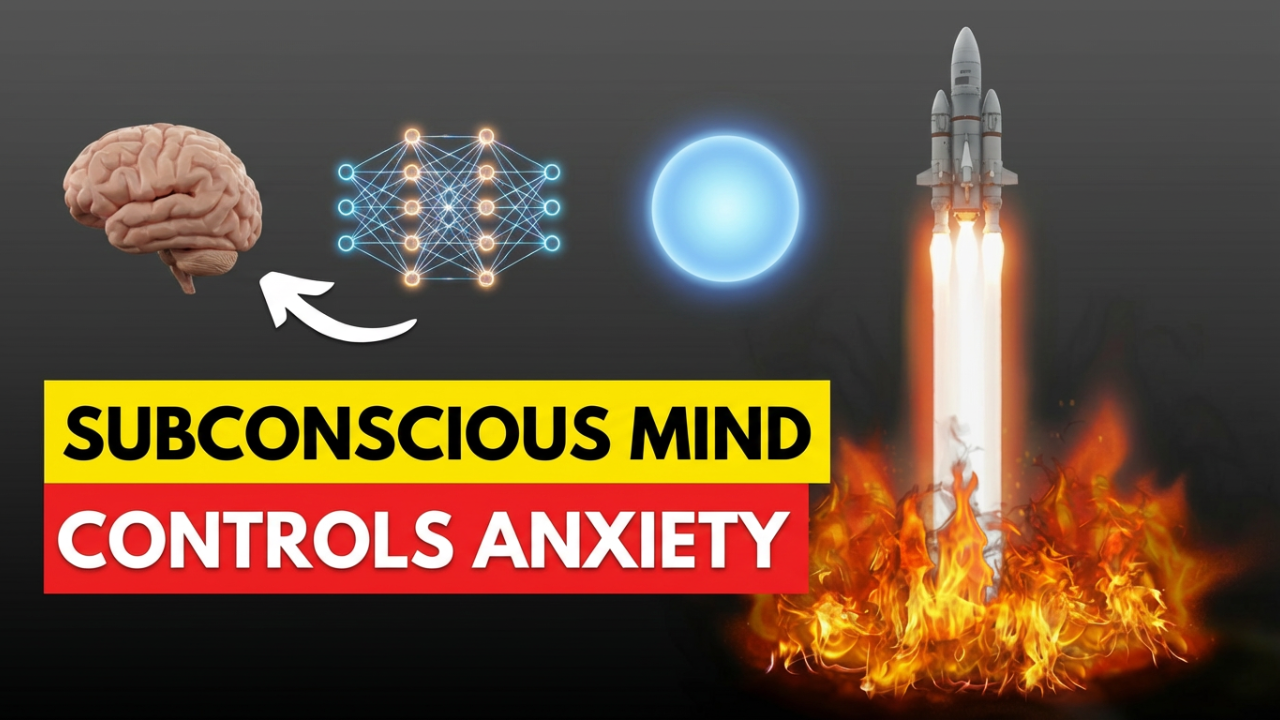
What if I told you that your anxiety isn’t your fault? That it’s less of a personal failing and more like a program running in the background of your mind, often without your permission? For years, you might have been trying to consciously fight a battle that’s being directed by your subconscious. Trying to “think your way out” of a feeling, wrestling with a force you can’t see and don’t fully understand. It’s like trying to fix a complex software bug by just restarting the computer, without ever looking at the underlying code. In this video, we’re going to expose that hidden code. We’re going to pull back the curtain on the invisible architect of your anxiety. And I’ll show you the science-backed way to start rewriting it, so you can finally gain control over that anxiety program. This isn’t just about coping. It’s about rewiring.

This book is scientific documentary of the Kingdom of God.
**Section 1: The Invisible Architect of Your Anxiety**
Have you ever felt a sudden wave of unease wash over you for no apparent reason? A racing heart, tense shoulders, or a knot in your stomach when, consciously, everything seems fine? Or maybe your anxiety doesn’t feel like a big, dramatic panic attack. Maybe it’s more subtle. Maybe it looks like procrastinating on an important project, even though you know it needs to get done. Maybe it’s an obsessive need to plan every single detail of your day, because not knowing what’s next feels threatening. Perhaps it’s people-pleasing—constantly saying “yes” when you want to say “no,” driven by a deep, unseen fear of rejection.
These aren’t just personality quirks. They are often the fingerprints of subconscious anxiety. Think of your mind like an iceberg. The small tip floating above the water is your conscious mind—the part you’re aware of. It’s the part that sets goals, makes to-do lists, and tries to reason with your feelings. But beneath the surface lies the vast, powerful mass of your subconscious. This is the operating system that runs almost everything in the background: your heart rate, your breathing, your deeply ingrained habits, and, crucially, your automatic emotional responses. While there’s debate on the exact number, many researchers suggest that a huge portion of our daily decisions, emotions, and actions are driven by this hidden part of our mind.
This is why trying to fight anxiety with logic alone so often feels like a losing battle. You can tell yourself, “There’s nothing to be afraid of,” a thousand times. But if your subconscious has been programmed to perceive a threat, it’s going to sound the alarm anyway. It’s a system designed for survival, not for your comfort in our modern world. And it doesn’t speak the language of logic; it speaks the language of emotion, memory, and instinct.
And this system often shows up in ways that are hard to connect back to anxiety. For example, persistent muscle tension, especially in the jaw, neck, and shoulders, is a classic sign. It’s your body physically bracing for a threat that your conscious mind doesn’t even see. Chronic fatigue that sleep doesn’t seem to fix can be another symptom; your nervous system can get caught in a low-grade “on” position, constantly draining your energy. Even things like indecisiveness, difficulty concentrating, or a constant feeling of being overwhelmed can often be traced back to this underlying state of hypervigilance. Your brain is so busy scanning for danger in the background that it has limited resources for everything else.
Some of the most common, yet overlooked, signs are behavioral. Procrastination, for example, is rarely about laziness. More often, it’s fueled by a subconscious fear of failure or criticism. By putting off the task, you avoid the potential pain of not being good enough. Similarly, perfectionism isn’t just about having high standards; it’s often a subconscious strategy to control the uncontrollable and avoid judgment.
Other patterns include a deep-seated reluctance to rely on others because your subconscious has learned it’s not safe, or its opposite, people-pleasing, where you sacrifice your own needs out of a fear of abandonment. These aren’t typically conscious choices. They are automated defense mechanisms, programs written long ago, often in childhood. When a stressful experience is over, the emotional brain doesn’t always return to baseline. It can get caught in a cycle of chronic stress, running these old, outdated programs on repeat long after the original threat is gone. The crucial takeaway here is that you are not broken or weak. You’re running a program you likely didn’t install, and you were never given the user manual. Until now.
**Section 2: Unmasking the Ghost in the Machine – The Science of Subconscious Anxiety**
To rewrite the code, we first need to understand how it was written. The story of your subconscious anxiety begins in a small, almond-shaped part of your brain called the amygdala. The amygdala is your brain’s alarm system, its threat-detection center. It’s constantly scanning your environment—and your internal state—for any sign of danger. When it perceives a threat, it triggers the fight-or-flight response, flooding your body with stress hormones like cortisol and adrenaline. This system is brilliant for keeping you safe from an actual predator. It’s less helpful when the “threat” is a work email, a crowded grocery store, or an unread text message.
A key feature of the amygdala is its “negativity bias.” Your brain is wired to pay more attention to negative or threatening information than to positive or neutral information. From an evolutionary perspective, this makes perfect sense. Missing a threat could be fatal, while missing a pleasant experience is a much smaller risk. This bias means your amygdala is more likely to interpret ambiguous situations as dangerous, a phenomenon some psychologists call “paper tiger paranoia.”
So, what determines what the amygdala flags as a “threat”? This is where the programming comes in. Your subconscious is a vast library of your experiences, especially the emotionally charged ones. While factors like genetics and temperament play a major role, significant programming can come from unresolved difficult experiences. When you go through something overwhelming that your brain can’t fully process, the memory can get “stuck” in your nervous system. It isn’t filed away neatly as a past event; it can remain active, like a live wire. As a result, anything that even remotely resembles the original event—a certain tone of voice, a particular location—can trigger the amygdala and set off the alarm.
Another powerful programmer is emotional suppression. From a young age, many of us are taught that certain emotions are “bad” or “unacceptable”—like anger or sadness. We learn to push them down. But these emotions don’t just disappear. They get stored in the subconscious. One useful model for understanding this comes from the psychologist Carl Jung. He called the parts of ourselves that we repress and deny our “shadow.”
Jung’s framework suggests that anxiety can be a message from this shadow. It’s the sound of these repressed parts knocking on the door of your conscious mind, demanding to be seen. When you feel a surge of anxiety from nowhere, it might be repressed anger or grief trying to get your attention. As the popular psychological saying goes, “What you resist, persists.” By trying to be only the “good” or “calm” version of yourself, you can create a deep division within, and anxiety is the tension that arises from that split.
This isn’t just abstract psychology; it has a neurological basis. Chronic stress and anxiety are associated with physical changes in the brain’s structure. Some studies show that prolonged stress can be linked to an increase in the size and reactivity of the amygdala, making it even more sensitive. At the same time, it can be associated with reduced function in the prefrontal cortex—the part of your brain responsible for logical reasoning and emotional regulation. This can create a vicious cycle: the brain’s alarm system becomes overactive, while the part of the brain that could calm it down becomes less effective. Your brain can get stuck in a pattern where the default response is fear.
So when you feel that anxiety, try to recognize it for what it is. It’s not a sign of weakness. It’s a signal. It’s a coded message from a deep part of your mind, pointing to an unresolved experience, a suppressed emotion, or an unacknowledged part of yourself. It’s a call for your attention. And the beautiful thing is, your brain has the ability to answer that call.
**Section 3: The Brain’s Superpower: An Introduction to Neuroplasticity**
For a long time, it was believed that the adult brain was essentially fixed. That after a certain age, the connections and pathways were set in stone. We now know this is fundamentally untrue. The single most important concept you need to understand is **neuroplasticity**.
Neuroplasticity is the brain’s incredible, lifelong ability to reorganize itself by forming new neural connections in response to our thoughts, experiences, and behaviors. Think of your brain’s neural pathways like paths through a forest. When you repeatedly think a certain thought or feel a certain emotion, you’re walking down a particular path. The more you travel that path, the wider and more well-worn it becomes. Soon, it’s the default route. Your brain, being incredibly efficient, will automatically take this path of least resistance.
If your life experiences have repeatedly triggered feelings of fear or uncertainty, you’ve inadvertently built a superhighway for anxiety. The neural pathways associated with fear have become strong and dominant. The amygdala’s alarm bell is on a hair-trigger. Meanwhile, the pathways for calm and resilience might be like overgrown, barely-there trails.
But here is the profoundly hopeful truth of neuroplasticity: you can create new paths. You can also let the old ones grow over. By intentionally and repeatedly engaging in new ways of thinking, feeling, and behaving, you can literally rewire the physical structure of your brain. This isn’t just a metaphor; it’s a biological reality.
How does this work for anxiety? Neuroplasticity allows us to do two crucial things. First, we can turn down the volume on the amygdala. By practicing techniques that calm the nervous system, we reduce its hyperactivity. Second, we can strengthen the prefrontal cortex—the brain’s “CEO.” A stronger prefrontal cortex can act as a brake on the amygdala’s fear response, letting you respond to situations with more logic and less automatic emotion. Mindfulness meditation, for example, has been shown to increase the functional connectivity between the prefrontal cortex and the amygdala, effectively improving the communication between your brain’s logical and emotional centers.
This process is not about “curing” anxiety in the sense of eliminating it forever. Anxiety is a natural human emotion that serves a purpose. Instead, this is about resetting your brain’s default response. It’s about taking the wheel back from an overactive, automatic system and teaching your brain to respond with greater resilience and calmness. You can shift from being a passenger in your own mind to becoming the architect of your mental habits. Understanding neuroplasticity is the key that unlocks the door to lasting change. You have the power to actively change your brain. Now, let’s talk about the tools you need to do it.
**Section 4: The Rewiring Toolkit – Part 1: Defragmenting Your Subconscious**
If your subconscious is running on faulty code, the first step is to access that code and begin the debugging process. This involves more than just positive thinking; it requires specific, evidence-based methods that work directly with the deep, automatic patterns of the mind. One of the most powerful of these tools is Cognitive Behavioral Therapy, or CBT.
CBT is a form of therapy that helps people identify and change destructive thought patterns. In our computer analogy, CBT is like running a diagnostic on your system. It helps you find the specific “if-then” code that is causing errors. These are what CBT calls “automatic negative thoughts.”
The core idea of CBT is that it’s not an event itself that causes anxiety, but your interpretation of it. For example, if you make a small mistake at work, an automatic thought might be, “I’m going to get fired.” This thought triggers panic. CBT teaches you to slow down, catch that automatic thought, and examine it like a detective. You learn to ask: “What’s the evidence for this thought? What’s the evidence against it? Is there a more balanced way of looking at this?”
By consciously challenging these thoughts, you are actively using neuroplasticity. You’re refusing to walk down the old, well-worn path of catastrophic thinking and forging a new, more rational one. It takes practice, but with repetition, the new thoughts start to become more automatic. CBT is considered a first-line, evidence-based treatment for many anxiety disorders, with numerous meta-analyses showing it is effective at significantly reducing symptoms. Some studies also suggest CBT can lead to changes in the functional activity and connectivity in the brain’s fear circuits, including the amygdala and prefrontal cortex.
While CBT is great for working with thoughts, sometimes the programming is buried deeper. This is where a technique called Exposure Therapy comes in. Exposure therapy involves gradually and systematically exposing yourself to what you fear in a safe, controlled way. The goal is to help your brain learn that the feared thing is not actually a threat. For instance, with a fear of social situations, you might start by vividly imagining being at a party, then move to having a brief conversation with a cashier. Each time you do this and survive, you’re sending a powerful new message to your amygdala: “See? We’re safe.” You are actively overwriting the old fear code.
For trauma that is deeply embedded, another powerful tool is Eye Movement Desensitization and Reprocessing, or EMDR. EMDR was developed to help people process traumatic memories that have become “stuck.” One leading theory is that the bilateral stimulation used in EMDR—like guided eye movements, tapping, or sounds—mimics the process of REM sleep, helping the brain finally “digest” the painful memory so it no longer feels like it’s happening in the present. It allows the trauma to move from being a raw, emotional memory to one that’s integrated into your life’s story. It’s a way of unlocking the healing power that already exists within your brain, allowing you to finally file the memory away as something that’s truly in the past.
These methods—CBT, Exposure Therapy, and EMDR—are not just coping mechanisms. They are targeted neuroplastic interventions. They are the tools we use to get under the hood and begin rewriting the programs that have been secretly running your life.
**Section 5: The Rewiring Toolkit – Part 2: Daily Practices to Install the New Software**
Therapies like CBT and EMDR are powerful ways to rewrite the deep code of your subconscious. But to make that new programming stick, you need to reinforce it with consistent, daily practices. These are the habits that strengthen the new neural pathways of calm and resilience.
One of the most researched and effective practices is **Mindfulness Meditation**. Mindfulness is simply the practice of paying attention to the present moment on purpose, without judgment. When you’re anxious, your mind is almost always in the future, worrying about what might happen, or in the past, ruminating on what went wrong. Mindfulness gently pulls your attention back to the here and now.
Neurologically, when you practice mindfulness, you’re exercising your prefrontal cortex. At the same time, you are helping to calm the amygdala. Studies using fMRI have shown that mindfulness programs can lead to a significant reduction in amygdala reactivity to emotional stimuli. This change can persist even when people aren’t actively meditating, suggesting lasting changes in brain function. Mindfulness practice is like taking your brain to the gym.
A simple way to start is with a 10-minute daily practice focusing on your breath. Find a quiet place, close your eyes, and just bring your attention to the sensation of the breath. Your mind *will* wander. That’s guaranteed. The real practice is noticing when it has wandered and gently, without judgment, bringing it back. Every time you do this, you’re strengthening that prefrontal pathway.
Closely related to mindfulness is **Breathwork**. Your breath is the most direct tool you have to influence your nervous system. When you’re anxious, your breathing becomes shallow and rapid. By consciously changing your breathing pattern, you can send a message of safety directly to your brain. One of the most effective techniques is the **4-7-8 breath**: Inhale through your nose for 4, hold for 7, and exhale through your mouth for 8. The long exhale is key; it stimulates the vagus nerve, which activates the “rest and digest” part of your nervous system. Another powerful technique is **Box Breathing**: Inhale for 4, hold for 4, exhale for 4, hold for 4. Practicing these for just a few minutes can help lessen acute feelings of distress and interrupt an anxiety spiral.
To work more directly with the symbolic language of the subconscious, you can turn to **Journaling**. If anxiety is a message, journaling is a way to decode it. Instead of just writing about your worries, try giving your anxiety a form. Ask yourself: If my anxiety were a person, what would it look like? What does it want? What is it afraid of? Writing out the conversation can feel strange at first, but it creates a dialogue between your conscious and subconscious minds, helping you see the anxiety more objectively.
Finally, when you’re caught in an intense anxiety spiral, **Grounding Techniques** are essential. These pull you out of the storm in your head and anchor you in the present through your senses. The **5-4-3-2-1 Technique** is a classic:
– Name **5** things you can see.
– Name **4** things you can feel.
– Name **3** things you can hear.
– Name **2** things you can smell.
– Name **1** thing you can taste.
By forcing your brain to focus on sensory input, you interrupt the rumination cycle. You are telling your brain, “Right here, right now, I am safe.”
These are not quick fixes. They are skills. Integrating just 10-15 minutes of these practices into your daily routine is like making a daily deposit into your mental health bank account. You are consistently and deliberately laying down new neural pathways that can become your new, calmer default state.
**Section 6: The Body-Mind Connection: Physical Rewiring**
Our discussion of rewiring the brain would be incomplete if we treated the mind as if it were separate from the body. Your brain and body are in a constant feedback loop. A stressed mind creates a stressed body, and a stressed body sends signals back to the brain that reinforce the stress. Using your body is one of the most powerful and direct ways to change your brain.
The single most effective physical tool for this is **Physical Exercise**. When you exercise, your brain releases neurochemicals that are incredibly beneficial for anxiety. Most famously, endorphins act as natural mood elevators. But the benefits go much deeper.
Some research, particularly in animal models, suggests exercise promotes **neurogenesis**, the creation of new brain cells, especially in the hippocampus—a region crucial for memory and emotion that can be negatively affected by stress. While the direct link between neurogenesis and anxiety reduction in humans is still being investigated, the overall anti-anxiety effects of exercise are well-established. It gets you out of your head and into your body, discharging the pent-up fight-or-flight energy.
You don’t have to become a marathon runner. Consistency is more important than intensity. Aim for 20-30 minutes of moderate activity like brisk walking most days.
Activities that combine movement with mindfulness, such as **Yoga**, are particularly potent. Yoga integrates physical postures, breathing exercises, and meditation, directly targeting key components of the anxiety response. It helps regulate the nervous system and increase body awareness.
Also, simply spending time in **Nature** has been shown to lower levels of the stress hormone cortisol. A 20-minute walk in a park can have a restorative effect on the brain, reducing the mental fatigue that comes from constant worry.
It’s also worth noting that a balanced diet, stable blood sugar, and good hydration all play a role in emotional regulation. Conversely, things like caffeine and highly processed foods can worsen anxiety for many people.
Think of these physical practices as another form of neuroplastic training. Moving your body is an active part of rewiring your brain. By integrating regular movement, mindful practices, and time in nature, you are supporting your mental rewiring efforts from the ground up, building a more robust and peaceful internal world.
**Conclusion: Becoming the Architect of Your Mind**
Let’s bring this all together. For years, you may have felt like a victim of your own anxiety, tossed about by waves of fear you couldn’t control. The central message here is that this feeling, while real, is based on a misunderstanding. Your anxiety isn’t a personal failing or a permanent part of who you are. It is a program—a set of old, automated, subconscious responses that were written to protect you, but are now causing distress.
We’ve seen that this program can be run by the amygdala, your brain’s hypervigilant alarm, and fueled by everything from past experiences to the parts of yourself you’ve learned to suppress. But we’ve also uncovered the most empowering truth in neuroscience: neuroplasticity. Your brain is not fixed. It is designed to change, adapt, and rewire itself based on what you focus on and what you do.
You have the ability to become the architect of your own mind. By using tools like Cognitive Behavioral Therapy to identify faulty code and techniques like EMDR to process deep-seated patterns, you can begin the work of rewriting your subconscious. And by integrating daily practices like mindfulness, breathwork, and physical exercise, you consistently reinforce the new, calmer neural pathways until they become your new normal.
This is not a quick fix. It is a journey. It requires patience, consistency, and a great deal of self-compassion. There will be days when the old program runs on autopilot. The goal isn’t perfection; it’s progress. It’s about slowly, deliberately, and consciously building a new relationship with your mind—one based on understanding rather than fear, and on intention rather than reaction.
You are not destined to be controlled by your anxiety. You have the map, you have the tools, and you have the innate capacity to change. The path forward is not to fight the anxiety, but to understand its message, integrate its wisdom, and consciously choose to build a new way of being, one neural pathway at a time. The power to do this has been inside you all along. Now, you know how to unlock it.