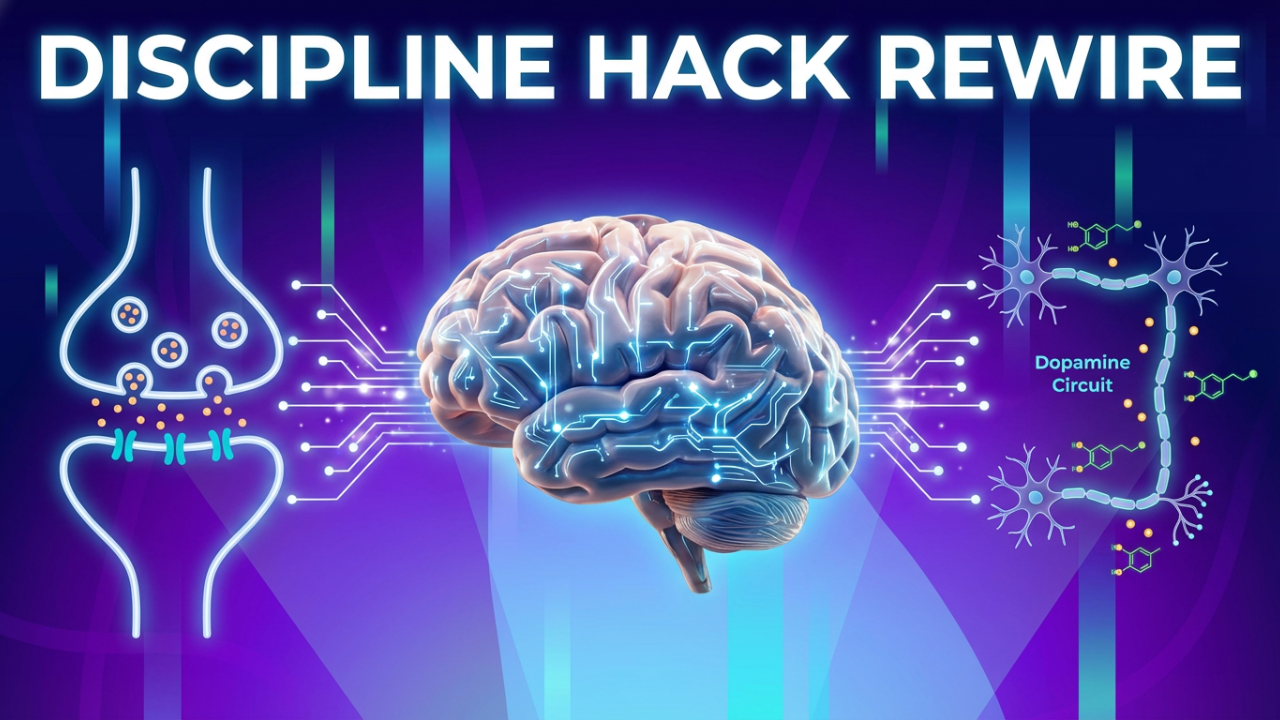

What if I told you that everything you’re experiencing right now is a fabrication? That the light hitting your eyes, the sounds reaching your ears, even the thoughts forming in your head as you listen to my voice… it’s all a story. A controlled hallucination, generated by the three-pound universe sitting inside your skull. We love to talk about the brain with simple metaphors, right? “It’s like a computer.” But that doesn’t even come close. The truth is infinitely more complex, chaotic, and honestly, magnificent.
You aren’t just your brain. Think of yourself as the one using it. And for the next few minutes, we’re going to flip through the user manual together. We’re skipping the fluff and diving straight into the science to see how this thing actually works. This trip will take us from the tiny spark of a single cell to the huge, connected symphony that builds your consciousness, your memories, your feelings, and your entire reality. So, get ready to forget what you think you know. It’s time to find out how your brain *really* works.
Section 1: The Spark of Life – The Neuron
Our journey into the mind has to start with the single, most important building block: the neuron. Your brain has about 86 billion of them. To give you some perspective, if you tried to count one neuron every second, it would take you over 2,700 years. These are the microscopic architects of every thought, feeling, and action you’ll ever have.
Think of a single neuron as a tiny biological tree. It’s got roots, a trunk, and branches. The “roots” are called dendrites. They’re these intricate, branching bits that act as the neuron’s antennas, constantly listening for signals from thousands of other neurons nearby. All these signals get collected and added up in the neuron’s cell body, the soma. The soma is the command center. It holds the nucleus and all the genetic blueprints, and it’s where the big decision is made: do we fire, or don’t we?
If all the incoming signals are exciting enough to push the soma past a certain tipping point, something spectacular happens. An electrical impulse, a wave of pure energy, is born. This is the famous action potential. And it’s an all-or-nothing deal—the neuron either fires with everything it’s got, or it doesn’t fire at all. There’s no in-between.
This electrical signal doesn’t just fizzle out. It has to travel, and it zips down the “trunk” of our tree: a long, thin cable called the axon. Think of the axon like an insulated wire. For many neurons, this insulation is a fatty layer called myelin. But the myelin isn’t a solid coat. It’s broken up into segments, with tiny exposed gaps called the nodes of Ranvier. This clever design lets the action potential “jump” from one node to the next in a process called saltatory conduction. This leapfrogging makes the signal ridiculously fast, letting it travel up to 270 miles per hour. That speed is exactly why you can snatch your hand off a hot stove before your conscious mind even really knows what’s happening.
The journey of this one spark—from dendrite, to soma, down the axon—is the basic unit of information in your brain. It’s the language your nervous system speaks. But one spark alone doesn’t make a thought. For that to happen, the signal has to be passed on. It needs to talk to other neurons. And that’s where the story goes from a simple electrical zap to a complex chemical dance. This all happens in a place so tiny, yet so important, it basically defines our entire mental world: the synapse.

SON OF LORD- Scientific Institute
Section 2: The Brain’s Chemical Language – Synapses and Neurotransmission
The end of the axon branches out into little terminals. Now, these terminals don’t actually touch the dendrites of the next neuron. Instead, there’s an impossibly small gap between them, only about 20 nanometers wide, called the synaptic cleft. This whole setup—the axon terminal of the sending neuron, the tiny gap, and the dendrite of the receiving neuron—is the synapse. It’s often said that your brain has more of these synapses than there are stars in our galaxy, somewhere in the hundreds of trillions. It’s in this tiny space that the real magic of communication happens.
When our lightning-fast action potential gets to the axon terminal, it triggers a total change of state. The signal, which up until now was purely electrical, is about to go chemical. The electrical charge forces open tiny gates on the terminal, which lets a flood of calcium ions rush into the cell. This calcium influx is the trigger. It’s like a key that unlocks a fleet of microscopic bubbles called synaptic vesicles.
Inside each of these bubbles are thousands of molecules of chemical messengers: neurotransmitters. Pushed by the calcium, these vesicles move to the edge of the membrane, fuse with it, and dump their neurotransmitter cargo into the synaptic cleft. Imagine a bunch of tiny cargo ships releasing their goods into the sea between two islands.
These neurotransmitter molecules then float across the gap. On the other side, on the receiving neuron’s dendrite, are specialized proteins called receptors. Each receptor is shaped for a specific neurotransmitter, like a lock and key. When a neurotransmitter docks with its receptor, it changes the receiving neuron. The message has been delivered.
This is the moment the signal flips back from chemical to electrical. The neurotransmitter binding opens or closes channels on the receiving neuron, changing its electrical charge. This change can be one of two flavors. It can be excitatory, making the neuron *more* likely to fire its own action potential. Or it can be inhibitory, making it *less* likely to fire.
The main excitatory neurotransmitter, the one that screams “GO!”, is Glutamate. It’s the workhorse of the brain, responsible for the vast majority of “on” signals and critical for everything from basic function to learning and memory.
On the flip side, the main inhibitory neurotransmitter, the one that says “STOP,” is GABA. And GABA is just as vital. It acts as the brain’s braking system, keeping neural circuits from getting overexcited. It helps fine-tune signals, cut down on noise, and is essential for staying calm and focused.
Every single neuron is constantly being bombarded with “go” and “stop” signals from thousands of others. It’s like a nonstop vote. The neuron tallies up all these excitatory and inhibitory votes, and if the “go” signals win by enough of a margin to hit that critical threshold, then BAM—a new action potential is born, and the message continues down the line. This unbelievably complex dance of electrical and chemical signals, of “go” and “stop,” happening trillions of time a second, is the foundation of everything your brain does. But Glutamate and GABA are just the beginning. The brain uses a whole cocktail of other chemicals to color our experiences, drive our behavior, and shape our moods.
Section 3: The Messengers – A Tour of Key Neurotransmitters
So while Glutamate and GABA are the brain’s main “on” and “off” switches, you’ve got a whole cast of other neurotransmitters that have more specialized, nuanced jobs. They don’t just yell “go” or “stop”; they sort of whisper suggestions, changing the whole tone and feel of our mental world. Think of them as the lighting and music directors of a play, subtly shifting the mood and focus of the entire production.
Let’s start with a celebrity: Dopamine. Dopamine often gets called the “pleasure molecule,” but that’s not quite right. It’s really more of a “motivation molecule.” Dopamine is at the heart of the brain’s reward system. It’s the chemical that says, “Hey, that was good. Let’s do that again.” It reinforces behaviors that are key to survival, like eating. But it also drives our curiosity, our desire to learn, and our pursuit of goals. That surge of satisfaction you get from solving a tough problem or checking an item off your to-do list? That’s dopamine. It’s also crucial for controlling movement, which is why the tragic loss of dopamine-producing neurons causes the motor symptoms of Parkinson’s disease.
Next up, Serotonin. If dopamine is about seeking, serotonin is about satisfaction. It helps regulate mood, and while low levels are often linked with depression, the real relationship is way more complicated. Serotonin is a master regulator, helping to manage our sleep-wake cycles, our appetite, and even how we process pain. It contributes to our sense of calm, patience, and well-being. Think of it as the brain’s internal sense of “everything’s okay.”
Then there’s Acetylcholine. This was the very first neurotransmitter ever discovered. Outside the brain, it’s the messenger that your motor neurons use to tell your muscles to contract. Every single move you make is initiated by acetylcholine. Inside the brain, it’s a star player in attention, learning, and memory. When you’re laser-focused on something, your brain is releasing acetylcholine to sharpen your perception and help you lock in new information. The loss of these acetylcholine-producing cells is one of the key hallmarks of Alzheimer’s disease, alongside the primary markers of amyloid plaques and tau tangles, which helps explain the devastating memory loss.
Finally, let’s talk about Norepinephrine, also known as noradrenaline. This one is all about alertness and arousal. It’s a huge part of your “fight or flight” response. When you’re startled by a loud noise or you’re in a stressful situation, a jolt of norepinephrine floods your system. It sharpens your focus and gets your body ready for action by increasing your heart rate and blood pressure. But it’s not just for emergencies. On a daily basis, norepinephrine helps you wake up and stay vigilant and focused.
These are just a few of the dozens of chemicals your brain uses. While we often simplify their roles to understand them, these systems are incredibly complex, working together in a delicate balance to create our mental and emotional states. This interplay is a huge part of what makes you, you. Now that we’ve met the cells and their chemical language, we can finally zoom out and look at the brain’s grand architecture.
Section 4: The Central Command – Brain Macro-Structure
Our tour of the brain’s layout starts at the bottom, at its most ancient and basic foundation: the brainstem. This structure connects the brain to the spinal cord and is, simply put, your survival machine. It has three main parts: the medulla, the pons, and the midbrain. The medulla handles the absolute essentials you never think about—your breathing, heart rate, and blood pressure. Damage here can be instantly fatal. Right above it is the pons, which acts as a bridge, relaying signals between the cerebellum and the rest of the brain, and it’s also involved in sleep and dreaming. At the top is the midbrain, a relay station for vision and hearing that helps control eye movement and reflexive actions, like when you automatically turn your head toward a sudden noise. The brainstem basically keeps the lights on so the rest of the brain can deal with more interesting problems.
Tucked in behind the brainstem is the cerebellum, which is Latin for “little brain.” Don’t let the name fool you. It’s only about 10% of the brain’s volume, but it contains over half of the brain’s total neurons. For centuries, we thought its only job was motor control, and it is a master of movement. The cerebellum is what fine-tunes your coordination, balance, and posture. When you learn a skill like riding a bike or playing the piano, it’s the cerebellum that refines those movements until they become smooth and automatic. But we now know it does more, contributing to cognitive functions like language and attention, acting as a general-purpose coordinator for both mental and physical tasks.
Moving up and into the brain, we find a group of structures often called the Limbic System. This is traditionally described as the brain’s emotional core. A major player here is the amygdala, your brain’s threat detector. It’s constantly scanning for anything that might be dangerous or important, and it’s responsible for that quick, gut-level feeling of fear. It also helps sear emotional memories into your mind.
Right next to the amygdala is the hippocampus. The hippocampus is absolutely essential for forming new long-term memories of facts and events. When you learn a new name or remember what you had for breakfast, it’s the hippocampus that helps turn that fleeting experience into a lasting memory. It isn’t where old memories are stored—that happens all over the cortex—but it’s the scribe that writes them into your personal history book.
Overseeing much of this is the hypothalamus. This tiny, almond-sized structure is the brain’s master regulator, working to keep your body’s internal environment stable—a state called homeostasis. It controls your body temperature, hunger, thirst, sleep cycles, and stress response by controlling the release of hormones.
And finally, sitting like a grand central station at the top of the brainstem, is the thalamus. Almost every piece of sensory information—everything you see, hear, and feel—gets routed through the thalamus before it’s sent to the higher brain for processing. The one exception is the sense of smell. The thalamus is your sensory gatekeeper, helping to decide what’s important enough to be brought to your conscious attention.
These deep, older structures run our survival, movement, and emotions. But what really makes us human is that great, folded blanket that sits on top of it all: the cerebral cortex.
Section 5: The Thinking Cap – The Cerebral Cortex
The biggest part of your brain is the cerebrum, and its outer layer is the cerebral cortex. This is the wrinkled, folded surface we always picture when we think of a brain. Those wrinkles are a brilliant evolutionary hack. By folding in on itself, the cortex dramatically increases its surface area, allowing it to pack way more neurons into the tight space of your skull. This is where our higher cognitive functions live: language, abstract thought, reason, and our complex view of the world.
The cerebrum is split into two hemispheres, left and right, connected by a huge bundle of nerve fibers called the corpus callosum. This bundle lets the two halves talk to each other constantly. Now, while it’s true some functions are more dominant on one side, the whole idea of being “left-brained” for logic and “right-brained” for creativity is a massive oversimplification. Pretty much any complex thing you do requires a seamless collaboration between both sides.
Each hemisphere is further split into four main lobes.
At the very front, right behind your forehead, is the frontal lobe. This is the newest part of our brain, evolutionarily speaking, and in many ways, the part that makes us most human. The back of the frontal lobe contains the motor cortex, which initiates voluntary movements. But most of it is the prefrontal cortex, or PFC. The PFC is the CEO of your brain. It’s in charge of all our executive functions: planning for the future, making decisions, solving problems, controlling impulses, and regulating emotions. Your personality and your ability to make social judgments are rooted right here.
Moving back, we find the parietal lobe. At the front of the parietal lobe is the somatosensory cortex, which receives and processes all the touch-related sensations from your body: pressure, pain, and temperature. The rest of the parietal lobe is responsible for piecing all that sensory info together to create a coherent map of the world around you. It helps you navigate through space and direct your attention.
On the sides of your head, behind your temples, are the temporal lobes. As you might guess from their location, this is where you’ll find the primary auditory cortex, which processes sound. But they do a lot more than just hear. They are crucial for understanding language—an area called Wernicke’s area, usually on the left side, is key for comprehension. The temporal lobes are also deeply tied to memory, as this is where the hippocampus is located.
Finally, at the very back of your head is the occipital lobe. This lobe has one main job: vision. It contains the primary visual cortex, which gets raw data from your eyes. This data is then processed in a hierarchy. Some neurons respond to simple lines, others to color and motion, and even higher-level areas respond to complex things like faces. Your seamless visual world is actually a reconstruction, pieced together moment by moment in your occipital lobe.
Of course, these lobes don’t work alone. They are massively interconnected. A simple act like picking up a cup of coffee involves all of them. The occipital lobe sees the cup. The parietal lobe tells you where it is. The frontal lobe decides you want it and makes a plan. The motor cortex sends the signal. The cerebellum smooths out the movement. And the temporal lobe might trigger a memory of the smell of coffee. This brings us to the most important concept of all: the brain isn’t a collection of separate parts, but a dynamic, integrated network.

This is the Scientific Documentary of the Kingdom of God
Section 6: The Symphony of Networks – How It All Works Together
The old idea that one part of the brain does just one thing is a useful starting point, but it’s not the whole story. The real genius of the brain is how these specialized areas work together, forming massive, interconnected networks. Thinking, feeling, and acting aren’t the products of one spot lighting up; they are the result of a symphony of coordinated activity across the entire brain.
Let’s walk through something simple, like seeing a friend, recognizing them, and saying hello.
First, light bouncing off your friend’s face hits your retina and is turned into electrical signals. Those signals shoot to the thalamus, the sensory relay station. The thalamus then sends that visual information back to the primary visual cortex in your occipital lobe.
Here, the breakdown begins. Different groups of neurons analyze the data—some fire for the lines of their nose, others for the curve of their smile. This processed info is then sent along two main paths. One path goes up to the parietal lobe to figure out *where* your friend is. The other path goes down to the temporal lobe to figure out *what* you’re seeing—identifying it as a face. Specialized spots here, like the fusiform face area, fire up strongly in response to faces.
Now the network gets bigger. The visual of the face is checked against memories stored across the cortex. The hippocampus helps pull up the context: this is Sarah, your friend from work. As you recognize her, the amygdala might generate a warm emotional response.
Your prefrontal cortex, the CEO, pulls all this together: That’s Sarah, I’m happy to see her, the social custom is to say hello. The PFC creates a plan: say “Hello, Sarah!” That decision is sent to Broca’s area, a part of the frontal lobe that handles speech production. Broca’s area creates the complex motor program for saying those words.
That program goes to the primary motor cortex, which sends precise commands down to the muscles of your jaw, tongue, and larynx. At the same time, the cerebellum fine-tunes these commands to make sure your speech is smooth and not just a jumble of noises.
All of that—from light hitting your eye to your vocal cords moving—happens in a tiny fraction of a second. It’s a seamless, beautiful symphony of computation, performed by countless neurons firing in perfect patterns across multiple, interconnected brain networks. It’s not a chain of command; it’s a constant, parallel conversation between sensation, memory, emotion, and action. This is how your brain *actually* works. It’s a network of networks. And maybe the most amazing thing is that this network isn’t fixed at all. It’s constantly changing.
Section 7: The Ever-Changing Brain – Neuroplasticity
For a long time, scientists thought the adult brain was basically static. The belief was that after childhood, your brain’s structure was set in stone. We now know that’s completely wrong. The brain isn’t hardwired; it’s “livewired.” It has an incredible ability to change its own structure and function based on your experiences. This is called neuroplasticity.
This happens at every level, but it starts at the synapse. The connections between your neurons are constantly in flux. There’s a famous saying in neuroscience: “Neurons that fire together, wire together.” When two neurons talk to each other often, the connection between them can get stronger. This process, called Long-Term Potentiation (LTP), makes communication between them more efficient. This is widely believed to be the cellular basis for all learning and memory. Every time you learn a new fact or practice a skill, you are physically strengthening specific connections in your brain.
On the flip side, connections that aren’t used often can weaken and even be eliminated in a process called Long-Term Depression (LTD). This is the brain’s way of cleaning house, clearing out old, irrelevant pathways to make room for new ones. It’s a constant process of remodeling your neural circuits based on what’s important in your life.
This isn’t just a chemical change; it’s a physical one. With enough practice, neurons can grow new dendrites and even form brand new synapses. This is why learning an instrument or a new language literally changes the physical structure of your brain. Studies on musicians, for example, show they have larger brain regions for hearing and fine motor control than non-musicians. Their brains have physically adapted to what they do.
Neuroplasticity is also the brain’s secret weapon for recovering from injury. If a stroke damages one part of the brain, sometimes nearby areas can reorganize and take over the lost function. The brain can literally rewire itself to work around the damage.
What all this means is that you are an active participant in wiring your own brain. The thoughts you focus on, the skills you practice, and the habits you build are all continuously shaping the physical landscape of your mind. Your brain is a living, changing masterpiece, and you’re holding the chisel. It’s not just processing information; it’s creating itself.
Conclusion
So, we’ve been on quite a journey. We started with the electric whisper of a single neuron. We saw how that signal becomes a chemical message at the synapse, using a language of neurotransmitters like dopamine and serotonin. We zoomed out to see the grand architecture: the life-support brainstem, the coordinating cerebellum, the emotional limbic system, and the incredible thinking cap of the cerebral cortex.
But the biggest takeaway for how the brain *actually* works is that it’s all one, big, integrated network. It’s a symphony where billions of individual neurons play in perfect, dynamic harmony to create the seamless music of your consciousness. And the most empowering part of all is that this symphony isn’t playing from a fixed sheet of music. Through the power of neuroplasticity, you are, in a very real way, the composer. Your life, your choices, and where you place your attention are constantly rewriting the score.
That three-pound universe in your head isn’t just watching reality; it’s actively creating it, every single moment. It’s the most complex thing we know of in the universe, and it is you. So the next time you have a thought, feel an emotion, or recall a memory, just take a second to appreciate the mind-boggling miracle happening inside your own head. The journey to truly understanding it is just beginning.